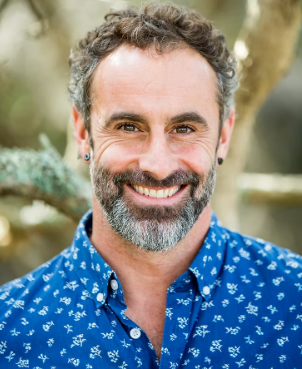

The word arrived recently, and it fits him the way a home fits the person who built it. Coherence architect. He tried it out with his community, then with his clients, and it held. It is the umbrella over everything he does in the world, and underneath the umbrella is a simple sequence: inner alignment first, then coherence in relationships, then coherence across whatever systems a person is responsible for.
Most people would call him a leadership coach. He lets them. He works one to one with very senior leaders, the sort who are turning over a hundred and fifty million dollars a year and carrying a hundred and fifty staff, and the first thing he helps them build is a foundation inside themselves. He helps a leader find equanimity, the steadiness that lets you meet a hard day without losing yourself in it, and from there the feeling, the mental and the spiritual begin to line up. From there the work moves outward, to how a leader understands the people around them, and then to the moving parts of the whole organisation.
“You are the common denominator that shows up in every aspect of your life,” he told Katherine. The personal and the professional are the same weave. If your inner life is capping your outer one, no amount of competence will free it.
This is Jem Fuller. He speaks at the CEO Institute one week and runs conscious leadership retreats in the Himalaya the next. He is an award-winning author. And when Katherine asked him to introduce himself, he began much further in.
The boy on the outskirts of Melbourne
He was born in Haarlem, near Amsterdam, spent his first year in England, and at one was carried out to the outskirts of Melbourne, where his parents built a house in horse paddocks and orchards. He was the oldest of four. From the outside it looked like a very normal, loving family, and in many ways it was. There was a lot of love in that house.
His father was from Leeds, a good man to a great many people, secretary of the church council, secretary of Rotary, an entrepreneur who built his own business. He was also, in Jem’s words, “a somewhat secretly tortured man,” and his drinking grew over the years. When Jem was six, his father lost his temper in a way he never had before. Only decades later, through deep work, could Jem look back and name what that day planted in him: the quiet belief that he was not good enough. He would spend the next thirty years unknowingly gathering evidence for it.
At eighteen, five days after his birthday, his closest friend died after a motorbike accident. Jem drank his way through the end of school, then left for London, lived in squats, acted, sang, and became what he calls a peaceful punk. He wanted no part of the system. That refusal turned into something gentler and stranger than rebellion: a hunger to immerse himself in the cultures least like his own. Through his twenties he earned his way as a fire dancer, a tribal tattooist working by hand, a kindergarten teacher in Taiwan. In India, barefoot and asking the big questions, he found a family who adopted him. He has belonged to them for almost thirty years.
The sweat lodge and the serpent
The turn came around a fire, on Wadawurrung country near his home, in a sweat lodge run by men trained in North American practice. It was pitch black and very hot, and Jem flew. He had an out-of-body experience as a five-year-old, light and playful, his age of innocence returned to him for a night. He crawled out covered in mud, ran down to the lake under a full moon, and named himself, laughing, Naked Wet Boy.
He went home to his sleeping boys and that night the real work came in a dream as vivid as waking life. A serpent lived in his core, and he had to pull it out of himself, and every time he freed it, it slithered straight back home into him. His toddler stirred; he half-woke, settled the child, and consciously went back into the dream, because the work was not finished. Faceless brothers appeared around him, and together they got the serpent out and found a way to keep it out.
“I immediately knew, wow, that serpent was the belief that I’ve been growing inside of me since I was six years old, that I am not enough. And it’s time for that belief to be out.”
He had read no psychology, no books on being good enough. It all came to him at once. And then the practice: sleeves rolled up, every single day. I am enough. I am enough. For the first six to twelve months he did not believe it. He said it anyway, over and over, until the neurology began to wire together and one morning it was simply true.
What the collapse cleared the way for
There is a piece of his story that sits underneath all of this, and Jem asked to add it himself. His father died at sixty-five of a brain tumour, with a reconciliation at the end, a man who could no longer speak but could look his son in the eyes and say he loved him. Four months later Jem’s youngest brother Tim, thirty years old, a bright shining star, died instantly in a motorbike accident. His mother lost her partner and her youngest child within a season. That grief was part of what led Jem into his midlife awakening, his own reframe of the crisis everyone else names.
Around the same time the outer scaffolding fell too: the job, the marriage, the house. He walked away with a hundred thousand dollars of debt and his two boys, and gave the rest to his then wife rather than fight over things. And what he found on the far side of all of it was the truest, happiest chapter of his life.
“I’ve brought together 12 founders of global movements fueled by love and it’s called the Center of Love Alliance. And I’m weaving these worlds together so that we can be a tide that lifts all the boats.”
He does not build alone. His non-profit, the Centre of Love, incorporated only last year, is raising money to build a meditation and education sanctuary on two acres gifted to him by his adopted family in the Himalaya, funding schooling for children in the local villages. He has gathered twelve founders of global movements into the Centre of Love Alliance: one who has put more than seven million children through school in India, another who built a love curriculum for primary schools now downloaded in a hundred and thirty-two countries. His for-profit retreats feed the non-profit, so he never has to go asking. A tide that lifts all the boats, he calls it. His mission underneath the mission is to remind people that their true value in the workplace lives in their human-to-human abilities, in bringing love to work.
What his life is asking us to see
Somewhere in the conversation, Katherine stopped and named what was happening between them. Sincerely carries the same shape as the Centre of Love: a revenue-generating body funding a foundation devoted to love. Two people who had never met were describing the same architecture from opposite sides of the world. Jem heard it and said it out loud, the spark of two worlds coming together, being shared in public so that others might witness it.
Living proof. The belief that you are not enough can be rewired. The identity that collapses is an invitation. And the life you rebuild afterward, from your essence rather than from the world’s instructions, can be truer than the one you lost.
Jem does not retire from this. You don’t retire from your life’s purpose, he said, and he means to be doing it until the day he dies. He wakes convinced that goodness and love keep finding each other through what he calls a mycelium network, the one we are all part of, rising to the surface. He holds no attachment to the outcome. He simply knows.
Coherence architect. The word fits him the way a home fits the person who built it, room by room, from the inside out, and the door of it is open to anyone still looking for their own foundation.
This is the kind of leadership our moment requires.
It is the kind of leadership Sincerely was built to honour.
A few hours with Jem
This is a long, unhurried conversation, close to an hour and a half, and it moves the way a good fireside talk moves: two people recognising each other, following the tangents, laughing, going quiet, going deep. Settle in with it when you have the time to stay a while.
There is no hurry. The library is always here.
Three things from Jem
“I’ve recently landed with a term to be the overarching title of my outer work, and it’s coherence architect.”
“I’m weaving these worlds together so that we can be a tide that lifts all the boats.”
“It’s not something to retire from. You don’t retire from your life’s purpose.”
About Jem Fuller
Jem Fuller is a leadership coach, award-winning author and retreat facilitator who describes his life’s work as coherence architect: helping senior leaders build inner alignment, then coherence in their relationships, then coherence across the systems they carry. He runs conscious leadership retreats in the Himalaya, Bali and Australia, and founded the non-profit Centre of Love, which supports education in the Himalaya and gathers global founders into a shared mission of bringing love into the workplace. He lives on a coastal farm at Bells Beach in Victoria with his partner Tahlia, their four young adults, and his mother. He describes himself first as a kind, generous, open-minded, loving, action-taking man.
Find Jem: jemfuller.com · Centre of Love · linkedin.com/in/jemfuller
Please stay.
Don’t just visit. This home is yours too.
There is a room here for you. It has always been here, waiting.
Once a week, you’ll receive a letter. Reflections from me. Sincerely recommendations. Small stories worth sitting with. Quiet offerings for the path, written for people who want to live a more gentle, bright, and honest life.
You’ll be the first to know when new conversations arrive on The Sincerely Show. When gatherings are announced. When the doors of Maison Millefleurs open for retreats.
The door is never locked. We’ve been preparing your room for a while now.
This conversation is for reflection and perspective only and should not be relied on as therapy or professional advice. Please seek qualified support where needed before making any decisions based on the information you learn through this conversation. This content is also subject to our full Terms and Conditions, which you can review on our website at sincerelyinc.com.