The Woman Who Built Sincerely
For the first time on The Sincerely Show, Katherine Dudtschak is the one in the chair. This welcome episode is an origin story: of a woman, a book, a platform, and a movement that began with one decision to stop performing and start living.
Katherine grew up on a mink farm in rural Canada, the daughter of two parents who survived the Second World War and carried its weight into the life they built. She was neurodivergent in a school system that did not know what to do with her. She was deeply feminine in a world that required her to be otherwise. For nearly five decades, she built a career of extraordinary scope, rising to become president and CEO of HomeEquity Bank, leading 25,000 employees through cultural transformation, and earning recognition as one of Canada’s most respected senior executives. She was also, through all of it, carrying a secret.
In this conversation, Katherine shares what she has rarely put into a single sitting: the collapses that cracked her open, the coming out to 80,000 people by video in 2019, the grief of retirement, the two-year journey into aloneness that became the beginning of herself, and the vision for Sincerely as a blanket, a cathedral, a place where human beings can come and hear each other’s stories without judgement.
This is where the show begins.
Bringing Love Into the Rooms Where Business Gets Done
Katherine Dudtschak sits down with Amy Elizabeth Fox, co-founder and CEO of Mobius Executive Leadership, a global transformational leadership firm she has led for 20 years. Amy has spent her career at the precise intersection of corporate rigour and deep human healing: working with Fortune 500 companies and professional services firms while drawing on psychology, somatics, trauma-informed practice, and spiritual wisdom to help senior leaders become more whole. She is also the co-author of the 2026 book Leading in Chaos, written with Nicholas Janni.
Before any of that, Amy survived non-Hodgkin’s lymphoma in her twenties, lived through childhood trauma, spent two years in silence near a lake after leaving the Cathedral Church of St. John the Divine in New York, and had a heart cracked open by a kirtan circle she almost walked out of. This conversation moves through all of it: the formation, the collapse, the rebuilding, and the 20 years of bringing love into organisations that weren’t sure they wanted it.
Amy also shares what she has observed across thousands of senior executive screenings: that collective trauma is not the exception in leadership. It is almost universal. And that the most important work any organisation can do begins not with strategy, but with the people carrying the weight of the past into every room they lead.
Teaching Children Who They Already Are
Katherine Dudtschak sits down with Dr. Delphine Le Serre, founder and president of EdHu2050, a global think tank dedicated to reimagining education in the age of artificial intelligence. Delphine is a physicist, behavioural scientist, former university professor, and entrepreneur ranked by Forbes among the Top 20 Women Transforming EdTech in Europe. She is also the creator of the MOON pedagogy framework, now being implemented in schools across North America and beyond.
Delphine’s path to this work was not linear. She left France at 40 having sold her company, enrolled her four-year-old son Moon in a Montreal school, and then did something she had never done in her adult life: she stopped. She walked without a destination, sat in a church not for religion but for quiet, and slowly learned to listen to her own heart. What emerged from 18 months of stillness was a framework she had first needed to live herself before she could offer it to anyone else.
The MOON pedagogy organises human development across four essential relationships: with self, with others, with nature, and with intelligent machines. It is, at its core, a pathway to wholeness. In this conversation Delphine and Katherine explore the science of it, the soul of it, and what it means to build an education system that begins by asking a child: do you know who you are, and do you love what you find?
Your Heart Cannot Break. It Can Only Break Open
Katherine Dudtschak sits down with Sophie Grégoire, mental health advocate, bestselling author, speaker, and yoga teacher whose book Closer Together became an instant number one bestseller on the Toronto Star and Globe and Mail lists. For over two decades Sophie has been a passionate advocate for youth self-esteem, gender equality, and emotional literacy, and she brings that same quality of honest, open inquiry into this conversation.
Sophie grew up in the Laurentians, raised by a father who told her to jump off cliffs and a mother who noticed every detail. She built a public life of enormous scope, and quietly, alongside it, did the inner work: learning to stop performing, to sit with what is difficult, to reclaim the parts of herself she had suppressed to fit spaces that seemed to require her to be less. Her closing gift to Katherine in this conversation is also its most complete teaching: your heart cannot break. It can only break open.
This conversation covers Sophie’s childhood and the qualities she suppressed for years, what Gabor Maté said to her on a stage in Vancouver that made her weep immediately, the science behind why hypersensitivity is so often mistaken for aggression, and why the most radical act of leadership available to us right now is the willingness to know and love ourselves honestly.
He Took It Further Than His Father. He Hopes We Take It Further Still.
Katherine Dudtschak sits down with Dr. John Izzo, public philosopher, bestselling author of eight books, and one of North America’s most prominent voices on purposeful living and intentional leadership. He has advised over 500 companies, spoken to more than one million people across four continents, and spent four decades asking the question that anchors everything: what does it mean to live and lead with genuine intention?
John’s father died at 36, having not seen his son since the boy was one year old. For decades John judged him quietly. Then he arrived at a different understanding: his father was not a bad man. He simply was not intentional. That realisation became the foundation of John’s life’s work. Near the end of this conversation, he did something he had not planned: he left the call, went to his wall for a photograph of his father, and said what he had been carrying for 67 years.
This conversation moves through John’s Staten Island childhood, the mother who shaped everything he became, the fractal insight that what we manifest outwardly is always a manifestation of the inner life, and the conviction, held with humility, that the work of becoming more intentional is never finished.
She Started Therapy at 72. She Has Never Been More Alive.
Katherine Dudtschak sits down with Joanna Barsh, Director Emerita of McKinsey and Company, creator of the Centered Leadership model, and author of three books including the bestselling How Remarkable Women Lead. Joanna spent more than 30 years at McKinsey advising Fortune 100 companies and developing a leadership framework now used by hundreds of thousands of leaders across the world. She is also a woman who, at 72, entered therapy for the first time, not from crisis, but from a refusal to fossilise.
In this conversation Joanna talks about the darkness that arrived only after she stopped working, held at bay for decades by extraordinary achievement and now finally asking to be seen. She talks about the somatic workshop in 2011 where she encountered that darkness in a room full of people. About the mother whose approval she still waited for, long after her mother was gone. And about the question that changed everything: not what am I missing, but what have I simply chosen not to unlock?
This conversation covers the hum of a life well integrated, four practices for the inner journey, and why people who stop growing fossilise. Whether you lead an organisation, are in the middle of your own becoming, or have been telling yourself the journey is behind you, this conversation will stay with you.
Episode 9 - She Felt Fungible in Her Dream Job. That Was the Beginning.
Katherine Dudtschak sits down with Anne-Marie Slaughter, globally recognised scholar, policy innovator, former Director of Policy Planning at the US State Department, the first woman to hold that position, former CEO of New America, and author of nine books including the landmark Unfinished Business: Women, Men, Work, Family. Her 2012 Atlantic article “Why Women Still Can’t Have It All” became the most-read piece in the magazine’s history and sparked a global conversation that has not stopped.
Anne-Marie mapped her career in high school. She knew exactly what she wanted and exactly how to get there. Then she walked out of the law firm she had spent her whole early life planning to join because she felt interchangeable with every other associate. A six-year period of drifting began that produced everything she had not planned: a professorship she had never wanted, a marriage she pursued for three years, and eventually a dream job at the State Department that also broke her when it collided with her family.
This conversation covers the Belgian-American childhood that gave her an instinct for living between worlds, the drifting years she rarely speaks about publicly, the tsunami that arrived when she told the truth in the Atlantic, the care economy capitalism does not measure, and what it will take to rebuild a world order that begins with people.
Eila Park Robertson: The Price of Peace Is Pain. There Is No Other Way Through.
Katherine Dudtschak sits down with Eila Park Robertson, former ABC News journalist, award-winning filmmaker, crisis communications strategist, and founder of Anecdotia, a production agency focused on racial, social, and climate justice storytelling. Eila led communications for the City of Portland during over 100 consecutive nights of civil unrest, navigating daily racial harassment, hundreds of death threats, and a period of personal crisis she speaks about with complete honesty.
What she built from that experience is a mission: to help progressive governments, advocates, and organisations communicate in ways that actually reach the people they most need to reach. Her central argument is simple and urgent. Calling people out has failed. Calling people in is the only thing that works.
This conversation covers her Korean immigrant parents, her violent father, the seven-minute video she posted after the Atlanta spa shootings that changed everything, the husband who fell in love with her when she could see nothing worth loving in herself, and what she now knows with certainty: the price of peace is pain, and there is no shortcut through it.
She exhaled in complete darkness and followed the bubbles home.
Katherine Dudtschak sits down with Dr. Robyne Hanley-Dafoe, award-winning educational behaviourist, globally recognised resilience and hope researcher, bestselling author, and one of the most trusted voices on what it actually takes to keep going when everything says stop. Robyne has delivered more than 2,000 keynotes worldwide and written three books including Calm Within the Storm and Stress Wisely. She is also a woman who was institutionalised at 16, got sober, and then drove her car off a road in a snowstorm into the Otonabee River.
The car sank fifteen to twenty feet. She swam out through the window, exhaled in complete darkness, and followed the bubbles from her own breath to the surface. A stranger named Joseph, who had seen her tyre tracks in the snow, crawled across the ice with a chain and pulled her to shore. He was later awarded the Governor General’s Award for bravery.
Robyne woke up in hospital with one thought: you’re here, do right by it. This conversation covers resilience, hope as a skill, what it means to borrow someone else’s belief until you can find your own, and why the helpers need to get their hope back.
She made a promise to the universe at thirteen, and she has kept it for sixty-one years.
On a playground in Skokie, Illinois, a thirteen-year-old girl watched two girls invite an outsider into their club and then cruelly take it back. In that moment, Debra Poneman saw something she has never been able to unsee: one person’s pain radiating out through a universe she could suddenly see as a matrix, boomeranging back into the very people who caused it. She made a silent promise that day. She would never consciously do anything that hurt another person. That promise became the through-line of everything she has since built.
Debra is the founder of Yes to Success, the seminar company she launched in 1980 that grew within three years to twelve major U.S. cities and representatives in nine countries on four continents, without the internet, without fax machines, on phones attached to walls with curly cords. She has spent decades teaching meditation through the Art of Living Foundation and her AWAKE Method, reaching hundreds of thousands of people. And when Katherine asks her what matters most in her life right now, she answers without hesitation: being a good friend and a good mother.
This conversation moves through the formation of a philosophy, the morning in 1980 when Debra woke up knowing what she would do for the rest of her life, a near-death experience in 2014 in which she watched words pull her back from death and push her toward it, and the quiet conviction she carries now that every act of presence, every refusal to judge, every moment of treating the person in front of you as the most important person in the world, adds light to a world that needs it.
Jem Fuller: Coherence Architect, Bringing Love Into the Workplace and Living From Essence
Jem Fuller has spent the last decade helping very senior leaders build something most leadership programs never reach: inner alignment first, then coherence in their relationships, then coherence across every system they are responsible for. He coaches one-to-one with leaders running organisations of significant scale, runs conscious leadership retreats in the Himalayan mountains, Bali, and Australia, writes award-winning books, and founded the Centre of Love, a non-profit building an education sanctuary in Northwest India and gathering twelve founders of global movements fuelled by love into an alliance aiming to touch 150 million lives. He recently landed the phrase that holds all of it together: coherence architect.
This conversation travels the full arc of how a person becomes that. It begins with the life Jem is living now, on a coastal farm at Bells Beach in Victoria, with his partner Tahlia and their four young adults, three generations under one roof. Then it walks backward: years of purposeful wandering as a fire dancer, tattooist, and barefoot traveller, an adopted Himalayan family he has belonged to for almost thirty years, a corporate career that fed his children and cost him his coherence, and a sweat lodge ceremony and the dream that followed, which showed him the belief he had carried since he was six and began the daily practice that rewired it.
If you have ever built an outwardly successful life and felt a quiet gap widening beneath it, this conversation is for you. An open door, and a reminder that the path inward is available.
Master Mingtong Gu: Coming Home to the Body, the Ground of All Healing
Partway through this conversation, Master Mingtong Gu stops talking and reaches for a song. He has not prepared it. He says so, and then he invites Katherine and everyone listening to close their eyes, to place a hand on the heart, to feel the heartbeat underneath the palm. He sings three lines, over and over, each one a truth about the body he has spent a lifetime returning to.
Master Mingtong Gu is the founder of Wisdom Healing Qigong and the Southwest Sanctuary near Santa Fe, where he leads people through month-long and longer retreats, teaching them to reconnect mind and body. He has been teaching full-time for twenty-five years and has just released a new book. He introduces himself first as a whole human being: a playful inner child, an artist, a devoted teacher.
This conversation moves through the philosophy of the body as home; the missing piece Mingtong adds to Descartes and the Buddha (“I feel, therefore I am”); the three truths he sings into the room; the medicine-less Qigong hospital in China where he lived for close to two years and found what he had been searching for; the ancient grandmother trees of the sanctuary and the glacier Katherine watched calve into the Arctic ocean; and the wish he sends out at the close: that every human being discover the deepest connection of their own mind and body, because that one reconnection can change everything else.
Tom LeNoble: Every Storm Leaves Fertile Ground to Plant
There is a question Tom LeNoble asks the people who come to him. He asks it after he tells them about the storm. Every storm, he says, leaves fertile ground to plant. The storms in our lives do the same. What are you going to plant?
Tom is a confidential advisor to founders, executives, and nonprofit leaders, CEO of the Academy for Coaching Excellence, an award-winning bestselling author of My Life in Business Suits, Hospital Gowns, and High Heels, a professional speaker, and host of the podcast Opening Pathways. He names himself, above all, a philanthropist, and what he means is not a name on a building or a seat at a gala. He means a smile. A hello. Sitting with someone in need, without expectation of anything in return.
This conversation walks backward through the chapters that made him: a one-bedroom Florida shack, a curious child his grandfather nicknamed Varmint, a corporate career from MCI to Facebook, a healing wheel of his own design, and three diagnoses that each gave him six months to live. He is 71, and retired from being retired to be inspired.
Florence Shaffer: What if the real innovation is you? Building a coherent life before the collapse
Florence Shaffer is the founder and CEO of Becoming, which she describes as the first strategic advisory for human flourishing: a diagnostic across the mental, emotional, physical, spiritual, and social dimensions of a person, matching leaders with world-class experts for an immersion so that success no longer erodes the life it was meant to serve. She has spent more than twenty years leading technology and transformation across BMW, Lucasfilm, Burberry, and Estée Lauder, and founded Becoming four years ago to hand others a way to reroute from a performative way of being onto a coherent and regenerative one.
In this conversation, Florence and Katherine walk the full arc of a life built in pursuit of human potential. Florence traces the thread from a third-culture childhood shaped by a South Korean mother who built ferocious love into every sacrifice, and a South Dakotan physicist father who earned a PhD out of pure curiosity, through Harvey Mudd’s creative sandbox, and into the twenty-year career that gave her everything the game promised. They talk about the “slip,” Florence’s name for the moment when success and joy begin to diverge, and about fragmented optimization. They build a new language for boundaries together, moving from the image of a wall to protecting the sources of energy that feed you. And they sit with what it means to make decisions from coherence rather than from the accumulated noise of performing a self.
This episode is for anyone who is winning by every external measure and losing the creativity, energy, and joy that made the winning worth it. Florence offers the recognition that the invitation to reroute arrives before the wheels come off, and that the body has been speaking long before we choose to listen.
Chip Conley: From Return on Investment to the Ripple of Impact
Chip Conley is the founder and executive chair of the Modern Elder Academy, the world’s first midlife wisdom school, with two campuses and 9,000 alumni. He teaches people to find their footing in transitions, cultivate purpose, awaken wisdom, and reframe their relationship with aging and longevity. He has written eight books, and he now measures his life by a single phrase he says plainly and often: the ripple of impact.
In this conversation, Chip and Katherine walk the full arc of his life, from his formation as the firstborn of two firstborn Stanford parents, programmed to achieve and perform, through his coming out at 22 on Independence Day in Greenwich Village, through the building of 52 boutique hotels over 24 years, and through the collapse in his late 40s that became the doorway to his life’s next work. They talk about the Enneagram, the shadow side of the performer, and what it means to move from performative identity to essence. They talk about the midlife atrium, and about the Modern Elder, someone as curious as they are wise.
This episode is for anyone standing at the threshold of their second adulthood, wondering whether their best work is behind them or ahead of them.
Jennifer Hill: The Spark of Light in Every Human We Meet
Jennifer Hill has spent her life learning to see the spark of light in every person she meets, and handing it back to them when they have forgotten it. She is the founder of the Gen Hill Tribe, a global community of entrepreneurs, thought leaders, and creators, and the founder of OptiMatch, an intelligent-matching platform built to connect people around the world according to their motivational makeup, values, and numerological alignment. She shares 180 self-developed tools for self-regulation and inner peace, freely, with anyone who wants them.
This conversation walks backward through the chapters that shaped her: a childhood spent contorting herself to earn love, a fierce awakening at a personal development class outside LAX, and a long decade of inner work that slowly rewired the way she lived. It walks through the autism diagnosis that gave her context to understand her own brain, the building of schools in Nepal and Senegal, the founding of OptiMatch, and the vision two Decembers ago of a magical mirror in which she saw not her own reflection but every human being she had ever met reflected back to her. From that mirror came her purpose: to look for and listen for the spark of light in every human and reflect it back when they have forgotten.
This episode is for anyone who has tried to earn love by becoming someone else, and is ready to find, and reflect back, the spark of light that was always theirs.
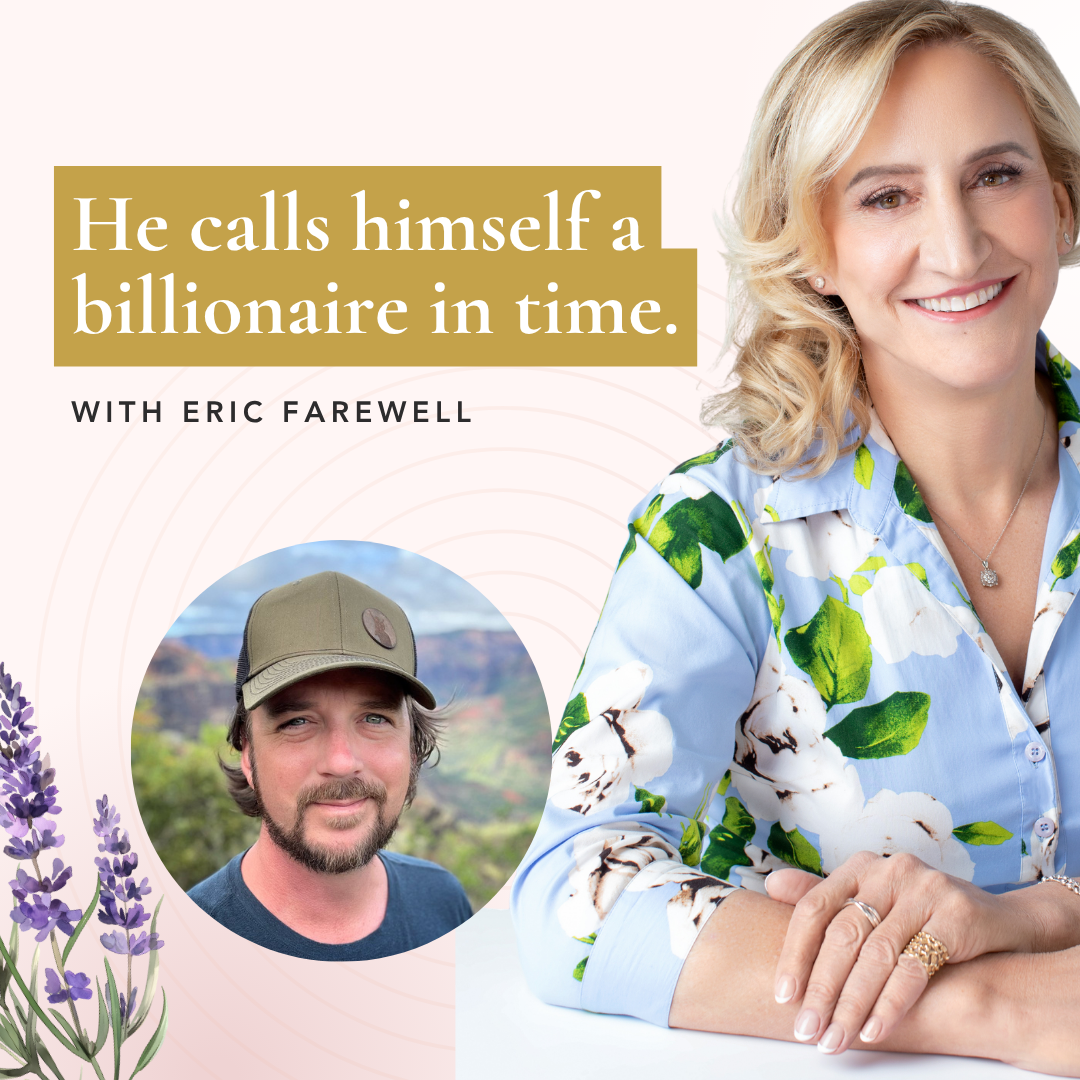
Eric Farewell: Becoming a Billionaire in Time, and Building a Life Around Love
A friend asked Eric Farewell two years ago if he could coach him. In what, Eric said. And the friend answered: you own four companies and you don’t work. You have more time than anyone else I know. Eric replied without reaching for it. He calls himself a billionaire in time: a man who, having never had a childhood, is living one now, driving his kids four minutes to school, playing volleyball on the weekends, calling someone he loves every single time he gets in the car. He is a coach and mentor to founders, the builder of a community called Royals for men and women stepping into their highest selves, and a husband of seventeen years who will tell you plainly that presence is the only currency that has ever mattered to him.
This conversation walks backward through the life that produced him. The seven-year-old who discovered that hard work made people call him remarkable, and who spent the next twenty-five years chasing that feeling through businesses, broken bones, and a marriage that very nearly ended. The convergence that came at thirty-two, when his body finally stopped him. And the years of somatic work, therapy, community, and radical honesty that brought him to the man sitting here now: loving, present, and genuinely grateful for all of it.
In this conversation Eric talks about why grief must be witnessed in community, not carried alone. He talks about the one emotion men are given permission to feel, and the slow, beautiful work of learning to feel the rest. He shares what he looks for in a king or a queen, which has everything to do with where their boundaries are. And he talks about fear as a highway sign: the direction you are most afraid of is very likely the direction you are meant to go.
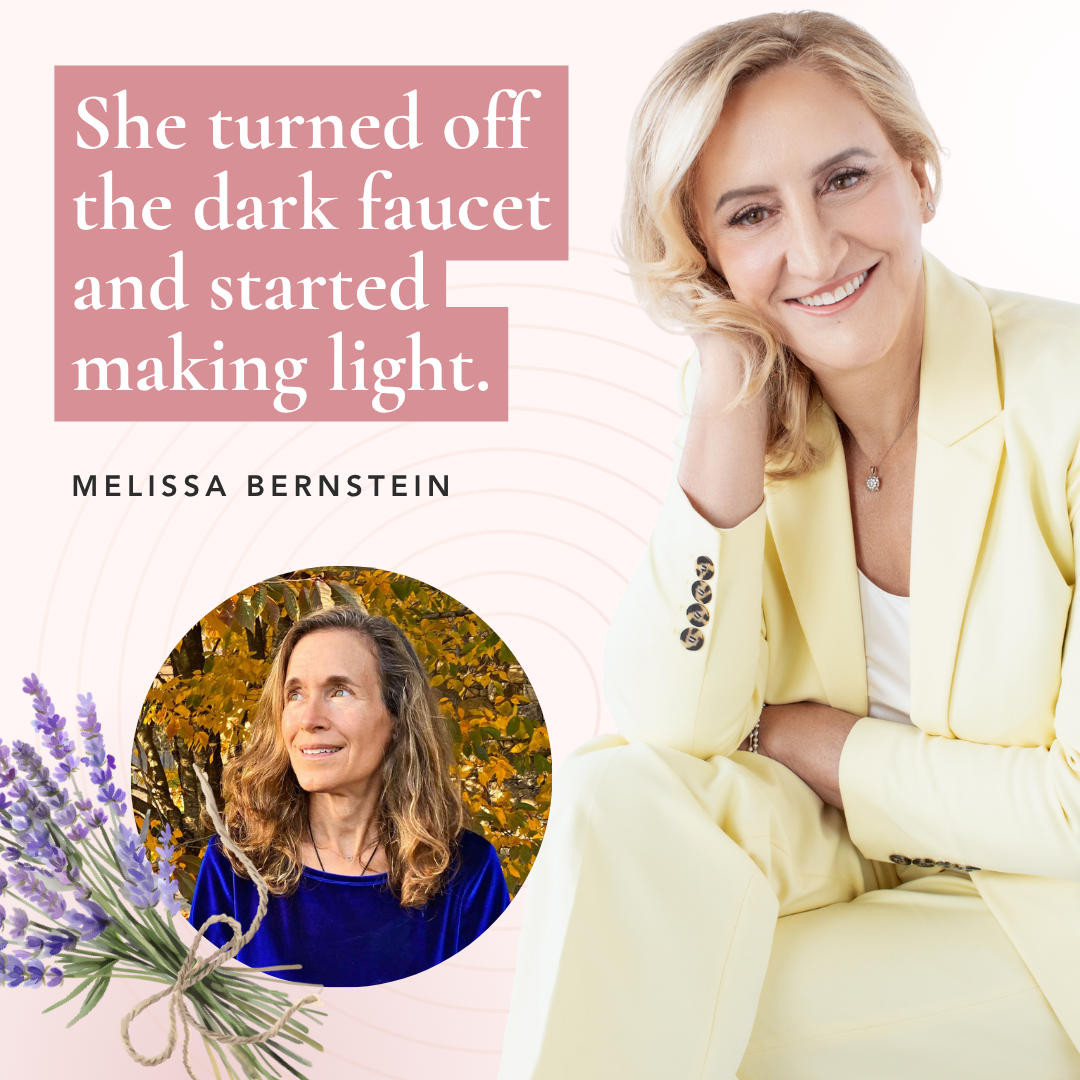
Melissa Bernstein: Turning the Chaos Within Into Light, One Life at a Time
There is a woman who has designed close to ten thousand toys, built one of the leading preschool toy brands in the United States, and founded Lifelines to put sensory wellbeing tools into as many hands as possible. She coaches despondent strangers for free, one person at a time, because she has learned, from the Talmud and from lived experience both, that to save one life is to save the world entire. That is who Melissa Bernstein is today.
The conversation walks backward from there. Melissa describes growing up with a profound crisis of meaning felt from the earliest moments of her life, and shaping herself into what she calls the three P’s: perfectionism, pleasing, and performance. We trace the arc from that formation through the pivot of her early twenties, when she and Doug left conventional careers and founded a toy company with their pooled savings, and she discovered she could turn off the dark faucet and turn on the light one full tilt. That led to her memoir, to the community that became Lifelines, and to the framework she calls the pie of meaning: building a life from many varieties of slice so that no single loss empties you. Katherine and Melissa also find the same arc in each other and name it plainly, two people meeting in the same truth.
This conversation is for anyone who has wondered whether the very quality that made them feel wrong might be the source of their best work. There are no promises of arrival, only an open-handed invitation to keep cultivating seeds and trust they will germinate in lives we will never see.
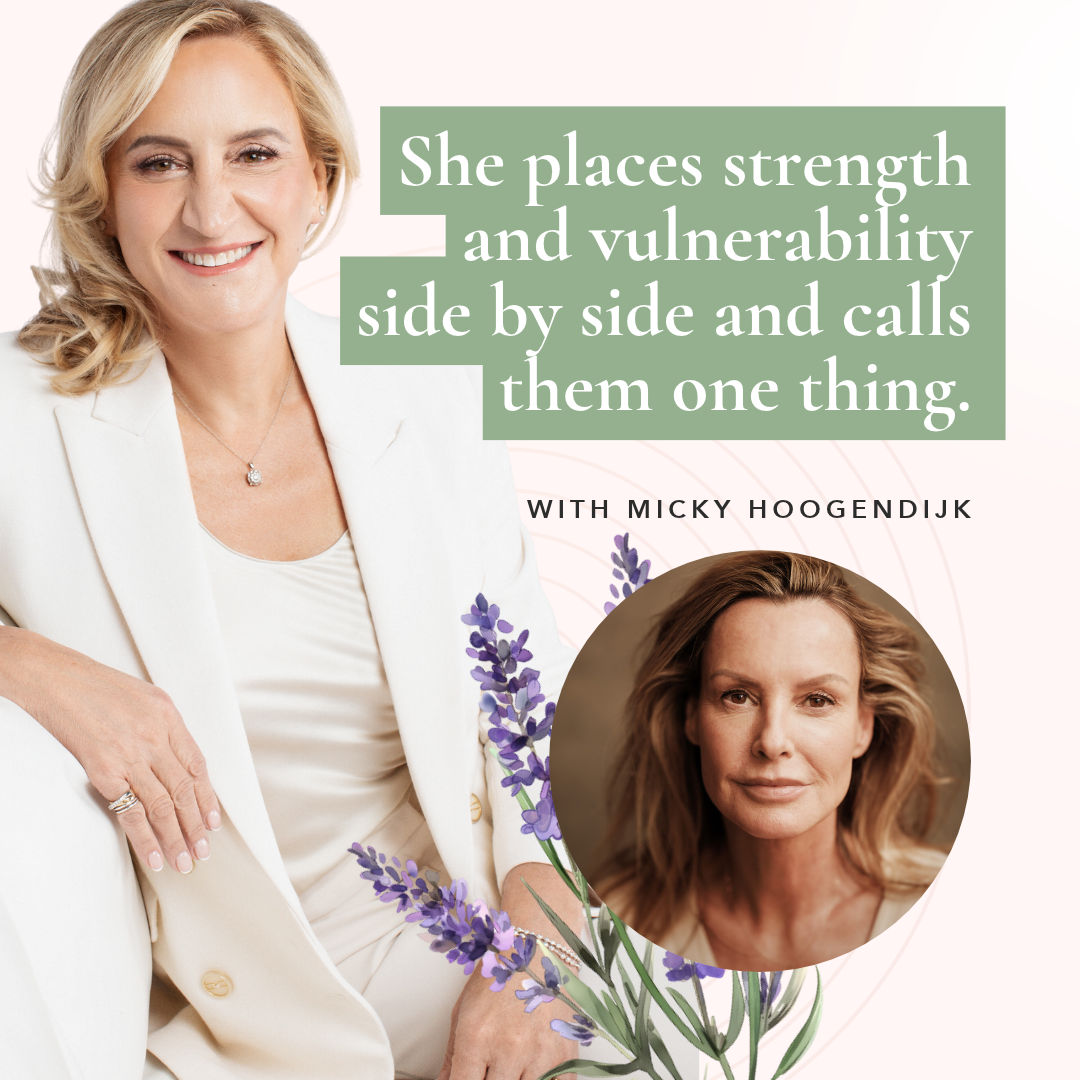
Micky Hoogendijk: Vulnerability Is the Strength, and the Art of Creating Space to Move Forward
Micky Hoogendijk is a self-taught artist working across photography, sculpture, painting, and stone carving, and the author of a memoir on the art of letting go. She creates bronze figures of people holding onto one another, coaxes stillness from her photographic subjects until they stop performing and simply arrive, and lives from what she calls her child energy. A photograph of seven-year-old Miriam lives on her phone. That child, she says, is the one she works for.
In this conversation, Micky and Katherine walk backward through a life lived across twenty-four moves, many countries, and as many forms of expression. They talk about The Artist’s Way and the morning pages that opened Micky’s creative door; about Eric Morris, the acting teacher who asked her to say “I’m a little girl, will you please be my friend?” in front of twenty-five working actors, and what she understood in the tears that followed. They talk about the army of bronze figures she began during the first week of COVID, “the ones,” people holding onto each other. And they talk about her memoir and what she discovered writing it: that letting go means creating space to keep moving forward.
This conversation is for anyone who was once laughed at for being wholly themselves, and who is finding their way back to that child.