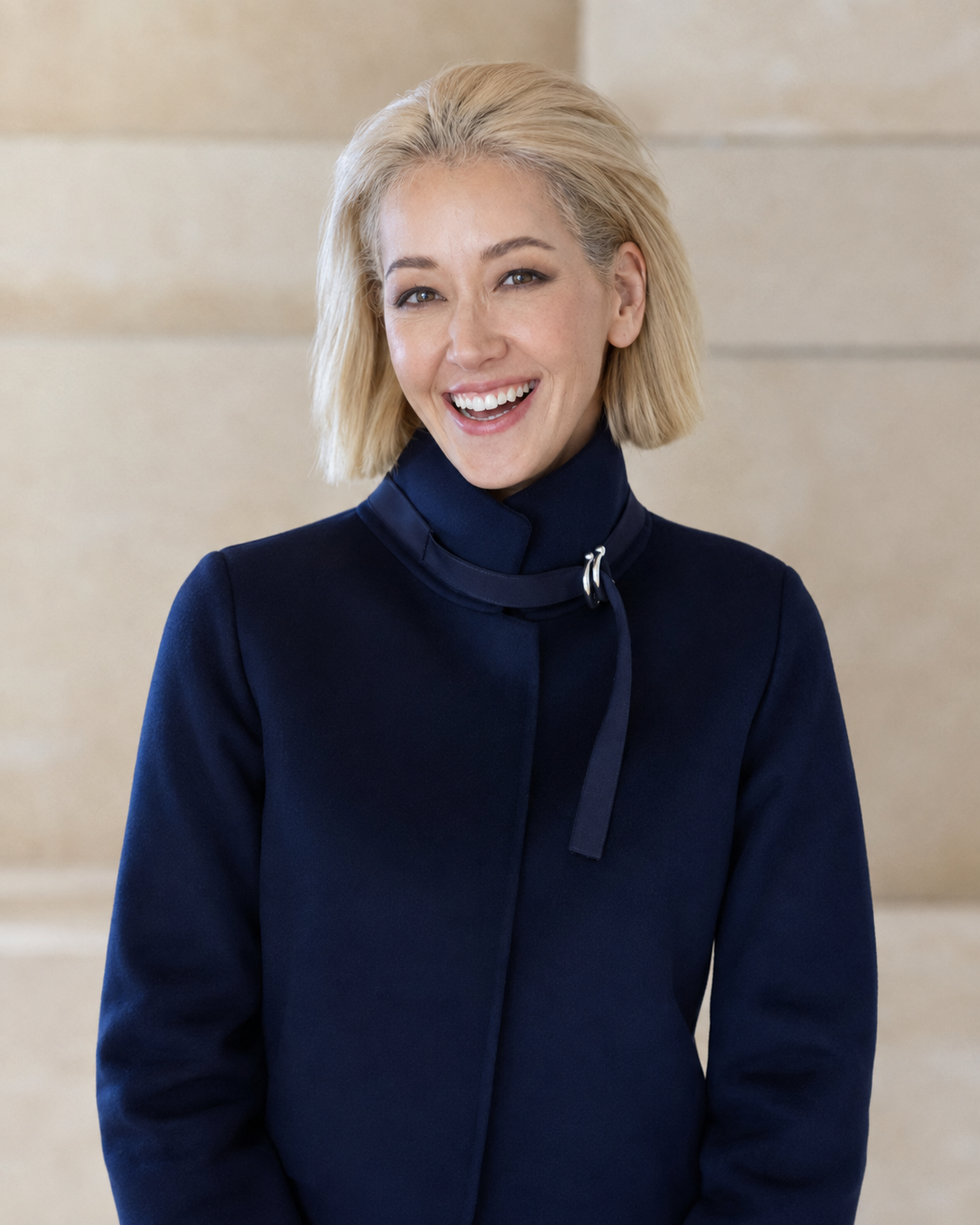
Florence Shaffer will tell you she does not have to catch every wave anymore. There was a version of her that treated the ocean as a thing to be beaten: more waves coming, so swim faster, hold your breath longer, get better tools. That version won a great deal. She describes something else now.
“You actually get out of the water and you start to surf, and you start to realize: wait a second, I don’t have to surf every wave. I’m with the environment because I am grounded. I’m anchored.”
She is six foot tall, a self-described car girl, a poet who reads about longevity and the future of society. She has led transformation across BMW, Lucasfilm, Burberry, and Estée Lauder. She founded a company. And when Katherine offered her a line early in their conversation, that she is a human being, not a human doing, Florence caught it and turned it straight toward the eight-year-old she once was.
That child already knew the work. Florence says she has known since she was eight that she was here to support and inspire other people to live in the full expression of who they are. Everything after that, the companies, the countries, the titles, was the long way round to the thing she started with.
The third-culture child of a physicist and an entrepreneur
Florence is what she calls a third-culture kid. Her mother is South Korean, disciplined and entrepreneurial, a woman who at eighty-four was still watching skincare tutorials and building a terrarium in the kitchen to make snail cream from scratch. Her father is a humble, endlessly curious physicist from South Dakota, the first in his family to go to college, who once accidentally got a PhD by simply not stopping the courses, and who keeps a stack of linear algebra on the table because he thought it would be fun to derive it from nothing.
They met when they were nearly forty. They raised Florence in Silicon Valley, inside a belief that whatever you want to build, you can make happen. Her mother’s own mother had been killed in the Korean War when her mother was six, and out of that loss came a single determination that shaped a whole family: to be the mother she had not had. Florence names what she inherited from it plainly.
“I confuse this idea of love and sacrifice. I thought love is sacrifice.”
She thought the fastest way to honour her parents’ sacrifice was to win the game they had worked so hard to give her a place in. She did. Harvey Mudd College first, which she wandered into almost by accident and found a creative sandbox, a place where the whole point was to protect what you were building rather than fence it in. A professor there mirrored back the thing she could not see in herself: that she was the only one who began every design with the human who would use it. Then twenty years of transformation work, Hong Kong, Nepal, the Americas, thirty brands.
The night in the Hong Kong office
She was alone in the Burberry office, ten-thirty at night, and she was weeping, which was not something she did. Being Korean, she says, we don’t have those moments. Her boss found her, this woman she still admires, and asked what was wrong. And then said it.
We sell trench coats.
Florence heard it. She had known since she was eight what she wanted to give the world, and she had let the titles and the making-her-parents-proud carry her somewhere else. Katherine has a word for that night. She offered it gently: call it a collapse, collapse number one, and told Florence about her own three or four collapses across nine years before she finally surrendered.
Florence calls it the slip. The successful leader inflection point. She is an engineer, so she draws it as a graph: success and enjoyment rising together for a long while, and then the two lines part. You keep performing. The performance holds. But somewhere the joy that made it worth it has thinned out, and you tell yourself maybe you need a new wardrobe, new friends, a therapist. The world keeps moving, so you keep moving with it.
The graph she had been ignoring
Two and a half years ago, out of nowhere, Florence was told she had stage four cancer. She had already started building her company. Her team said, well, it is time for you to go through the programme you built.
She moved through it fast, she says: shock, then tears, then, in about forty seconds, an image that came to her whole and has stayed as the picture of her entire life before that moment.
“I was driving the car of life and the warning lights went off and I was like, no problem, I can drive.”
The trench coats were the first light. She had kept driving. The windshield cracked; she was resilient, she kept driving. Steam came off the engine; still driving. The wheels, she says, blew off. She was supposed to have stopped. Her body had been telling her to pause and reorient her whole life, and she had normalised every ache and headache the way high performers do, folding the exhaustion into her identity until being tired was simply what leadership meant.
Later in the conversation Katherine returned to the thing Florence had said, that she was supposed to stop. She would not let it sit as a failure. You did the best you knew how, she told her. And Florence received it: well, and I wouldn’t be here, would I. I wouldn’t be doing this. She was learning, slowly, to stop fighting the water and to be with it.
What she has actually built
Florence founded Becoming four years ago, and she frames it as the first strategic advisory for human flourishing. She built it by speaking with more than 250 experts, asking one question: how would you recalibrate a person from making decisions out of an extractive, performative system to being driven by their own coherence?
The answer she built is a diagnostic across the whole of a person, mental, emotional, physical, spiritual, social, that finds where someone is working against themselves. It matches them with world-class experts, individual contributors kept out in the world so the programme stays alive and evolving. Then a five-day immersion, a modern rite of passage, designed to make one or two shifts at a deep enough level that everything downstream gets simpler. The point she guards most carefully is that it happens without blowing up your life. You stay in your life. The adjustments reintegrate into it.
The byproducts, she says, are great health, real relationships, joy, and genuine performance. They come from being anchored.
Selling us back what was always free
Florence laughs that we have built whole industries because we forgot how to be. Rest, health, movement, eating well: things that were always ours, packaged and sold back to us until we feel we must perform them too. She once heard of a company in New York selling memberships to sit in an empty room. Brilliant, she thought, and then: how far have we come that we pay to sit quietly.
When she and Katherine reached the word boundaries, they found a better one together in real time: Katherine offered it, Florence affirmed it.
“Protecting the sources of energy that feeds me. It means about knowing myself well enough so I know what brings me joy, what brings me rest, what brings me peace.”
This is what Florence hopes to make reachable earlier, before the slip, before the warning lights go unheeded. She is winning by every measure and she is also holding stage four cancer with a self-observation so steady it disarms you, calling it, of all things, a gift, saying her relationship to it will be love, because her body decided to tell her where she had stopped listening. You may be somewhere on that same graph right now, success still climbing, joy quietly slipping. She would tell you the invitation is already here.
What her life is asking us to see
Florence Shaffer is curious, playful, radiant, and she watches herself with a gentleness most of us reserve for other people. She grew up believing love was sacrifice, and she has spent her adult life learning that love is coherence: the state of being so at home in yourself that you are not doing anything, and somehow everyone around you feels freer to be who they are.
She said it plainly: she is part of the ocean, and she flows with it.
She put it plainly: intelligence is becoming a commodity, and the real question is what our role is now. Her answer is to come back to the whole self, the morality, the humanity, and the wide-open wonder a child still carries before anyone tells them to stop, and to build from there. A regenerative life instead of an extractive one. A soft reroute off the conveyor belt before it reaches the cliff.
She is doing all of this while not knowing what next week’s scan will say. And she is enjoying her life anyway, being exactly who she wanted to be, which she says is the only thing that ever mattered. She got out of the water and started to surf, and she is still out there, with the environment rather than against it, grounded because she is anchored.
This is the kind of leadership our moment requires.
It is the kind of leadership Sincerely was built to honour.
A few hours with Florence
Settle in for a conversation of a little over eighty minutes. It moves slowly and warmly, from an eight-year-old’s certainty to a physicist father and an entrepreneurial mother, from a night in a Hong Kong office to the surfboard image that holds the whole thing together. Bring your own graph if you have one.
There is no hurry. The library is always here.
Three things Florence said that I keep returning to
“When you start to realize that you feel so coherent in who you are and how you show up that you’re not really doing anything and somehow you’re giving other people permission to just show up as who they want to be.”
“We’ve created industries because we’ve forgotten how to be, right? So we’re really selling you back rest, your own health, and eating well, and moving.”
“You don’t need to command the ocean. You don’t need to control it. You’re just part of it, and to really just flow with it.”
About Florence Shaffer
Florence Shaffer is the founder and CEO of Becoming, which she describes as the first strategic advisory for human flourishing: a diagnostic across the mental, emotional, physical, spiritual and social dimensions of a person, paired with world-class experts for an immersion so that success no longer erodes the life it was meant to serve. Over more than twenty years she led transformation across BMW Design Works, Lucasfilm, Burberry, a Harvard-partnered healthcare organisation in Nepal, and Estée Lauder, where she was global VP of technology across thirty brands. A third-culture child raised in Silicon Valley, she writes poetry, explores forests and ancient cities, and studies longevity and the future of society.
Find Florence: florenceshaffer.com · startbecoming.co · linkedin.com/in/florenceshaffer
Please stay.
Don’t just visit. This home is yours too.
There is a room here for you. It has always been here, waiting.
Once a week, you’ll receive a letter. Reflections from me. Sincerely recommendations. Small stories worth sitting with. Quiet offerings for the path, written for people who want to live a more gentle, bright, and honest life.
You’ll be the first to know when new conversations arrive on The Sincerely Show. When gatherings are announced. When the doors of Maison Millefleurs open for retreats.
The door is never locked. We’ve been preparing your room for a while now.
This conversation is for reflection and perspective only and should not be relied on as therapy or professional advice. Please seek qualified support where needed before making any decisions based on the information you learn through this conversation. This content is also subject to our full Terms and Conditions, which you can review on our website at sincerelyinc.com.