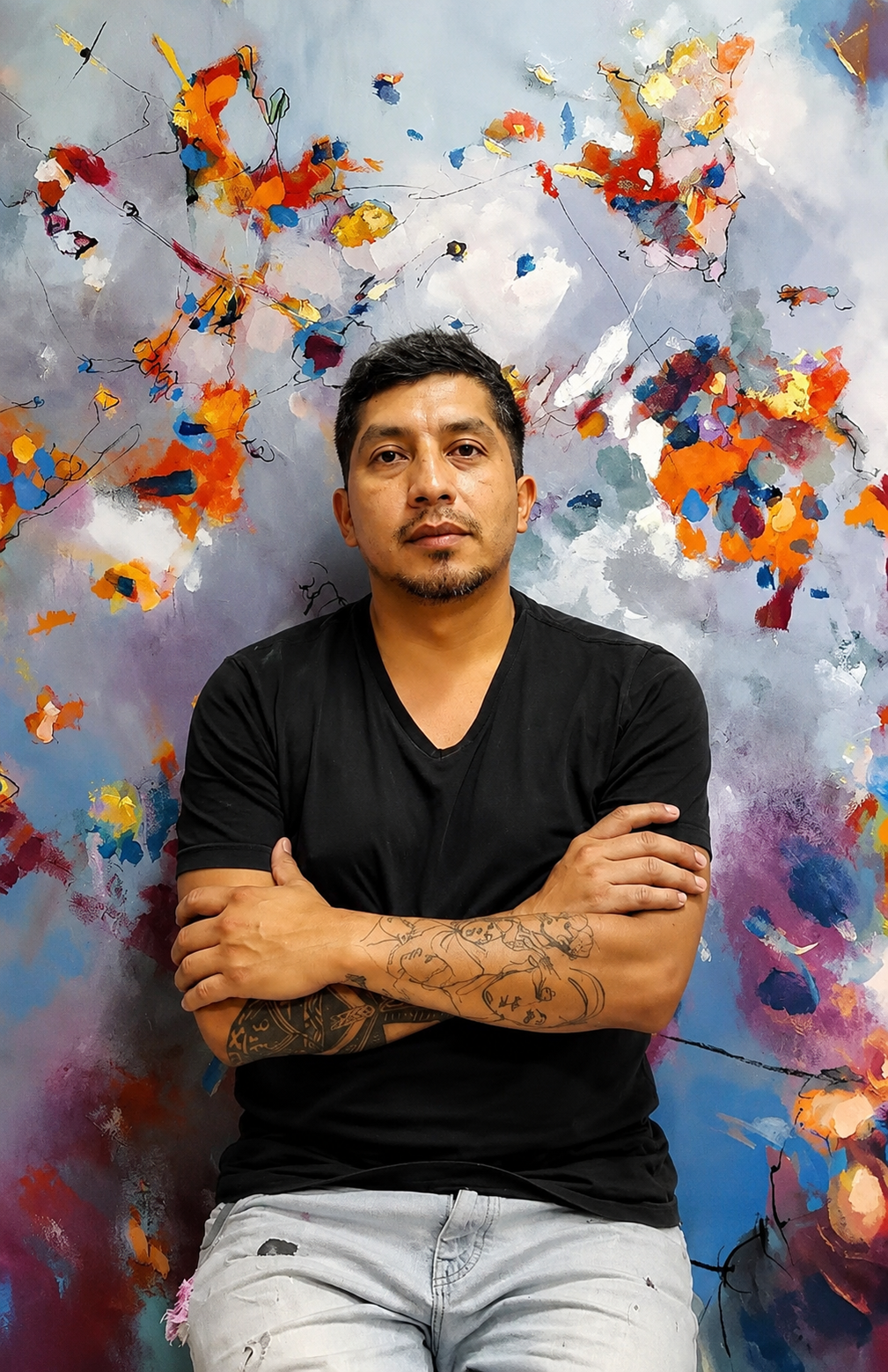
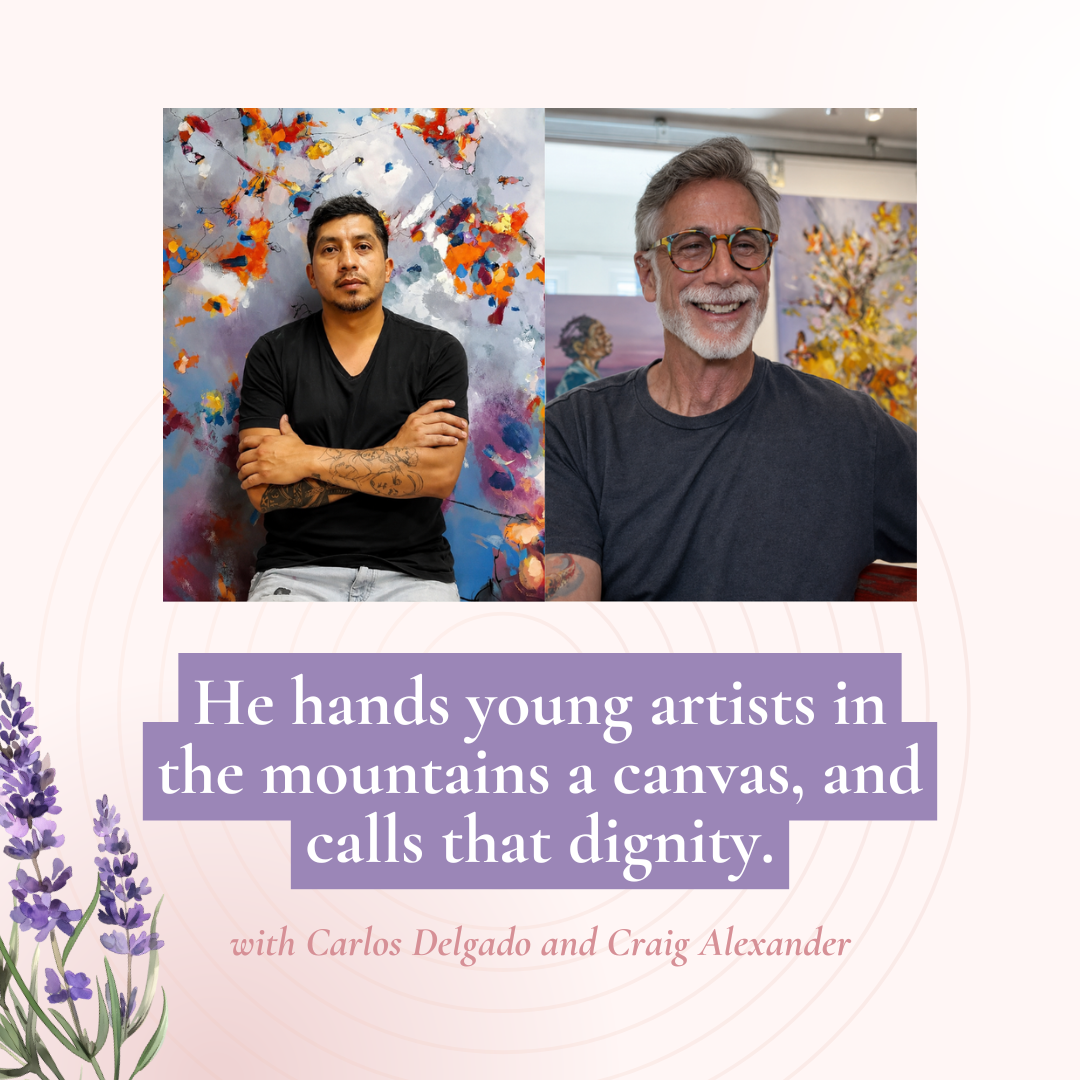
He works with a knife more than a brush. A collector who owns his paintings and had never watched him make one stood in a gallery in Wellington and gasped, because Carlos Delgado turned a portrait facing straight ahead into a profile with one or two moves of the blade. The music played. People pushed him gently to keep going. And when the music stopped, he turned and said, I’m done.
That painting sold before he set the knife down. Someone in the room said they couldn’t leave without it.
Carlos calls what he makes “the simplicity of chaos.” Apocalyptic strokes, worked and reworked, until the chaos comes out as love. He believes chaos means new, rebirth, birth. On this episode of The Sincerely Show, recorded on location at Sybil Frank Gallery, he sat beside the friend who first saw his work online seven years ago and drove him out to a small gallery two and a half hours from Toronto. That friend is Craig Alexander, who sold his first painting inside a week.
Two boys who found themselves early
Craig named his gallery Sybil Frank after his two grandmothers. He was close to both of them. He picks paintings the way he imagines each of them separately, then asks himself what happens if he puts them together. That is how he chooses the artists he represents.
Carlos found himself much further away. Today nine artists work from his studio in the mountains of Colombia, he sells their work internationally, and with his wife Diana he runs Arte Espiral, carrying art workshops to indigenous children in the mountains. But he began there, as a boy, drawing from the time he was two or three years old. His father still tells the story of watching a toddler draw and being amazed. Paper was hard to find in the mountains. Paint was harder. And in his country, he says, people think being an artist means being poor.
He carried six months of childhood guidance into a whole life of making. Everything else he taught himself.
The mountains, and the paper that was never enough
The art school was out of reach. He tells it plainly.
“when I had the chance to be in the art school it was complicated, I didn’t have the funds to kill to pay the rent, to stay and and also I decided to study a different thing to be in art because art is con in my country the people think being an artist being poor”
So the school never had him. The knife and the canvas would come later, taught by his own hand.
A young man knocking on the studio door
In 2010, Carlos moved to Canada. He worked part-time jobs and rode the Toronto subway, watching the faces of tired commuters at the end of rush hour, the ones looking down, the ones pretending to sleep. He learned that when a person looks away, they give a little of their soul away too. From those faces, the art came. Over roughly fifteen years he came to feel he was worth something, and the proof was the community of galleries and collectors who gathered around him and became his friends.
After the pandemic, the cost of the studio and the apartment in Toronto grew heavy, and he felt his art “was like being killed just to keep expensive.” His parents were getting older. He moved home to Colombia to be near them, back to a town of fifty-seven thousand people in the mountains, back, as he put it, to the beginning.
Then the young artists began knocking. One of them, Eliasar, drove four hours to ask Carlos for support. Carlos said no at first. But Eliasar showed him a small painting, two portraits of children, made in oil on cheap paper.
“I didn’t have money to buy canvas. And I was loyal so touched. I told my wife, look this is he’s so talented but he doesn’t have at least a canvas to do a painting.”
Carlos offered the young man space to work and materials to work with, canvas for a boy who could only afford paper, and later a knife of his own to learn with. A year later he sold one of Eliasar’s paintings in Norway for six thousand dollars, a sum equal to four or five months of a regular salary in Colombia.
What the return home opened in him
He went home to be near ageing parents and found himself at the beginning again, in the town where paper had once been scarce. What looked from the outside like a retreat became a gathering. The knocking at his door turned into a studio full of people. He had come back to the mountains he thought he had left, and this time he had something to give away.
What Carlos and Craig have built
Today nine artists work from Carlos’s studio in the Colombian mountains. He buys big rolls of canvas and oils. Until this January he paid the rent himself, and the materials, and everything else, and the artists have only recently begun to help a little. He sells their work internationally through his own collectors. He looks around his studio and sees who has gathered there: a woman, a young man who is part of the LGBTQ community, a seven-year-old boy who can draw you in a minute.
Two years ago he and Diana founded Arte Espiral, which brings art workshops to indigenous children in mountain communities. Last year they ran ninety workshops. When they arrive, they bring snacks for the children and good materials, so the teaching carries dignity.
Craig, meanwhile, keeps Sybil Frank Gallery open in Prince Edward County as a place anyone can walk into for free. People ask how much it costs to come in. It is free, Craig tells them, just come in and enjoy. He also runs a talent agency. He brings to it the same care he brings to hanging a room. He calls the gallery a happy maker.
“It’s not a moneymaker. It’s it’s It’s a happy maker.”
When someone sees you, and you carry it home
Carlos found his worth in Canada, in a world of collectors and curators who told him, in effect, that he mattered. Craig was one of them. Craig drove Carlos out of the city, sold his first painting within a week, then his next two within another week, and became family alongside Diana. Both men have known dark and heavy seasons. Craig speaks of the church of the Sagrada Familia on his seventieth birthday, sitting from nine in the morning until five in the evening to watch the sun move through the stained glass, and feeling everything negative leave and beauty take its place. His mother has dementia and lives in a home. She tells him he is always in a good mood. He tells her it is because he woke up, and every second after that is a gift.
Katherine put it to his face:
“You brought community to Canada. And Canada showed you back the love and the community that was already in you.”
The gift that once saved someone becomes the gift they hand away. He was sitting on the floor painting while Craig gave his interview. He helps young artists so they can live from what they love, and he asks them for discipline alongside their talent.
What their lives are asking us to see
Two men met because one of them was searching online in a gallery in Wellington and one of them was making paintings out of the faces of tired strangers. When Craig first saw Carlos’s work, he drove two and a half hours out of the city on the strength of it, and sold the first painting within the week.
Carlos’s wish for humanity is balance. He has watched crazy poverty and enormous wealth stand side by side in his country, and he dreams of dignity for people who cannot reach the most basic things. He believes art does its part in that. A canvas for a boy who could only afford paper. Last year, he and Diana carried ninety workshops into the mountains with snacks and good materials for the children. Nine artists learning to live from what they love.
Craig believes the same thing from a different angle. Beauty is for everybody. You walk into a room, you see something you have never seen, and you feel held. He keeps the flame of the gallery alive so that others can feel his grandmothers’ presence the way he does.
Carlos names his work the simplicity of chaos, and he means that the strokes go in like an apocalypse and come out as love, one or two moves of the blade turning the whole thing over. That is also the shape of a life given over to service. The chaos is real. The beauty it can be worked into is just as real. And the two of them, Craig who saw and Carlos who was seen, are proof that we become ourselves in each other’s company, and then we give what we have become away.
This is the kind of leadership our moment requires.
It is the kind of leadership Sincerely was built to honour.
A few hours with Carlos and Craig
This conversation runs a little under an hour, recorded live at Sybil Frank Gallery with the paint still fresh on the canvas Carlos made while Craig spoke. It moves slowly and warmly, two friends and a witness, from a gallery named for two grandmothers to a studio in the Colombian mountains. Come and sit with it when you have the time.
There is no hurry. The library is always here.
Three things from the afternoon at Sybil Frank Gallery
“You know how I name my art my style I call the simplicity of chaos. All my art is simplicity of chaos.”
“I didn’t have money to buy canvas. And I was loyal so touched. I told my wife, look this is he’s so talented but he doesn’t have at least a canvas to do a painting.”
“It’s not a moneymaker. It’s it’s It’s a happy maker.”
About Carlos Delgado and Craig Alexander
Carlos Delgado is a self-taught artist from the mountains of Colombia who spent some fifteen years building his life and work in Canada before returning home. From his Colombian studio he mentors nine young artists, provides their materials and space, and sells their work internationally. With his wife Diana he runs Arte Espiral, delivering art workshops for indigenous children in mountain communities. He calls his style the simplicity of chaos. Craig Alexander is the founder of Sybil Frank Gallery in Wellington, Prince Edward County, Ontario, named for his two grandmothers, and a curator who also runs a talent agency. He represents Carlos and has done for seven years.
Find Carlos and Craig: carlosdelgadoarts.com · arteespiral.com · Sybil Frank Gallery, Wellington, Prince Edward County
Please stay.
Don’t just visit. This home is yours too.
There is a room here for you. It has always been here, waiting.
Once a week, you’ll receive a letter. Reflections from me. Sincerely recommendations. Small stories worth sitting with. Quiet offerings for the path, written for people who want to live a more gentle, bright, and honest life.
You’ll be the first to know when new conversations arrive on The Sincerely Show. When gatherings are announced. When the doors of Maison Millefleurs open for retreats.
The door is never locked. We’ve been preparing your room for a while now.
This conversation is for reflection and perspective only and should not be relied on as therapy or professional advice. Please seek qualified support where needed before making any decisions based on the information you learn through this conversation. This content is also subject to our full Terms and Conditions, which you can review on our website at sincerelyinc.com.