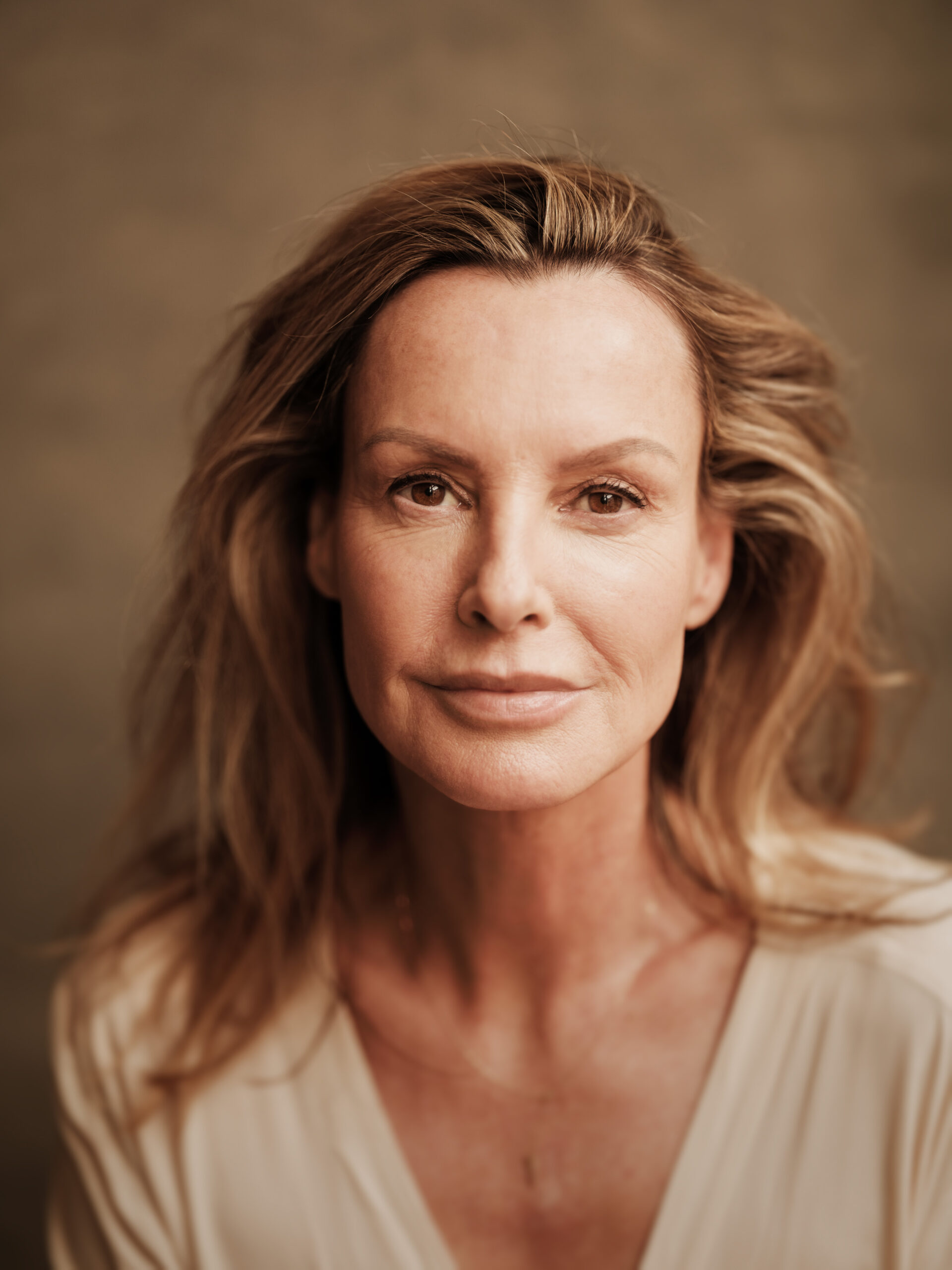
She stands six foot one, a girl from the Netherlands who was once nicknamed the gentle giant when she moved to Los Angeles. Put a camera in her hands and something quiets in the room. No smiling. No redirecting. She waits until the person in front of her stops performing and simply arrives.
“In my photography, you see stillness,” she says. “There’s no smiling, there’s no redirecting, there’s this being state, as I call it.”
That is Micky Hoogendijk, and stillness is the thread that runs through everything she has made. Her first book of photography she called Strength and Vulnerability, the two words set beside each other with no resolution between them, because she does not believe they oppose one another. She believes vulnerability is the strength. She believes it is the most beautiful part of a human being. When she sees it in someone, she says, she falls a little in love.
Over one life she has lived many. Actress for twelve years. Photographer. Painter. Sculptor. Author of a memoir on the art of letting go. Now, most recently, she has gone to Italy to learn to carve stone. She is entirely self-taught in nearly all of it. And through every form, she is doing the same thing: coaxing the unperformed human out into the light, then holding it there long enough for the rest of us to recognise ourselves.
The girl who arrived as Princess Miriam
She was born Miriam Hoogendijk in 1970, conceived by artificial insemination, one of the first in the Netherlands, raised by her mother alone. When she was around five, her mother told her the whole truth of it. The next morning she walked into school and announced, “I am a very special seed. I am so special.”
The children laughed. The parents laughed. The teachers thought she was lying. Nobody there had heard of such a thing, and this beautiful naive girl had simply told them who she was.
She drew and sang and danced. She needed a great deal of attention, being an only child, and she gave it back to the world in colour. When the family moved from Amsterdam to the rural east of Holland, she arrived at her new school dressed as Princess Miriam, in her mother’s golden nightgown with a little crown on her head, and introduced herself that way. The room decided she was a dork.
Katherine knew that room. She told Micky about being six years old in grade one, putting her hand up to say she had found a dead baby bird and buried it and gone back and found it gone, and being laughed at by the whole class, teacher included. Two dismissed children, decades apart, recognising each other across the conversation.
The name she built to survive, and the girl she is walking back toward
At around fourteen she named herself Mickey. “I think she came from surviving,” she says. Mickey was the strong one, the good organiser, the one who could put her face on and walk through customs at LAX and be waved through. Mickey protected the sensitive, scattered Miriam through the parts of a childhood that were not safe.
There was a stepfather she genuinely loved. He was a painter, a hunter, a man who taught her to draw and paint and sing and play guitar. He also abused her when she was eight. She told her mother. She confronted him, her mother beside her. And as a child, she learned something she carried the rest of her life: that she could say no, that she could say she did not want this.
What she came to understand only much later, in the writing of her book, was that her body had learned to step outside itself to survive. “Whenever I enter the room, I know what’s going on,” she says. “But it’s a survival mechanism that I have learned because of all of these things. I’m putting it to good use right now.”
She reads a room the way most people breathe. It is the source of the work. Our deepest hurts, as Katherine names it, become our deepest gifts.
Her mother’s essence in a camera
Micky was an actress for twelve years. In Los Angeles, the master teacher Eric Morris stood her in front of twenty-five working actors on her first day and had her say, out loud, “I’m a little girl, and I need to be loved.” She stood there with tears coming down and had no idea what had happened. He told her: vulnerability is much more interesting than being a tough girl. Nobody had ever told her that.
Then her mother died. Her last gift to Micky was a beautiful camera.
“I really sincerely believe that her essence was in that camera,” she says, “and it allowed for me to create new lives.” She moved to the United States with it, and her photographs travelled the world within no time. The actress became the artist. She would meet a face, a girl walking out of a dressing room in a Forever 21 in Austin, and her whole body would say: I need to photograph you. Then she would dream the image whole, and make it.
The turn to sculpture came in the first week of COVID. She looked at her studio in total isolation and decided either the world would end or she would begin. Within weeks she had an army of figures she calls “the ones”: people holding onto one another, the way children draw people, the thing the whole world was forbidden to do that year. People love the work, she says, because they see themselves, they see their own family in it. She did not plan any of it. It came from the subconscious, which is where she says the healing actually lives, because we so often want everything too literal, printed out one, two, three, four, five, and it is never that.
The art of letting go is the art of making room
Her memoir is called The Art of Letting Go. She resisted releasing it for years. She did not want to stand in a supermarket beside a stranger who knew everything about her. It took four years to finish, and three weeks of real fear before the launch, until she read that an artwork is at its most vulnerable right before release, because it has not yet found its audience. Katherine knew that fear too, and named the book what it is: a being, another child, given birth to and sent where it is meant to go.
She reaches for a more precise word, and finds it.
“It’s not really about letting go of anything, but it’s about creating space,” she says. Making room. And the way you make room is to keep moving.
“As long as you move yourself into certain directions and allow yourself to keep moving and to keep living and to keep doing the things you do and creating and being curious, then things just appear and happen and continue.”
She does it all from her child energy. To create, she says, she has to be in a playful state, so she wears her work clothes because the little girl loves them, and she lets the child steer the boat. Innocence, as Katherine puts it, is the highest form of wisdom. And there is a second guide now: someone told Micky to picture herself at eighty-three, and the woman she imagines is a daredevil who says yes to everything, more playful even than the child. She juggles the two of them. The hurt little girl she comforts, and the free old woman she is walking toward.
What her life is asking us to see
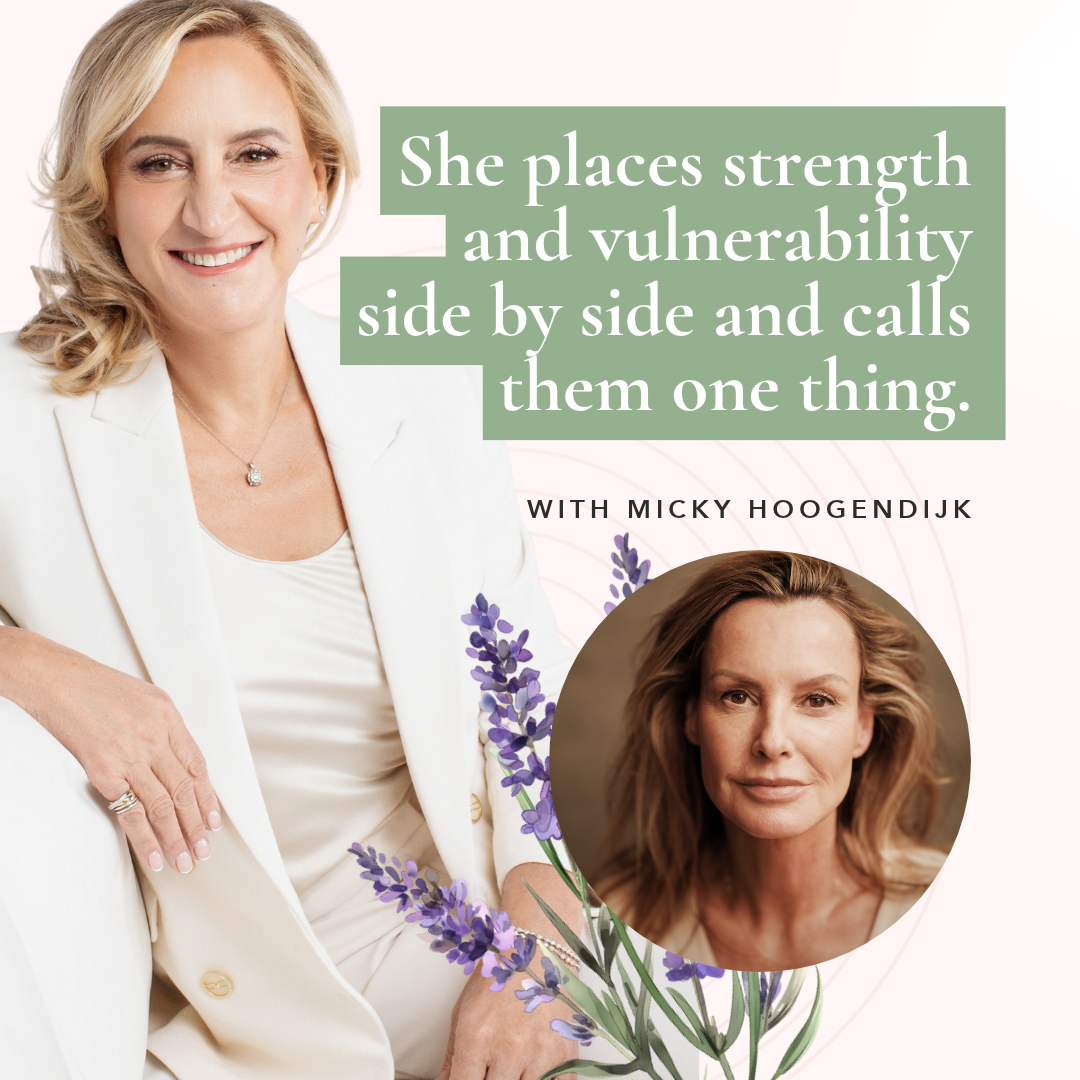
Micky places strength and vulnerability side by side and refuses to choose between them. That is the whole of it. The child who was laughed at for being wholly herself did not vanish. She was protected by a stronger self, hidden for a while, and is now being walked, gently, back home.
What she has made from what happened to her fills rooms and travels internationally. The lost children have rooms in her work, alive and breathing. The survival that taught her to read a room is the very thing that lets her make what she makes. The wound, she says, quoting Rumi, is where the light enters you. She has made space beside her past and kept moving, and the moving is the creating.
The stillness she coaxes out of the people in front of her camera is her gift to them, and it is the same stillness she has learned to hold for the child inside herself. In that stillness, the moving becomes possible. This is what she is walking home toward: Miriam, in the truest and freest and most pure state she began in.
Her wish for us is that we learn to live. That we teach children to love themselves first, to be kind, to take care of one another, so that a generation grows up in touch with what it is actually about. Every essence, Katherine reflected back to her, is its own radio station, its own frequency. Micky’s journey is the journey back to hers.
Please believe in you, she says. Don’t let that little girl drown. That voice is the purest form of you.
This is the kind of leadership our moment requires.
It is the kind of leadership Sincerely was built to honour.
A few hours with Micky
This is a warm, unhurried conversation, a little over an hour, between two women who kept recognising themselves in each other. It moves through art and acting, the inner child, the art of letting go, and the quiet work of coming home to who you were before the world laughed. Settle in with it whenever you have the space.
There is no hurry. The library is always here.
Three lines I wrote down after we recorded
“I actually think and believe that vulnerability is the strength and it’s the most beautiful part of a human being.”
“In order to create, I have to be in a very playful state. I have to be in my child energy.”
“The moment you stop doing, the moment you don’t allow yourself to try, then it stagnates. And stagnation is the worst thing you can do, I think.”
About Micky Hoogendijk
Micky Hoogendijk is a self-taught artist from the Netherlands who works across photography, sculpture, painting and, most recently, stone carving. Born Miriam Hoogendijk in 1970, she spent twelve years as an actress before her mother’s gift of a camera turned her toward visual art, and her photographic work soon travelled internationally. Her sculptures, figures of people holding onto one another that she calls “the ones,” began in the first week of COVID. She is the author of a memoir on the art of letting go, published in Dutch and titled in English The Art of Letting Go. Her photography book is Strength and Vulnerability. She lives and works in the Netherlands.
Find Micky: mickyhoogendijk.com
Please stay.
Don’t just visit. This home is yours too.
There is a room here for you. It has always been here, waiting.
Once a week, you’ll receive a letter. Reflections from me. Sincerely recommendations. Small stories worth sitting with. Quiet offerings for the path, written for people who want to live a more gentle, bright, and honest life.
You’ll be the first to know when new conversations arrive on The Sincerely Show. When gatherings are announced. When the doors of Maison Millefleurs open for retreats.
The door is never locked. We’ve been preparing your room for a while now.
This conversation is for reflection and perspective only and should not be relied on as therapy or professional advice. Please seek qualified support where needed before making any decisions based on the information you learn through this conversation. This content is also subject to our full Terms and Conditions, which you can review on our website at sincerelyinc.com.