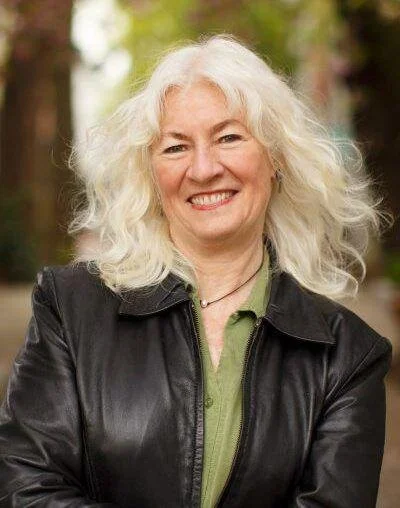
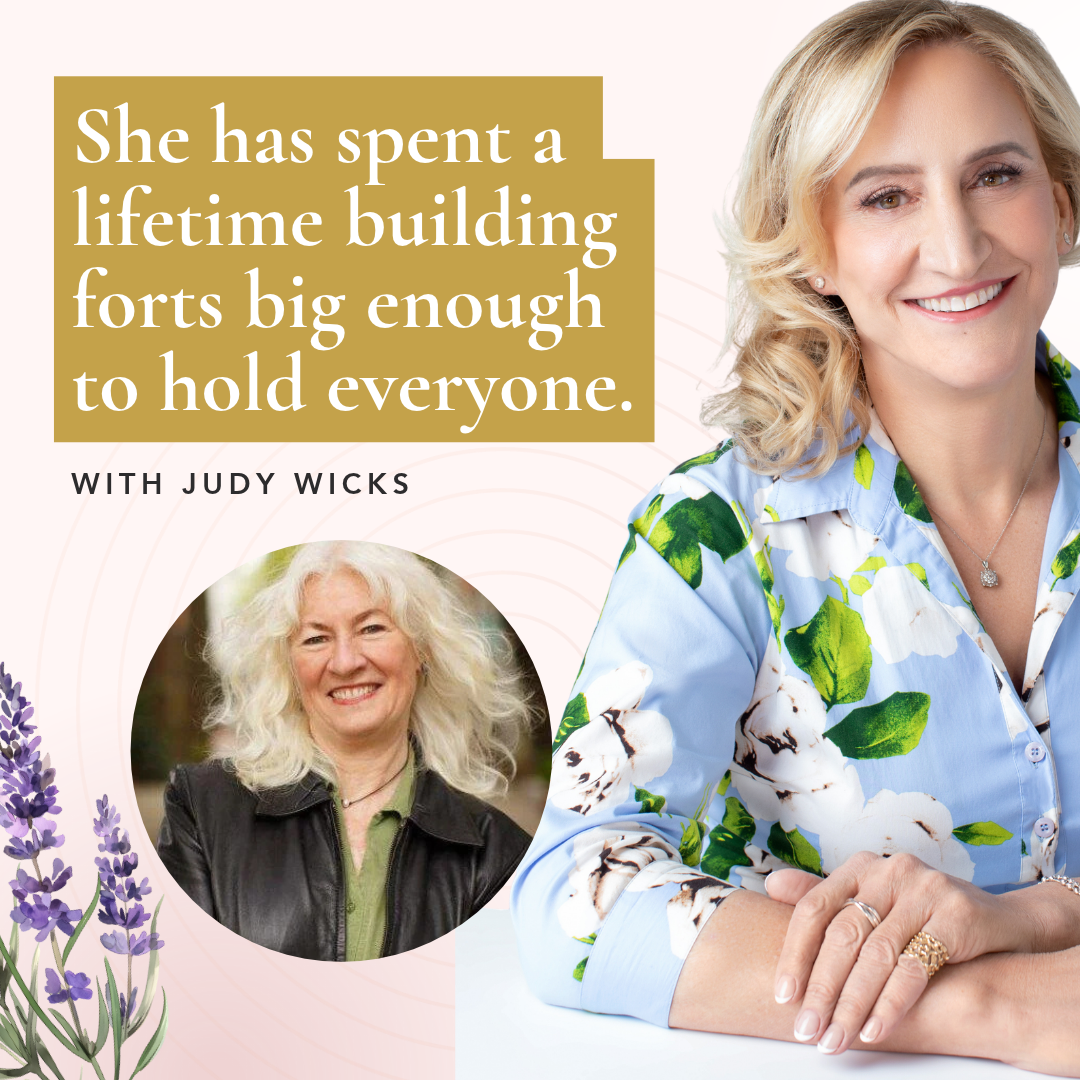
On a hill in the Chestnut Hill section of Philadelphia, a green lawn has become a meadow. There are birches and maples and a red bud, peach and pawpaw and cherry, an arbor with wisteria that bloomed so hard this spring that Judy Wicks calls it gorgeous and means it. Her daughter Grace, a professional gardener, cut the paths through the tall growth at their level so that the older friends can walk. One section of the hill has been levelled into a plateau. That is where the bar goes, and the food, and the fire pit, and the stage when there are performers. Judy calls it the party plateau.
She is nearly eighty. She has not stopped.
Soon there will be a Black-Eyed Susan party, because the Black-Eyed Susans are about to burst. There will be a Liberty and Justice for All Ball, its second year, after 250 people came the first. Everyone brings their own plate, their own cup, their own wine, and hops from table to table meeting people they have never met. Some of the tables are set for guests who can make it down the stairs and no further. This is what she does. She has always done this.
“My life has been about building the beloved community,” she told Katherine. “That whatever I’m doing, whether it’s running my restaurant or having parties, what I’m really doing is building the beloved community.”
She said it as though she had only just noticed it, and in a way she had. But it is the through line of an entire life. She has built one fort after another, every one of them a world made on purpose to hold the people she loves and the people who are different from her, which for Judy is the same joy.
The girl who wanted tar paper and a can of nails
She grew up in Ingomar, a small town in western Pennsylvania, an all-American, Norman Rockwell sort of childhood, and from the start she wanted none of what a girl in the fifties was handed. Every year on her birthday she asked for a roll of tar paper and a can of nails, the same request, every year, because what she wanted was nothing a girl in the fifties was supposed to want.
At nine she found a pile of felled sassafras trunks her father had cleared, took his saw, cut them to length, lashed them into a square between four standing trees and built her first fort out of logs, with a roof and a trapdoor at the top. When bullies smashed the roof in, she ran through the woods to the clubhouse they were building, saw the new glass windows they had just installed, and broke every one of them. Nobody said a word afterward, because the boys could never admit they had attacked a girl first. She had got them back, and she had got them back for a reason.
Her father was a lawyer, the son of a lawyer, a man with justice in him. Her mother was a Girl Scout leader who stepped forward and led the flag ceremony and gave people their chores, and who ran what she proudly called the loudest classroom in the school. They did not think it was appropriate for a girl to build forts. They never took a single photograph of them. And they never once stopped her.
“I think it was a matter of trust,” Judy said. They trusted her to have her own set of values that would keep her from harming anyone, and so they let her be exactly who she was.
The red light that turned her into a restaurateur
At ten, watching the boys play the baseball she was not allowed to play, she chose the best player on the field and decided she would marry him. She lifted the lid of her school desk, crossed her own name off her tablet, and wrote Mrs. Richard Hain over it. She did marry him.
They joined VISTA and spent nearly a year among the Yupik in the village of Chefornak, Alaska, hundreds of miles from any road, waiting together for the mail plane. There she saw a culture built entirely on sharing and giving, where if you admired what someone wore they simply took it off and handed it to you. When the volunteers took the side of the Eskimos over a pipeline and over the men sent to Vietnam, they were fired, given forty-eight hours to leave the state. Judy still keeps the newspaper clipping framed in her bathroom, her badge of honour.
Back in Philadelphia she and her husband started a store for students. She drove a Volvo station wagon to New York and filled it with cool things she liked. When she asked how much money they were making, her husband patted her on the head and said, “Don’t you worry your pretty little head about that.”
A pat on the head in answer to a direct question about her own business. That was the door. She borrowed the car to drive to Florida and make the break, ran a red light half a block from the store, and wrecked it. The man who witnessed the crash worked at a restaurant called La Terrasse, and told her they were hiring a waitress.
“When people say, how did you get into the restaurant business,” she said, “I always say, by accident. Because he was the witness.”
The store she left behind became Urban Outfitters. She became a waitress, and then something else entirely.
What she built when she got to build her own world
From a muffin and coffee shop on the first floor of her own house, Judy grew the White Dog Cafe into a two-hundred-seat restaurant she ran for twenty-six years. She bought from local farmers before anyone used the phrase. She served only Pennsylvania beer and California wine. When she learned how pigs were treated in factory farms, she pulled the bacon and the pork chops until she could find a humane source.
She calls it the turn that changed the whole shape of her work. She had spent years assembling proprietary lists of the farmers she bought from, her competitive advantage, and she gave them away to her competitors, because one restaurant doing it right was a drop in the bucket and the whole food system was what mattered.
“I went from me to we,” she said.
Having founded the nonprofit Fair Food and co-founded the Business Alliance for Local Living Economies, she sold the restaurant to give her full attention to local economies, wrote Good Morning Beautiful Business, and later built All Together Now around four pillars: food, textiles, plant medicine and building materials. That textile work continues today as Pennsylvania Fibershed. As she put it, people used to say she used good food to lure innocent customers into social activism, and she says do, because she is still doing it.
Never outsourcing your soul
There is a thread that runs from the child who broke the bullies’ windows to the woman who gave her competitors her farmers. She has always known when a place has finished with her, and when it has, she builds the next one.
When she left her first marriage she could not even find the words for why. This was before there was language for it. All she knew was that she had to go and find the Judy Wicks she had crossed off her tablet at ten years old.
“We need to be our true selves,” she said. “And do what we have to do, to be that person that we truly are.”
Katherine named the whole shape of it back to her, that she had always trusted the inner refusal and moved, and Judy went quiet. “Your questions are really interesting,” she said, “because they’re making me think about things I’ve never thought about before. About my own life.”
You may know that refusal in yourself. The name crossed off the tablet, the desk lid lifted, a new self written in over the old one. Judy is fifty years of evidence that following it is a whole life.
What her life is asking us to see
Judy Wicks has a banner in front of her house. It says love is the strongest power, and she believes it plainly.
She names a moment of pure joy: dancing in the street at a rum and reggae party, and looking around at Black people and Latino people and Asian people, old people, her children, her employees, her neighbours, her customers, all of them dancing together. Her joy comes from diversity, from opening her arms to those who are different from her.
The homestead is her last fort, her daughter’s phrase and now her own. A world of nature, of community, of joy and abundance and peace, made on purpose so that everyone has a table. She has been building it her whole life, in different woods, under different roofs, and she is still building it now.
She told Katherine, plainly, that you get to create the world you want to live in. She has proven it more than once. The banner still hangs in front of her house, saying love is the strongest power, and every fort she has ever built has been an argument that she is right.
This is the kind of leadership our moment requires.
It is the kind of leadership Sincerely was built to honour.
A few hours with Judy
This conversation runs a little over an hour, wandering from meadows to forts to Alaska to a red light and back to joy. Sit with it when you have the time to let it wander.
There is no hurry. The library is always here.
Three things Judy said
“My life has been about building the beloved community. That whatever I’m doing, whether it’s running my restaurant or having parties, what I’m really doing is building the beloved community.”
“I was in charge of creating the world in which I lived. And I guess I’ve always done that.”
“It’s where our joy is in opening our arms to those who are different from us.”
About Judy Wicks
Judy Wicks is a retired social-activist entrepreneur living on a two-acre homestead in the Chestnut Hill section of Philadelphia, which she and her daughter Grace have rewilded into meadow, orchard and garden. She founded the White Dog Cafe, a farm-to-table pioneer she ran for twenty-six years, and went on to found Fair Food, co-found the Business Alliance for Local Living Economies, and build All Together Now around local supply chains in food, textiles, plant medicine and building materials. She is the author of Good Morning Beautiful Business. Nearly eighty, she hosts gatherings that are, in her words, either just fun or political in nature, and names her whole life’s work as building the beloved community.
Find Judy: judywicks.com · Good Morning Beautiful Business
Please stay.
Don’t just visit. This home is yours too.
There is a room here for you. It has always been here, waiting.
Once a week, you’ll receive a letter. Reflections from me. Sincerely recommendations. Small stories worth sitting with. Quiet offerings for the path, written for people who want to live a more gentle, bright, and honest life.
You’ll be the first to know when new conversations arrive on The Sincerely Show. When gatherings are announced. When the doors of Maison Millefleurs open for retreats.
The door is never locked. We’ve been preparing your room for a while now.
This conversation is for reflection and perspective only and should not be relied on as therapy or professional advice. Please seek qualified support where needed before making any decisions based on the information you learn through this conversation. This content is also subject to our full Terms and Conditions, which you can review on our website at sincerelyinc.com.