
Picture a room with vintage parachutes strung across the ceiling, soft and billowing, so that everyone underneath them is standing inside something whimsical and green. There is a rap duo in one corner who also happen to tend a community garden. There is a grassroots environmental organiser at a table nearby. Someone is leaving with a free book about environmental justice they did not know they wanted. The scientists who usually speak on world stages, usually tense, usually braced to be ignored, are allowed, for one evening, to soften.
Leah Thomas calls these gatherings Earth Sessions. They are concerts, and they are also exercises in a thing she names carefully: radical imagination. The set design is deliberate. The questions she hands people are deliberate too. What does a future rooted in renewable energy look like? What does the solar punk future look like? She wants attendees to walk in braced for a lecture about collapse and walk out having rehearsed, with their whole bodies, the greener world they are working toward.
For a long time, that was the part she could not do.
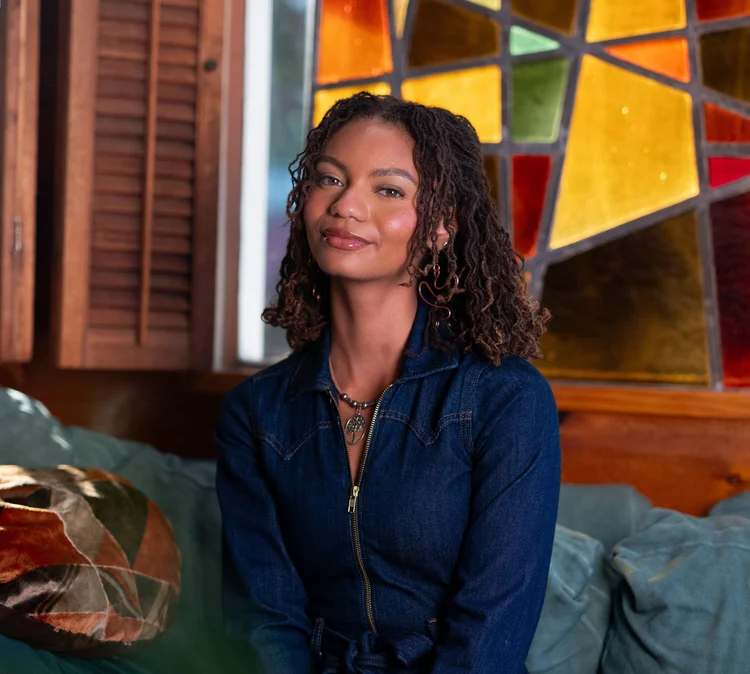
Leah is an environmental author, advocate, and content creator in Los Angeles who works, in her own phrase, at the intersections of climate and culture. She is also a self-described introvert who shares her home with two cats named Cosmo and Sunny, and who treats joy, rest, and play as part of the work. Once you have met her, the parachutes make sense. She is building the room she wishes the whole movement could stand inside.
A mud swing, a tennis coach, and a mother who paid for the hard books
Leah grew up in St. Louis, Missouri, right in the middle of the country. She was the kind of child who caught toads and kept them, dug holes in the backyard with shovels taken from the garage, and once turned the family swing set into a mud swing out of some weird and glorious idea that arrived and would not leave. Her parents said, do whatever you want. She is grateful for that line to this day.
Her father is a tennis coach, a creative with a head full of business ideas, some wonderful and some less so, the kind of man who will always pick up the phone and give her a pep talk. Her mother is a therapist who works in a school district. Most of her family are educators. They were also activists, though Leah did not know that was unusual.
“I didn’t know that it wasn’t normal to have activist parents. Like, they took me to protests when I was like two years old.”
Once, her mother offered her twenty-five dollars to read a radical book about race in America and write a report on it. Once, her sister passed a petition around elementary school asking for more recess time and got in trouble for it, and their father came to the school to say his daughters had the right to protest. A strong sense of justice settled into Leah early, so woven through everything that she did not recognise it as activism. It simply felt, as she puts it, like something in her body she could not ignore.
The town that became a hashtag
At nineteen, studying environmental science, Leah watched her own corner of Missouri break open. The police shooting of Michael Brown happened in Ferguson, about ten minutes from her house. People called to ask if she had known him. She had not, but he was so close.
“I naively at the time thought as a child that we were almost moving towards this post-racial society and most people were on the right side of history. And then to just see that illusion kind of shatter.”
She went off to begin her degree while her hometown filled with protests and arrests and journalists being detained. And something in her advocacy began to feel incomplete. If she cared about clean air and clean water, she could not care about them only in the abstract. The communities carrying the heaviest environmental burdens, Black and Brown, Indigenous, rural, urban, were the ones her work had to reach, or it was not finished.
The shaping went on. A summer as a park ranger took her to Nicodemus, Kansas, one of the least visited parks in the whole system, a town built after slavery by freed African Americans who followed the stars out of the South and raised homes, farms, churches, and schools from the soil. A hidden story, she calls it, and one that gave her empowerment. There is a chapter she has said she will write about fully in her next book, one she carries with care: her sister lost a friend to domestic violence, and Leah has known that weight herself. Part of why she keeps returning to the link between harm to the earth and harm to women is the number of people who have answered her with their own stories, so casually, so many of them carrying the same weight in silence.
What she has built, and what she is building
Today Leah works across climate and culture in several directions at once. She is writing a book called Earth as Mother, due out next year, an exploration of ecofeminism rooted in a single conviction: a better future has to be one that treats women and the planet well, because the two are bound together. She hosts Earth Sessions, the parachute concerts that put R&B artists, rappers, scientists, and gardeners in the same joyful room. And while she is deep in the heavier research, she keeps herself tethered to something light. She runs a local crafting club where people gather to learn mending and sewing, ordinary sustainable skills, hands busy, lives a little greener.
She makes environmental justice something a person can see themselves inside: creative, communal, emotionally alive.
How we treat the earth, how we treat each other
Leah returns again and again to one mirror. The ways we treat the planet reflect the ways we treat women. She noticed it in the research: domestic violence rises after natural disasters and climate catastrophe, isolating women further in the hardest moments. Stress goes up, fear goes up, and the harm lands where it always lands.
Katherine named her own version of the same pattern: the planet degraded, the economy fracturing, people turning on each other, and now AI accelerating the noise until the anxiety is more than human beings were built to carry. The exploitation of each other and the exploitation of the earth come from the same root, the same survival-based, fear-based ground. The two of them could hear it in each other’s language.
And then Leah said where she goes to put it down. She is an anxious person, she said, and when she steps into the sun, into nature, it grounds her. It is the closest thing she has to church. Katherine shivered from head to toe as she handed it back: nature is the ultimate healer, the ultimate church, the place where we remember we are nature, one with it.
This is the thread the whole conversation hangs from. The mud swing of a St. Louis childhood and the spiritual ground she stands on now are the same ground. The toads she protected as a girl and the women she protects in her work are the same instinct. Nothing in her is separate from nature, because she never was.
What her life is asking us to see
Leah Thomas will tell you she does not know exactly where the work is going. She just knows it is what she is supposed to be doing right now, and she is trusting that. Her dream is to teach, to become a professor, to live in a little forest and pop out occasionally with a book. For the foreseeable future, as she puts it with a grin, she will keep yapping about women and nature.
What she keeps showing us is that joy is not stolen time. After one global conference, she took a room full of climate activists her own age to an underground club in Scotland and got them into a conga line. She wanted them to carry their wholeness into the work, that play and fun belong there too, sustaining it rather than competing with it. Katherine said she wanted to be in that conga line too.
There is a particular grace in a person who honours exactly where she is. So many of us do not. We rush past the present toward the version of the life we have decided counts. Leah holds her dream loosely and her today with both hands, writing the book, running the crafting club, stringing up the parachutes so the rest of us can stand under them and picture the softer world long enough to start believing in it.
This is the kind of leadership our moment requires.
It is the kind of leadership Sincerely was built to honour.
A few hours with Leah
Sit with this one when you have an afternoon and a window with some light in it. It runs about an hour, and it moves the way a good long walk moves, from toads and mud swings to Earth Sessions and ecofeminism, with two cats wandering through and purring on the microphone. It is warm, and it is honest, and it leaves you gentler than it found you.
There is no hurry. The library is always here.
Three things Leah said that changed the room
“I feel the ways in which we treat the earth really mirrors the ways in which we treat women. So that’s also something I’m very passionate about.”
“I want you guys to know that you don’t have to give your youth away to this movement and that you can be a whole human being and part of you can be an activist but you still deserve to have play and fun and all those sorts of things.”
“It feels so grounding and I feel like it’s the closest thing that I have to church right now because I haven’t gone in a very long time. So it’s a very spiritual connection I would say.”
About Leah Thomas
Leah Thomas is an environmental author, advocate, activist, and content creator based in Los Angeles, working at what she calls the intersections of climate and culture. She is the author of The Intersectional Environmentalist (2022) and founder of the platform of the same name, and her next book, Earth as Mother, an exploration of ecofeminism, is forthcoming. She hosts Earth Sessions, a series of whimsical climate concerts rooted in radical imagination, and runs a local crafting club teaching sustainable skills like mending and sewing. Raised in St. Louis, Missouri, by activist, educator parents, she makes environmental justice creative, communal, and accessible. She helps people see themselves within the work and within the natural world they belong to.
Find Leah: Leah Thomas Website
Please stay.
Don’t just visit. This home is yours too.
There is a room here for you. It has always been here, waiting.
Once a week, you’ll receive a letter. Reflections from me. Sincerely recommendations. Small stories worth sitting with. Quiet offerings for the path, written for people who want to live a more gentle, bright, and honest life.
You’ll be the first to know when new conversations arrive on The Sincerely Show. When gatherings are announced. When the doors of Maison Millefleurs open for retreats.
The door is never locked. We’ve been preparing your room for a while now.
This conversation is for reflection and perspective only and should not be relied on as therapy or professional advice. Please seek qualified support where needed before making any decisions based on the information you learn through this conversation. This content is also subject to our full Terms and Conditions, which you can review on our website at sincerelyinc.com.