There are large photographs of Ruby and Hart on the walls of the living room. Three by two feet each. Their faces filling the frames, smiling. Colin put them there in the weeks after the crash because something about seeing them helped. It was the only thing that helped.
One morning, early in the grieving, he came downstairs and looked away.
He didn’t plan to. His eyes simply slid past the photographs the way eyes sometimes do when what they’re about to see carries too much weight. And then he stopped on the bottom stair. He stood there and he thought about what he’d just done. He had looked away from his own children because he was afraid of the pain of looking at them.
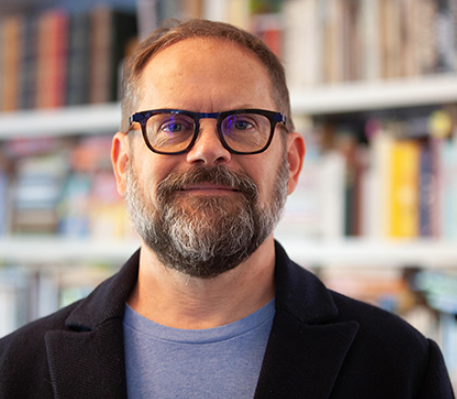
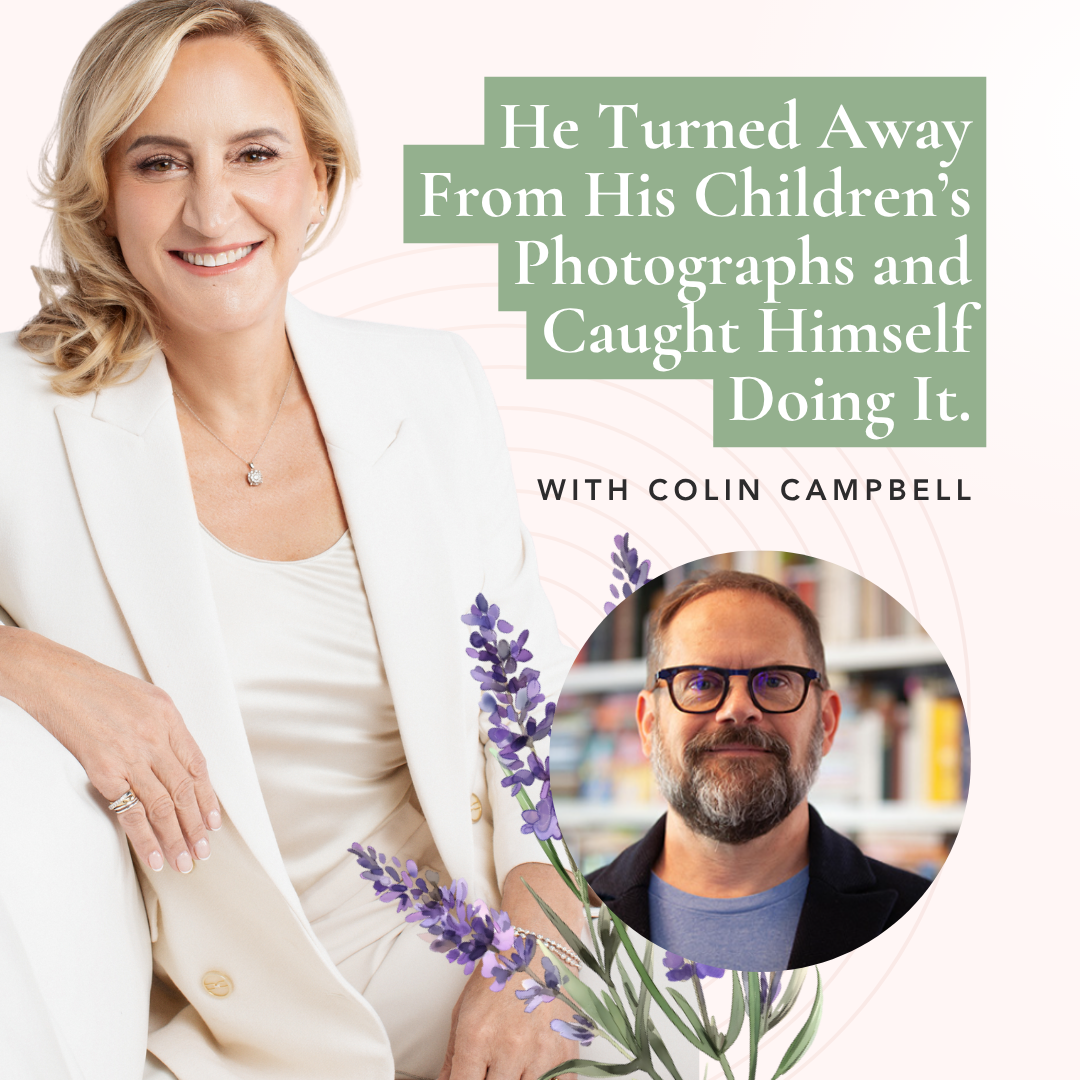
Colin Campbell told me this story sitting still, in the particular way people become still when they’re telling you the thing that most changed them. He said: the only reason to look away is fear. And how can he let fear of pain get in the way of loving Ruby and Hart. He won’t do that. He won’t do it.
That moment, small as it sounds, is the whole architecture of the man. Every choice he has made since, every book and every performance and every adoption and every advocacy hearing, runs through that question asked and answered on a staircase. Face the thing you most want to turn away from. The photographs. The grief groups. The woman in the prison. The new children who might break your heart all over again. Face it all. The pain is the form the love takes.
Who he was before
Before the crash, Colin Campbell was a filmmaker. A theater artist. A teacher. A husband.
He and his wife Gail Lerner met at Columbia University, both MFA students in the theater directing programme, class of 1996. They married shortly after graduation and built a life in Los Angeles shaped by art. Together they co-created Seraglio, a short film that won the Grand Prix at the Deauville American Film Festival, aired on HBO, and earned an Academy Award nomination. His stage work, Golden Prospects, was nominated for five LA Weekly Theater Awards and received critics’ pick notices in both Time Out New York and The Los Angeles Times. He taught at Chapman, Loyola Marymount, and Cal Poly Pomona, and ran workshops through The Unusual Suspects, a programme for incarcerated youth. He was, by every account including his own, someone who had found the particular satisfaction of a life oriented toward meaning.
He was also, by his own description, a man who had grown up with no cultural tools for grief. He was raised an atheist WASP, his phrase, in a family where loss was not discussed. Where the protocol around pain was something closer to silence and getting on with things. He had no framework. He had never needed one.
His children were Ruby and Hart. Ruby was 17. Hart was 14.
Ruby was an artist, deeply gifted, a proud lesbian who her father describes as a warrior for social justice. Hart was the clown at the centre of every room he walked into, magnetic, so funny and so beloved that when Colin and Gail would arrive to collect him from a sleepover, his friends would literally pile on top of him to hide him from them.
Hart’s not here. He left already.
They both had crowds around them. They were both, as Colin says simply, larger than life.
The four of them went to Joshua Tree regularly. They would pull up by the side of the road and scramble out into the rocks until they were half-lost, laughing, trying to find their way back to the car. They had just made an offer on a small two-bedroom house in the desert, their own place, with amazing views and the possibility of a pool, Ruby’s idea. They had been accepted. Colin had started making the calls.
He went back to the desert one Wednesday evening in June 2019, all four of them, to meet with someone about whether a pool was possible and where it might go. Ruby had insisted on coming; she was the one who’d thought of the pool. She had to be there to say where it should go.
A drunk and drugged driver travelling at 90 miles an hour T-boned the car as they turned into a petrol station. Ruby and Hart were in the back seat. They were killed. Colin and Gail were knocked unconscious. When they came to, the children were not moving.
The driver never touched the brakes.
What the first days were
I asked Colin what the days looked like after that, and he paused for a moment in the way that people do when they are trying to give an honest answer to a question that has no honest answer.
He said the denial was complete. His brain was worrying away at it, trying to fix the situation. He was searching through Ruby’s computer files for anything he hadn’t seen yet: stories, drawings, scraps of writing. Searching for her. He said he would go through two or three hours without weeping and begin to feel physically ill, almost nauseous, as if the grief needed to move through his body at regular intervals and holding it back was its own kind of sickness. He was scared to weep fully, afraid that if he started he would never stop, afraid his mind would shatter with the enormity of it. It took him two days to understand that was not true.
He and Gail were both certain the other was grieving better. She thought he was weeping more. He thought she was. They were both wrong, both judging themselves against a standard that did not exist. He found that moment, strangely, clarifying.
He had no framework of his own, and so he trusted himself to Jewish ritual. Gail is Jewish; Ruby and Hart were raised Jewish. He was not, but the structure was there and he needed structure. Shiva arrived, which for those unfamiliar is the Jewish tradition of sitting with the bereaved for the seven nights after a funeral. Friends came to the house. At first it seemed impossible, counterintuitive, that strangers and acquaintances should be in the house two days after the children had been killed. Then something shifted. He found he needed to talk about Ruby and Hart. He needed to tell people what was happening inside him because the inside of him was so strange and so overwhelming that he could not process it without speech.
That realisation, in those first raw days, became the whole foundation of what he would eventually build.
“There are no words” is the phrase our culture most often offers to the grieving. Colin’s work, across every form it has taken, is a sustained argument that this is wrong. Not unhelpful. Wrong. Grievers have all the words. They are overflowing with them. What they need is someone willing to receive the words, and the permission to speak them.
The morning on the stairs
Six months in, the photographs were still on the wall. They have never come down.
He told me about the morning on the stairs with the particular clarity of someone who has thought about that moment many times, who understands it as the decision that preceded all other decisions. He had looked away. He had caught himself looking away. And he asked himself: how can I let fear of pain get in the way of me loving Ruby and Hart? He won’t do that. He won’t do it.
What he means by this is not a single act of courage. He means the ongoing, repeating choice to face rather than turn away. The same question comes up in different forms, constantly, in grief: will he go back to the restaurant they loved? Will he look at the videos? Will he walk the same hike? Will he go into their rooms? Each time, the answer requires the same small act of will. Each time, he chooses to face it.
He told me that a woman in his grief group, about four or five months after the crash, said she missed the early days when she wept every day. At the time he thought she was mad. He told her so, gently. And then, six years on, he got there. He knows what she meant now. The daily weeping was the form his love took in those months, the way it expressed itself, and its absence is its own kind of loss. Grief changes shape but it does not leave. He holds both the relief of that and the particular sadness of it.
For anyone reading this who has wondered whether the intensity of early grief means something is wrong with you: it does not. And for anyone who has wondered whether the lessening of it means you have stopped loving the person you lost: it does not mean that either. Colin has sat with enough bereaved people to say this with certainty.
The woman in the prison
For five years, Colin did not think about the woman who killed his children. He made a deliberate decision not to. She had ended their lives but she was a stranger, and strangers do not deserve the space inside you that belongs to the people you love. He was not going to give her that. He compartmentalised her into a box labelled
nameless monster
and closed the lid.
He drove the car the night of the crash. He made a left turn in front of a distant vehicle that appeared safe to pass. The woman was going 90 miles an hour, forty above the speed limit, and never once touched the brakes. He could not have known. And yet he makes left turns now, every time, and thinks about that turn. The guilt lives in his body.
The woman’s name is Rebecca Packer. She was charged with two counts of second-degree murder. She pled to a lesser charge and was sentenced to fourteen years and nine months. She was, Colin says, a repeat offender; the National Highway Traffic Safety Administration estimates that by the time a person is first pulled over for drunk driving, they have driven drunk an average of eighty times without being caught.
About five years after the crash, Colin’s dentist recommended a book: The Many Lives of Mama Love, about a woman imprisoned for fraud, struggling with addiction, who found her way to sobriety and eventually ghost-wrote Bishop Desmond Tutu’s The Book of Forgiving. He read Tutu’s book. And in it he found a passage that stopped him. Tutu writes about the way grieving people sometimes deny the humaneness of the person who harmed them, turning them into a monster, a nameless thing, to make the pain of it more bearable.
Colin read this and understood immediately what he had been doing. He had been compartmentalising Rebecca Packer the same way he had vowed not to compartmentalise the pain of losing Ruby and Hart. And the reason was the same reason. Fear.
He is preparing to meet with her. There is a victim-offender dialogue programme, part of restorative justice practice, run by trained facilitators. She will be brought from prison. They will sit together and have a conversation. He does not know exactly what he will find there, or what it will give him. He says only that it feels connected to his unfinished work with guilt, that there is something about the encounter that is, mysteriously, helpful to him already, just in the preparing for it.
What Ruby said
Ruby said it a year before she was killed, at sixteen years old, in the particular offhand way teenagers sometimes say the things that turn out to matter most.
We should foster-adopt some kids.
She said it to Gail and Colin one afternoon. They were surprised; it is not the most obvious thought for a sixteen-year-old from a comfortable Los Angeles family to have. Ruby explained:
We have so much love in our family. And there are so many kids out there who need a family.
Colin said gently that they already had a family, that they were full up, that the thought was beautiful but they had their hands full. Ruby dropped it.
When Ruby and Hart were killed, Colin and Gail had that conversation again. What they both felt, in the wreckage of those first months, was that they had this enormous amount of love and nowhere for it to go. Ruby and Hart were gone. The love was still there. Gail and I had just this gush of love that had nowhere to go, he said. And then he remembered what Ruby had said.
Three months after the crash, Colin and Gail signed up for a foster-adoption training class. They showed up, red-faced, to an intake interview. The facilitator asked how long it had been since their loss. They looked at each other. Nine months too early, they were gently told. Come back in a year.
They waited. One year on, they began meeting children. A thirteen-year-old girl connected with them, chose them, came to live in their home. They felt, both of them, that their hearts were working again, that something had opened. Then it was revealed that she had decided she did not want to be adopted. She had started to care for them and the vulnerability had frightened her; in her history, opening your heart had led to betrayal, and she would not risk it. She left. She chose to age out of the system instead.
Colin said: by then, we had lost three children.
They waited another two months. They began again. This time they were shown a brief blurb and a photograph of two siblings: a boy and a girl. They were given no opportunity to meet them first. In California, as Colin explains it, a prospective adoptive family must decide before meeting the children, sight unseen, because these children cannot stand more rejection. The adults are the ones who can absorb the risk. He and Gail said yes without meeting them.
Andrew and Gladys were adopted on June 17th. They have been in the family for three years now. They are teenagers, both carrying the particular, complicated damage of having been failed by every adult before Colin and Gail. They act out. They struggle. Colin and Gail take their daily walk with the dog and talk through what is working and what isn’t, and remind each other to be kind to themselves. Colin says: we are parenting. That’s what we’re in.
There is a lot in that statement if you sit with it. He and Gail have buried two children and then chosen, twice, to open their hearts to children who might leave or might hurt them or might find the love too frightening to stay inside. They know what loss feels like. They are doing it anyway.
Ruby thought of it first.
The work
Finding the Words: Working Through Profound Loss with Hope and Purpose was published by Penguin Random House in 2023. It has been praised by Sheryl Sandberg, Congressman Jamie Raskin, and Rabbi Sharon Brous. It is a practical book, which is what makes it unusual in the grief genre. Colin’s contribution to the literature of loss is not a theory of stages or a spiritual framework. It is a set of tools for keeping your community close while you grieve.
He and Gail developed what they call a “grief spiel”: an explicit description, given to the people around them, of what they needed. Talk to us about Ruby and Hart. Say their names. Ask how we’re doing. Offer specific help rather than a general “let me know if you need anything.” He had noticed early on that Shiva created a container for people to show up, but that once Shiva ended, those same people became frightened of mentioning Ruby and Hart in case it reminded Colin and Gail of their loss. As if, he says drily, they had forgotten. The book teaches the bereaved to ask for what they need, and teaches everyone else what asking for it looks like.
He also wrote and performed Grief: A One Man ShitShow, a solo theatrical piece that premiered at the 2022 Hollywood Fringe Festival where it won a Best of Broadwater Award, and subsequently ran for a month at Theatre Row in New York City. The title is deliberate. He wanted something that conveyed the messy, ugly, unglamorous reality of grief as most people actually live it: the comparisons of whose loss is worse, the rage at the universe, the dark comedy of continuing to eat and sleep and shower while your world has ended. NPR and The New York Times reviewed it. Colin performed vulnerability publicly as a gift to the people sitting in those seats who had never found a room where grief was allowed to be exactly what it is.
He joined the National Board of Directors for Mothers Against Drunk Driving in 2025. The work there is specific: the HALT Act, a bipartisan piece of legislation already passed by Congress, mandates the installation of anti-drunk-driving technology in all new vehicles. The technology would prevent a car from being driven by an impaired driver. The Act is law. It is waiting to be implemented. Colin is fighting for implementation alongside other families who have lost people to impaired drivers, the 10,000 families a year in America who know exactly what he knows.
He writes for The Atlantic and The Los Angeles Times. He speaks at conferences. He keynoted The Compassionate Friends National Conference, which is the largest bereaved parent organisation in America.
He still teaches. He still makes films.
What grief is for
There is a question that hangs over lives like Colin’s: how do you hold the horror of what happened alongside the life that has been built from it?
He is clear that he does not want to be better for having lost his children. He finds the idea, as he says plainly, repulsive. Ruby and Hart were not the price of his evolution. They were his children.
And yet the man sitting across from me had spent six years walking toward the things that frightened him, loving two new children, fighting a legislative battle in the names of 10,000 families a year, performing grief in theaters so that strangers might feel less alone in theirs. He had followed Viktor Frankl’s central insight from Man’s Search for Meaning: that what allows people to survive unimaginable suffering is the search for meaning and purpose, and that the most reliable place to find it is in service to others. Frankl observed this in concentration camps. Colin confirmed it in the years after a crash on a desert road.
He told me that the most important things he could say to anyone navigating loss are two: don’t be afraid of the pain, and choose love.
Don’t be afraid of the pain. He knows the fear of it. He knows the terror that if you let yourself fully weep you will never stop, that you will go mad with it, that the grief will swallow you whole. It does not swallow you whole. The pain is the correct response to losing someone you love. It is the measure of how much you loved them.
Choose love. He said it the way people say things when they mean them without decoration. He means: when the question of whether to open your heart again arrives, and it does arrive, choose to open it. Choose to go back to the restaurant. Choose to look at the photographs. Choose, sight unseen, to say yes to two teenagers who need a family. It is always worth it. He has not found an exception.
Katherine offered a third, at the end of their conversation: choose service. Colin accepted it without hesitation. He finds, he said, real value in being of service to other people. It actually helps me. The help is not incidental. It is the medicine.
What his life is asking us to see
There is a particular kind of courage that our culture rarely honours because it is not dramatic. It does not arrive with fanfare. Colin Campbell’s courage is the kind that happens at the bottom of a staircase, in the moment before his eyes slide past a photograph. It is the courage of the repeated, ordinary, daily choice to face what is hardest to face.
He has faced it every morning for six years. He will face it every morning for the rest of his life. Ruby and Hart are not a story he survived. They are present in his life as ongoing companions: in the house in Joshua Tree they almost bought together, in the love that Ruby named and Gail and Colin are now attempting to give to Andrew and Gladys, in the annual beach memorial where 120 people spell Ruby and Hart’s names in rocks on the sand, shout their names into the open air, and wade into the Pacific together.
I know something of what it is to go looking through old photographs you have been avoiding, and to sit with them for hours, and to emerge from that sitting changed. I did not go through what Colin has been through. His specific grief is his own and I would never claim otherwise. But there is something he offers that is for all of us, something in the architecture of his choices that speaks past the particular horror of his circumstance and addresses something broader about what it means to be a person.
The thing we most want to protect ourselves from is the thing most likely to be worth going toward. The pain that feels as if it will break us is often the pain that, if we stay inside it without flinching, becomes the ground we stand on. This is not a silver lining. It is not consolation. It is just what Colin’s life has shown to be true, slowly, over years, in the company of other people willing to say their loss aloud.
He did not arrive anywhere. He is still in the middle of it. Andrew is still doing his homework under protest. The facilitators are still preparing the meeting with Rebecca Packer. Gail and Colin still take their walk each day and talk through what is hard. The grief for Ruby and Hart is still there, changed in shape but not in weight. He will always be the father of four.
What he has found, in the middle of all of it, is that the middle is where the living happens. The turning toward rather than away. The finding of the words.
This is the kind of leadership our moment requires.
It is the kind of leadership Sincerely was built to honour.
A few hours with Colin
The conversation between Colin and me runs close to two hours. It is quiet, mostly. Colin is not a man who performs his story; he lives inside it while he tells it, and the difference is visible. There is a moment toward the end where he shares a story about Hart and his hairdresser, a story about a fourteen-year-old boy who was simply and completely at ease with someone his father found more complicated, and it is one of the most beautiful things I have heard on this show.
Watch it. Or listen. There is no hurry. The library is always here.
Three things Colin said I am still sitting with
“I was scared that I would lose my mind. That if I started to weep, I would never stop. If two hours went by and I hadn’t wept, I was starting to feel ill. It was almost nauseous. I had to just feel their loss and weep.”
“I missed the weeping. I missed just weeping for Ruby and Hart every day. Now it’s so complicated, because I don’t every day, and that’s hard in a different way.”
“Don’t be afraid of pain. And choose love. If the question comes up, choose love.”
About Colin Campbell
Colin Campbell is an author, filmmaker, theater artist, and grief educator based in Los Angeles and Joshua Tree, California. His memoir Finding the Words: Working Through Profound Loss with Hope and Purpose (Penguin Random House, 2023) has become a resource for grieving people worldwide. He is the writer and performer of Grief: A One Man ShitShow, which ran at Theatre Row in New York City and earned rave reviews from NPR and The New York Times. As an Academy Award-nominated filmmaker, he co-created Seraglio with his wife Gail Lerner. He serves on the National Board of Directors for Mothers Against Drunk Driving. His writing has appeared in The Atlantic and The Los Angeles Times.
Find Colin: colincampbellauthor.com · Instagram · LinkedIn · Facebook · Finding the Words on Penguin Random House
Please stay.
Don’t just visit. This home is yours too.
There is a room here for you. It has always been here, waiting.
Once a week, you’ll receive a letter. Reflections from me. Sincerely recommendations. Small stories worth sitting with. Quiet offerings for the path, written for people who want to live a more gentle, bright, and honest life.
You’ll be the first to know when new conversations arrive on The Sincerely Show. When gatherings are announced. When the doors of Maison Millefleurs open for retreats.
The door is never locked. We’ve been preparing your room for a while now.
This conversation is for reflection and perspective only and should not be relied on as therapy or professional advice. Please seek qualified support where needed before making any decisions based on the information you learn through this conversation. This content is also subject to our full Terms and Conditions, which you can review on our website.