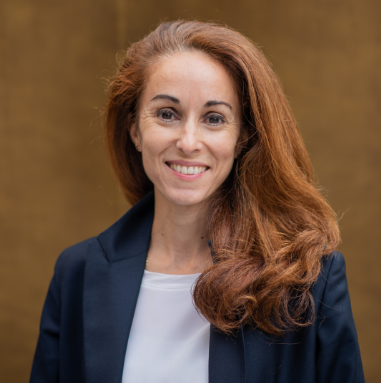
A 40-year-old woman walks into a church in Montreal.
She does not believe in the religion. She is not there for the religion. She has just left France. She has sold her company. She has enrolled her four-year-old son in a Montreal school. She has decided, for the first time in her adult life, not to be useful. She walks her son to school in the morning, takes the metro back, walks through the parks, watches the birds, drinks her coffee on a bench, and then, slowly, finds her way inside the church because it is quiet. She sits for thirty minutes. Forty minutes. Sometimes an hour. She tries to listen to her own heart.
She does not know, yet, that she is meditating.
She only knows that it feels good. This is so good, she says to herself, sitting in the cold of an unfamiliar church in an unfamiliar city. No constraints. No phone calls. No emails. Just me with myself, and I’m listening to me, and it is good.
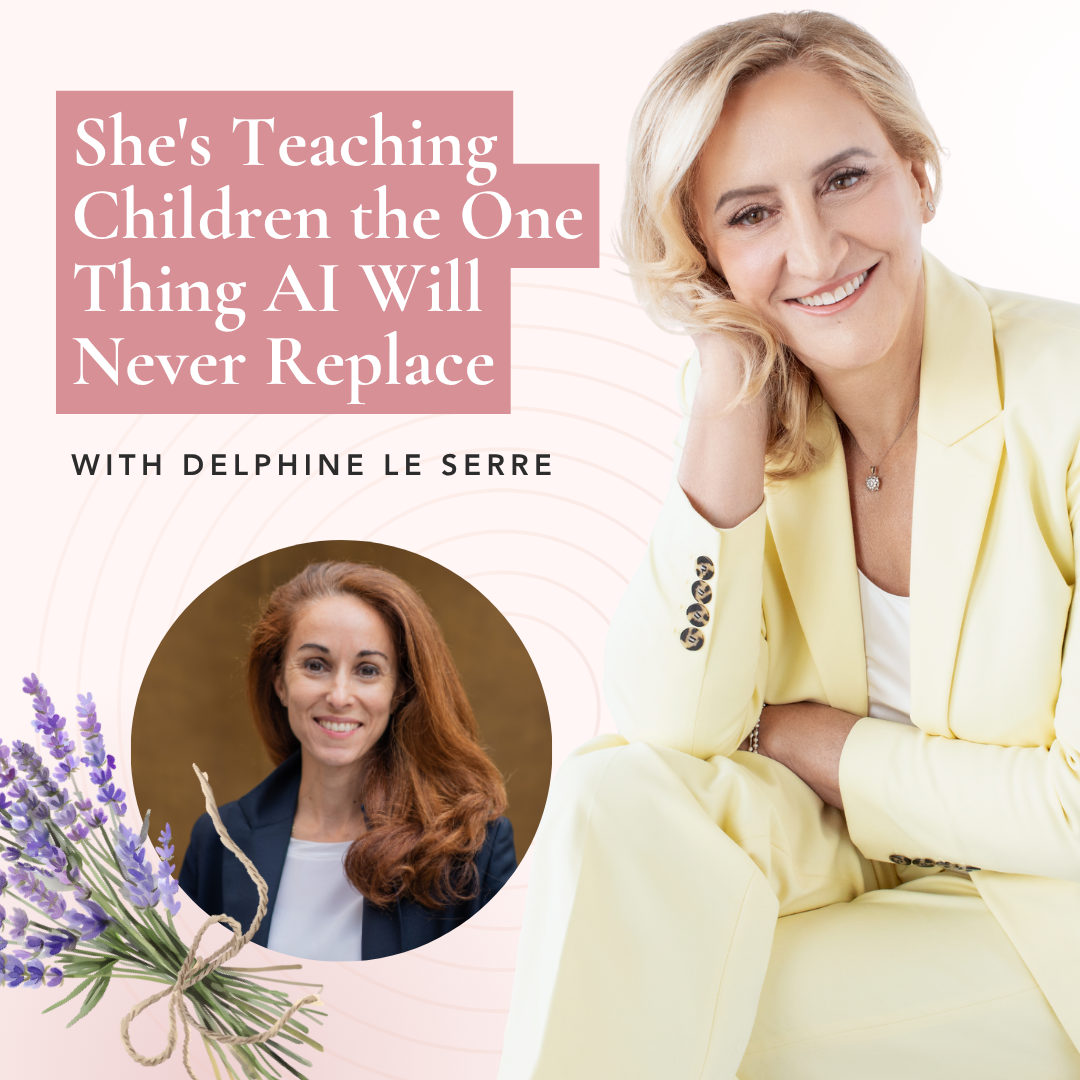
This is the moment Dr Delphine Le Serre walks into the rest of her life.
She does not know, yet, that the framework being born inside that silence will be adopted by schools across North America and welcomed at the tables of ministries of education redesigning curriculum for an AI-shaped century. She does not know that the woman she is becoming, slowly, in a building she does not believe in, is the woman who will write the book that explains what a child actually needs in the world artificial intelligence is making. None of that is in the room yet. In the room there is a heartbeat she has never properly heard, and a quiet that is finally large enough to contain her.
This is a portrait of who she is, what those months gave her, and what her life is quietly trying to teach the rest of us about education, about leadership, and about what it costs to wake up. The full conversation is at the top of the page if you want to spend an evening with her. The piece that follows is for those of you who want to understand her first.
The warrior on paper
There is a French word for what Delphine was, in the years before that church. Malheureux. It does not translate cleanly. Unhappy gets close and misses entirely. Malheureux is the precise word for a life that looks like a success from the outside and feels incomplete from the inside. Happy in the wrong way. Whole in the wrong shape. Built but not lived.
She had built a great deal.
She is a physicist by training. An engineer in microelectronics and nanotechnology at Grenoble. A PhD in behavioural science earned at night while she ran teams of seventy people in industry. Fifteen years as a university professor and academic researcher at HEC Montréal, INSEEC and across European business schools. The founder of two companies, the first launched while she was still teaching, both later sold. In 2018 Forbes named her among the Top 20 Women Transforming EdTech in Europe. She has the kind of CV that explains itself. She has, by her own description, never cried in a professional context. She calls the woman she was for the first forty years Delphine the warrior.
And on paper, she says, her life was a complete success. Really.
Underneath the paper, she was malheureux.
The formation that produced this woman is worth slowing on, because the most important pieces of it are the pieces no recruiter would ever notice. Delphine grew up in Brittany, near the ocean. Her mother worked in the public library. There was a younger sister and an older brother and a middle child who learned early to be calm, to listen, to read. She was eight when she taught herself the rotation of the Earth, reading Copernicus and Kepler and Galileo at her mother’s library and building her own presentation on the heliocentric model. There was no audience for it. She built it because she wanted to understand. At the same time, she was reading Greek mythology. The wars between the Titans and Zeus. The goddess Athena. The Oracle in a city called Delphi, from which her own name was drawn, and whose meaning she would not understand for decades.
And then there was her uncle. Not a blood uncle. A philosophy teacher who taught her tennis on the side. From the age of nine onward, he picked her up from her parents’ house and drove her to the tennis court. In the car, he asked her things. By the time she was ten, the questions had become these.
Do you think reality exists?
What do you think the truth is?
Do you think there is only one truth?
Most ten-year-olds are not asked these questions. Most ten-year-olds would not know what to do with them if they were. Delphine remembers them as gifts. A mother who answered every question. An uncle who asked impossible ones. A library that contained more than she could finish. A Greek goddess whose name she had inherited. The combination produced the kind of mind that would later sit at the intersection of quantum physics and human consciousness without finding the combination strange at all.
Then the formation became forty years of doing. Physics. Engineering. The PhD. The professorships. The companies built and sold. The digital transformation work inside European higher education. The Forbes recognition. A warrior at the apex of her field.And the warrior was malheureux.
Three acts of courage
Before Montreal, there were three thresholds, and each one required her to disappoint someone she loved to stay true to herself.
The first was a relationship. A wonderful man. The kindest man on earth, in her own words. She was engaged to him. The life being assembled around the engagement looked, again, like a complete success on paper. Inside her, something was quietly saying no. The voice was not loud. It was not dramatic. It simply did not stop. She listened. She ended the engagement.
It was, she says, the first time in her life she had disappointed people by choosing herself. She had been raised, like most of us, to satisfy others. Disappointing them was the unthinkable thing. She did the unthinkable, and survived it.
The second was her career. She left engineering. She was successful. She came from a family in which no one had been to university; she was the first one with a well-paid job. Are you having a nervous breakdown? people asked her, because nothing about her decision was rational in the language anyone around her spoke. She enrolled in the PhD anyway. She gave her first university lecture, walked off the stage, and said to herself the sentence that has stayed with her for thirty years.
I could do that for free.
That was how she knew. She would have done it for nothing. The work was a calling, and the calling had announced itself in the form of a simple, almost embarrassing sentence about money she did not need.
The third was love. She fell in love with a woman. She came out. Her family did not understand. She talks about this, in the conversation, with the gentleness of someone who has lived inside the difficulty long enough to be tender about it. Coming out, she says, is the act of courage in which the very people who are supposed to love you unconditionally may be the ones who reject you. There is no safe house to return to, the way a child of colour can return to a home that understands them, the way a Jewish child can return to a family that shares the heritage. The gay child often comes out alone.
She came out anyway. She thought, at that point, that her transformation was done.
She was wrong.
The church that arrived
She sold her company in 2018. She moved her family to Canada in 2019, six months before the world locked down. She landed in Toronto, decided the energy was not what she needed, and three days into Montreal said this is the place. She enrolled her son. And then she did the thing she had spent four decades being unable to do.
She did nothing.
No projects. No company. No clients. No deck. No keynote. No salary depending on her performance. She did not even take a car. She walked. She walked to the school in the morning. She took the metro back. She walked through the parks. She drank coffee on benches and listened to people laughing and sometimes crying. She walked under rain and snow. She did this for weeks, then months. And then she started stopping at the church.
It does not matter that the building is a church. Delphine says it clearly. She was raised Christian, she is past the dogma, the theology is no longer her language. What the church offers her, in this season of her life, is the thing the rest of her life has been failing to offer: quiet. A place where her phone does not ring. A place where nobody needs anything from her. She sits inside it for thirty, forty, sometimes sixty minutes, and she tries to listen to her own heartbeat.
“I didn’t know at the beginning that I was starting to meditate.”
The sentence is worth sitting with, because it is the sentence on which her entire next decade turns. A woman who has been running so fast for forty years that she has never properly heard her own heart. A woman with no spiritual vocabulary for what is happening. A woman who walks into a quiet building because she needs quiet, and discovers, slowly, that what she finds inside is the part of herself she has been too busy to meet.
Later in the conversation Katherine names it for her. The place acted as a Sincerely blanket, holding you as you went through the storm. Delphine nods. Yes, she says. Yes. Definitely.
The storm was real. She does not romanticise the 18 months. She calls them heavy. She calls them dark. She had what she calls a dream team: a therapist who specialised in emotions and family configurations, an osteopath because she believed in epigenetics and what the body carries from the people who came before us, and an energy practitioner because the quantum physicist in her had never stopped believing that there are dimensions of reality our instruments have not yet learned to measure.
It took 18 months. It was a nightmare in places. It was the most important thing she had ever done.
Most women who go through a passage like this come out with a more peaceful life, perhaps a different relationship, perhaps a meditation practice. Delphine came out with a pedagogy. The physicist in her had been there the whole time, watching, taking notes, mapping the territory. By the time the silence began to break, she had a structure for what she had learned.
The structure became MOON.
What she built
It is worth slowing down on what MOON is, because what Delphine has built deserves to be understood and not skimmed.
MOON is a pedagogical framework that organises a child’s development across four relationships.
Me with myself. The inner pillar. Knowing who you are. Identifying your emotions, accepting them, learning to deal with them. Naming the talents you came in with, because honouring them is how you find your way to the work that feels like teaching for free. Loving the person you find inside.
Me with others. The relational pillar. The capacity to see another human being for who they are. To hold difference without violence. To stay in connection through disagreement.
Me with nature. The reconnection with the natural world. The understanding that human beings have, until very recently in our history, known how to communicate with vegetation, with animals, with the larger field of life. Jane Goodall, Delphine notes, said before she died that she had twice asked the rain to stop and the rain had stopped.
Me with intelligent machines. The newest pillar, and the one that gives the whole framework its urgency. The cognitive and ethical relationship with the AI systems that will be the largest fact of the lives our children are walking into. AI literacy. Critical thinking. Discernment. The capacity to use these tools without being used by them.
Four pillars. One curriculum. A complete map of what it means to be a whole human being in the century that is arriving.
Katherine names something inside the conversation that I want to put a marker on, because it is the sentence the framework itself is built around. The first pillar carries most of the weight. Maybe seventy percent of it. You cannot raise a child to know and love others if you have not raised them to know and love themselves. You cannot teach a child to connect with nature if they cannot connect with the nature inside their own body. You cannot teach a child to use intelligent machines well if you have not taught them what an intelligent human being actually is.
The other three pillars rest on the first one. The first one is the one Delphine had to learn last.
She founded EdHu2050 in 2022 to carry the framework into the world. It is a Montreal-based foundation and equity fund building, eventually, one hundred schools designed around this question: who is the human being on the other side of this curriculum, and what kind of life is the curriculum preparing them for. The first school is in Ottawa. Fifteen to twenty more are joining the network across the next two years. Her book, The Future of Human Intelligence, is out in French and arrives in English in March. There is a MOON virtual assistant in development for families, students, and entrepreneurs. There is a certification for schools that want to formally adopt the framework.
And, in a detail Delphine almost throws away in conversation, the schools came to her. She did not seek them. The work calls its people. The work does not have to chase them.
What the parents already know
There is one finding in this conversation that organises everything else.
Two parents came to Katherine in the months before this episode was recorded. Loving parents. Successful in corporate Canada. They sat in her office and told her, almost in shame, that they thought they were making a mistake. They had raised their children to be heart-centred, gentle, attuned, kind. The children were being bullied at school. The parents were wondering, out loud, whether they should have made them tougher. More aggressive. More armoured. Better equipped to compete for jobs in the world they were going to enter.
Katherine asked them. Do you really think that’s the answer?
They cried. Both of them. We’re afraid, they said. We know that what is in our child’s best interest, long term, is that they love themselves and find peace within and develop a love for nature and for others. We know. But we are afraid.
This is the conversation parents are quietly having with themselves all over the world right now. They know what their children actually need. They are afraid the world will punish their children for needing it.
What Delphine has built, in the calmest and most rigorous voice imaginable, is the answer to that fear.
She names the four crises that frame the lives our children are walking into. Social fracture. Economic fragility. Planetary breakdown. Information collapse, with AI as the gasoline on that fourth fire. Each one impossible to solve from the same operating system that produced it.
What children need is the capacity to build a different system than the one they are inheriting. To know who they are and love what they find. To hold space for others who are different from them. To feel into the natural world as if they belong to it, because they do. To develop a discerning, ethical, alive relationship with the intelligent machines that are now part of the family. Competing harder inside a broken system will not get a child to a life worth living. Building a better system might.
Delphine has built a curriculum for the world that is coming, the one her physicist’s eye saw arriving years before most of us were ready to look at it.
“You don’t need to know exactly what the jobs of the future look like. All you need to do is be guided by your heart and what you know to be true.”
That is Katherine speaking to Delphine, near the end of the conversation. It is also, in a way, Katherine speaking to every parent and every teacher who has been holding the question and not finding an answer that did not make them complicit in something they did not want to perpetuate.
There is an answer. It is being built. It is already in a school in Ottawa, and in fifteen to twenty more across the year ahead, and in a foundation in Montreal run by a woman who learned what whole human beings need by becoming one herself.
What her life is asking us to see
The agreement of The Sincerely Show is a simple one. The guest is witnessed. They sit, they are seen, they tell the truth about the path they have walked, and the meaning is made together with the listener.
But because Delphine has lived the way she has lived, the witness becomes a teaching anyway. Her life teaches, even when she does not.
What her life teaches is this.
You can spend forty years building a life that looks complete on paper and discover, in your forties, that you are malheureux. Happy in the wrong way. Successful in the wrong shape. Built but not lived. That word is the beginning of the conversation with yourself that you have been too busy to have. It is also, if you let it be, an invitation into the years that come next.
The voice inside you is real. It will ask you to disappoint people you love to be honest with yourself. It will ask you more than once. Each time you listen, the next time gets clearer. The third or fourth time, you may find yourself in a foreign city with no plan, walking to a church you do not believe in, sitting down inside it for an hour, and discovering that the quiet has been waiting for you the whole time.
The work you are uniquely here to do is being prepared inside everything that has happened to you, including the parts that felt like prisons. I am very grateful for all the prisons, all these opportunities that have been prisons, that life has placed on my path, Delphine says. Because I understand now that they were here to prepare me for what I was supposed to do. You will not see the shape of it at twenty-five. You will see it at forty, or fifty, or sixty, looking back across the puzzle pieces and finally noticing the picture. The picture was there the whole time. You needed to live long enough to see it.
And the most important thing you can give a child is the capacity to know who they are, to love what they find, to recognise the inner life of others, to feel into the natural world they belong to, and to live with discernment alongside the intelligent machines that will be the air they breathe. The world we are leaving behind cannot teach them this. The world that is coming will demand it. The skills for that century are being designed right now by a woman in Montreal who spent forty years not knowing what her own heart sounded like, and who became the person who could design them on the day she finally sat down and listened.
This is the kind of leadership our moment requires.
It is the kind of leadership Sincerely was built to honour.
A note on the conversation
The full conversation with Delphine is at the top of this page. Almost ninety minutes, unhurried, the way we do the show. We move through her childhood in Brittany, the philosophy lessons in her uncle’s car, the years inside engineering, the move to Montreal, the church, the dream team, the founding of EdHu2050, the architecture of MOON, the first school in Ottawa, and the conversation we keep having with parents who are afraid the world will punish their children for being kind.
You will hear her say things, in her own voice and her own quietness, that no portrait can fully carry. The way she pauses before she answers. The way she returns to the body without making a point of it. The way she speaks about quantum physics and the Oracle of Delphi in the same breath, without finding the combination strange, because for her it is not.
Take the conversation slowly. When you have time. With a cup of something warm. There is no hurry. The library is always here.
Three things Delphine said I am still sitting with
“I didn’t know at the beginning that I was starting to meditate.”
“We can live an entire life without knowing our talents. And most of the time it’s sad. And we know it.”
“On paper, my life was a complete success. Really.”
About Dr Delphine Le Serre
Dr Delphine Le Serre is the founder and president of EdHu2050, a Montreal-based foundation and equity fund dedicated to financing the creation of one hundred schools of tomorrow built around a different way of thinking about human potential. She is the creator of the MOON pedagogy, now being adopted by schools across North America and beyond. A physicist and engineer by training, with a PhD in behavioural science, she spent fifteen years as a professor and researcher at HEC Montréal, INSEEC, and other leading institutions in Europe. She holds a Professional Certificate in AI, IoT, Blockchain, and Cloud from MIT Professional Education, and was ranked by Forbes among the Top 20 Women Transforming EdTech in Europe in 2018.
Her first book, The Future of Human Intelligence, was published in French and arrives in English in March.
Find Delphine: delphineleserre.com · EdHu2050 · LinkedIn · Instagram
Please stay.
Don’t just visit. This home is yours too.
There is a room here for you. It has always been here, waiting.
Once a week, you’ll receive a letter. Reflections from me. Sincerely recommendations. Small stories worth sitting with. Quiet offerings for the path, written for people who want to live a more gentle, bright, and honest life.
You’ll be the first to know when new conversations arrive on The Sincerely Show. When gatherings are announced. When the doors of Maison Millefleurs open for retreats.
The door is never locked. We’ve been preparing your room for a while now.
This conversation is for reflection and perspective only and should not be relied on as therapy or professional advice. Please seek qualified support where needed before making any decisions based on the information you learn through this conversation. This content is also subject to our full Terms and Conditions at sincerelyinc.com, which you can review on our website.