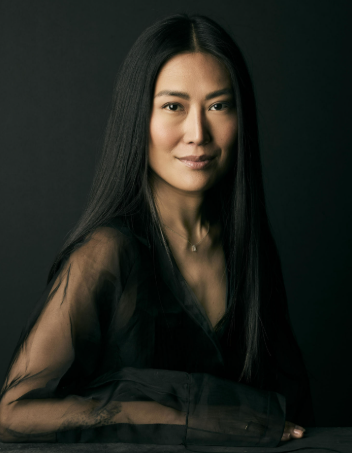
She was in her apartment in Vancouver. It was 2021. Her wedding had just been featured in Vogue, a celebration months in the making, and the publication date had landed on the same day as the Atlanta spa shootings, when six Asian women were killed and the continent was still absorbing what that meant.
She had her tweet deck open. She was watching the responses arrive in real time.
The messages were in the thousands. What they said, I will not repeat here in full. The gist: she was a mail-order bride. She was a servant. She had been collected. The words aimed at her body, her race, her marriage, her presence in public life alongside a prominent white man were the kind of words that, as she told me, even now she will not say aloud on a podcast.
She collapsed to the floor of her apartment. She wept for hours. And then something shifted, the way things shift when you have been broken to the point where there is nothing left to protect.
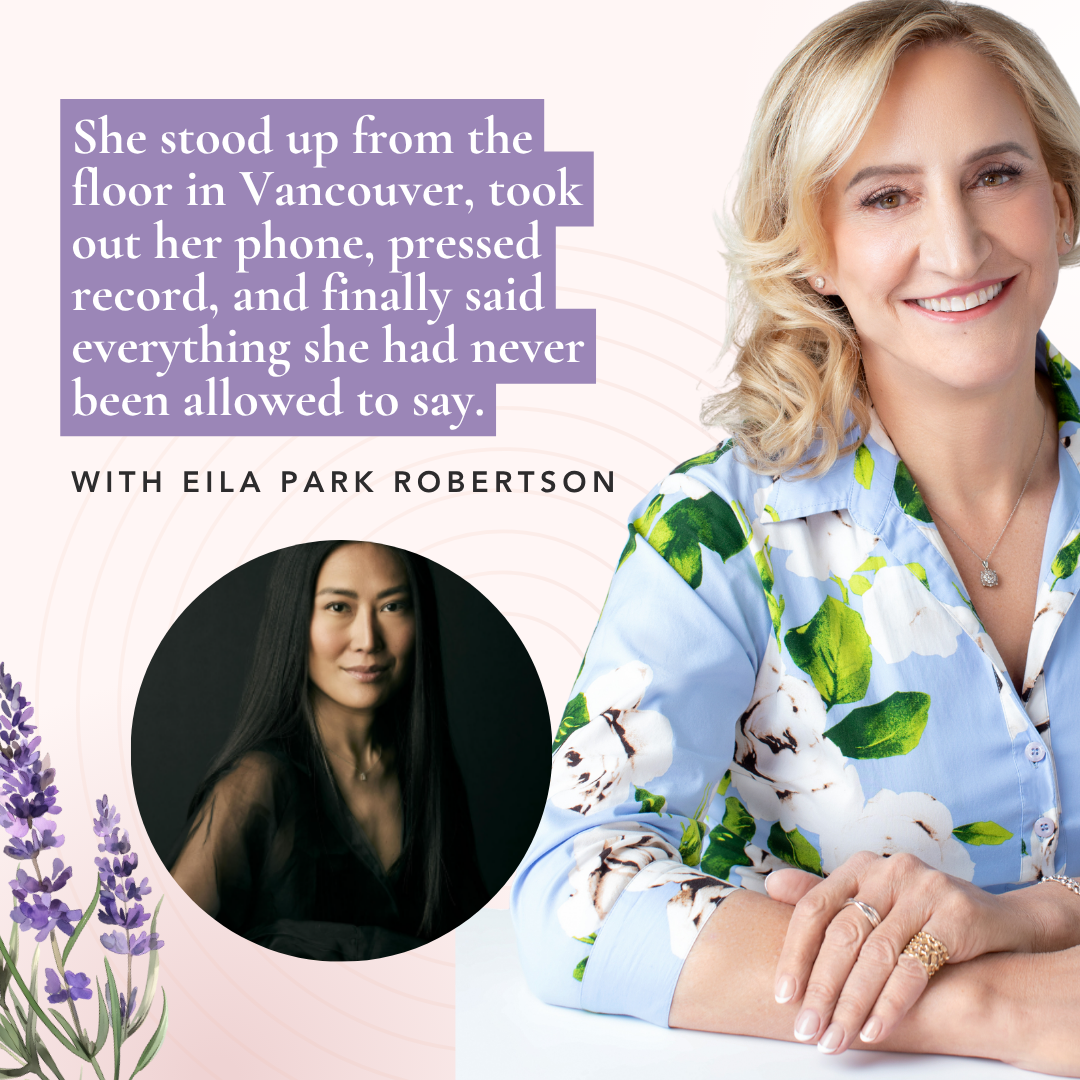
She stood up. She took her phone out. She put it on a tripod. She pressed record. And for seven minutes, Eila Park Robertson spoke.
The formation
She was born in Queens and raised in New Jersey, the daughter and granddaughter of Korean immigrants who had arrived in North America with barely enough language to get by and a vision for a life they could not build in South Korea at the time. Her parents started a business. They built something in a country that did not always make room for them.
“One does not do that,” she said, “unless you are really exceptional and extraordinary. You have a vision.” The ethos was baked into her, she told me, over and over through childhood. That ethos was survival married to belief. It was not passive. It was not modest. It was the insistence, inherited rather than learned, that the world contained more than it was currently offering.
Her childhood was, in her own words, a life of real polarities. Eastern mindset in a Western world. She was in classrooms that were, as she put it, eighty percent white or higher, trying to explain to classmates why her food smelled the way it did while they held their noses. She navigated all of it. And somewhere in the navigating, she developed what she calls buoyancy: an ability to move through all sorts of spaces with ease that came from having always been between worlds.
Her father was brilliant and violent. He would take scissors or staplers and throw them at her mother in the office. She witnessed this as a small child. She watched it and she understood, even then, that her father was in a great deal of pain. That knowing did not make the violence less. It sat alongside the violence, strange and unresolvable, the way children often carry things that adults cannot.
What it produced in her, she told me, was a desire. A long, determined desire to become strong. Years of reading about women who were strong. Years of absorbing them. Years of wanting, with the kind of wanting that does not let you go, to be someone who could not be levelled by what she had seen. “I became someone who dreamed of becoming strong,” she said. “And years and years and years of dreaming that ultimately got me to a place where I finally have that strength. Because I desired it.”
I keep coming back to that word, desired. She did not say she worked for it, or earned it, or survived her way into it. She desired it. As though strength were something you could call toward yourself across the years of a childhood, quietly and with great seriousness, until it arrived.
The journalism years, and the turning
She spent more than a decade in broadcast journalism, working as a reporter, anchor, and foreign correspondent for ABC News, KOIN-TV in Portland, and WNCN in North Carolina. She covered the climate crisis on the west coast. She covered geopolitical tensions in East Asia. She won an RTDNA award. She worked across the United States, South Korea, and internationally, doing the work of making the world’s events legible to the people watching at home.
She also navigated, throughout those years, what it costs to be an Asian woman in newsrooms and on camera. The sexualisation. The questioning of competence based on appearance. The rooms that looked past her. None of this is abstract for Eila. She was there for it, professionally and personally, through more than a decade of it.
When Donald Trump began campaigning heavily in 2015, she was covering those campaigns. She described watching, in real time, the rapid shift the media was undergoing. It had been moving towards entertainment-style journalism for years, she said, but this was different: swift, accelerating, a turning point. She found herself becoming increasingly unable to report on both sides of what she was witnessing. “I started to get to a point,” she said, “where I realised this isn’t a matter of both sides anymore. This is a matter of truth and lies.”
She left journalism. In September 2018, she was appointed Director of Communications for the City of Portland, Oregon, in the Office of the Mayor. She walked into one of the most violent periods in the city’s history. Portland had held the record for the most consecutive nightly riots, over a hundred in a row. Federal agents. White supremacists in the streets. Antifa. A mayor’s office in disarray. She described the city as being in a state of complete crisis and chaos when she arrived.
Every day for two years, she walked into City Hall and walked out of it. She was followed. She was spat on. She was harassed by bloggers and YouTubers who held cameras four inches from her face and shouted every racial slur they knew, looking for a reaction. As a Korean woman who had also been on broadcast television, there was an extensive inventory of ways to try to dehumanise her, and they used all of them. There were also the daily press conferences, the national reporters descending on the city whenever an event broke, the sparring with colleagues she admired over news coverage she believed was reckless. Every day, she said, was warfare.
“Two years of that really breaks you down in every imaginable way.”
The breaking point, when it came, did not arrive in a dramatic form. She got a bicycle. Within an hour it was stolen, and an anarchist tweeted about it, offering to return the bike if she stopped working for a fascist. She worked for a Democratic mayor. The next day, they came to her home, unbolted the secured gate, took the new bicycle, and tweeted again: you are never going to be safe. The death threats had been ongoing. The deepfake pornographic images had been ongoing. This was one bike, one tweet, one small thing in a long inventory of things.
It was, somehow, the thing that broke her open.
She lay awake at two in the morning in the middle of all of it, the workload, the threats, the social humiliation, and she began to think that not waking up would be a gift. “For the first time in my life,” she told me, “it got me to a point where I was actively thinking about suicide.”
What she said next I have been sitting with since.
“That experience, for the first time thinking of ending my own life, was strangely where I was reborn.”
What the floor revealed
She met her husband, Gregor Robertson, during the Portland years. He is the former Mayor of Vancouver, one of the city’s longest-serving, who had built a global climate leadership profile after leaving office. She was manically depressed, she told me. Actively thinking about suicide. Being followed home by white supremacists and Antifa. And somehow, in the middle of all of that, Gregor saw her. “He could not see anything else,” she said. “He saw the purest light in me.” She was confounded by it. She could not see what he was seeing. She did not know what about her, in that state, could possibly be worth seeing. But he kept seeing it, and it took someone who showed her, for the first time, what unconditional love was, to bring her back.
“I wish it was a story of where I was able to rise up on my own and find myself and heal from it. But it was really my current husband who saved me.”
I have heard many versions of this story across the conversations I have had for this show: the moment another person’s seeing of us becomes the mirror we could not hold for ourselves. Katherine’s own coming through required someone who could hold her when she could not hold herself. What Eila is describing is the same human truth. We are not solitary creatures. We do not save ourselves alone. Sometimes the most courageous thing a person can do is allow someone to see them clearly, at the exact moment when they cannot see themselves at all.
They married in 2020, in an intimate ceremony at Stanley Park in Vancouver, beneath the largest maple tree in Canada. A marriage commissioner and two close friends as witnesses. The families couldn’t be there; it was the pandemic, and they had chosen to elope. They held the news privately for four months before their Vogue feature published in March 2021.
The day it published was the day of the Atlanta spa shootings.
She sat on her apartment floor, she wept, and then she stood up.
What emerged was seven minutes of radical honesty, recorded on her phone, posted to the world: what it costs to be an Asian woman in public life, how she had been sexualised for standing beside male colleagues, how her professional accomplishments had been erased in favour of the story people wanted to tell about her body and her marriage. She called out everyone who had been holding her accountable to their projections of what an Asian woman should be or do or belong to. She said: this is who I am. How dare you.
“That was the turning point. It was the moment I found my voice, and it was the moment the world heard my voice.”
She was asked to appear on national news for a month to discuss the hypersexualisation of Asian women and its history. There was, as she said, a hunger for it: Asian women were being beaten and killed on the streets, and suddenly the world was listening. That was when her voice was injected into that space. And she has not stopped since.
What she carries
Psychologists have studied what happens to the brain when a person is socially humiliated. The research Eila cites is striking and precise: when you are reading threatening and dehumanising messages, the part of your brain that activates is the same part that activates when you touch something hot. Your nervous system cannot differentiate between physical pain and social attack. The experience is the same. The body registers both as injury.
This matters for understanding what two years in Portland actually cost her, and what it cost the hundreds of elected officials and their teams whose mental health and wholeness Eila now cares deeply about. She has a vast love, she told me, for bringing awareness to the humanity of people in government service: the people holding cities, states, provinces, and countries together, who are seen from the outside as political agents or dehumanised figures, who absorb the weight of a community’s needs and fears every single day. “When that becomes so toxic,” she said, “it has a profound impact on your ability to be effective and whole and continue on.”
She told me about an early lesson from Portland: she came in with precision, ready to fix the immediate mess, and what she found was that her team needed something else first. They needed to grieve. You cannot fix an absolute mess at the same time as the people around you are still in the middle of the experience of it. The fixing and the healing have to happen together, and neither can happen without the other being acknowledged.
I have carried that observation since she said it. It reaches far beyond government communications. It reaches into every organisation that has been through something hard and moved too quickly past the human cost of it into the business of rebuilding.
The work
Anecdotia is Eila’s production agency, founded in August 2020, focused exclusively on climate, racial, and social justice storytelling. The name reflects her philosophy: anecdotes with weight, with meaning, with the power to shift what people know and feel and do. She works with national and subnational governments, international agencies, and nonprofits at global climate negotiations, using documentary film and strategic communications to amplify voices that have historically been marginalised from the rooms where decisions are made.
She serves on the Global Board of Directors for the International Fund for Animal Welfare, appointed in 2024. She is an ambassador for #Elimin8Hate, standing alongside other prominent Asian-Canadian voices in the work of racial equity and systemic change.
Her thesis, stated plainly in our conversation, is this: progressive and left-leaning institutions have largely failed to communicate with emotional resonance, while conservative movements have mastered it. “They have created a world of inclusivity,” she said, and she meant it analytically, not approvingly: a movement that said, are you a little racist? Come on in. Are you frustrated and afraid? You belong here. Progressive messaging, by contrast, had defaulted to cancellation, to purity tests, to the message that if you were imperfect you had no place. The result was predictable. People who were apolitical, confused, or simply wounded looked at those two options and chose the one that didn’t threaten to exclude them the moment they made a mistake.
Her mission now is bridge-building. “We have to call people in and stop calling people out.” She is direct about the difficulty of this: it requires progressives to do something genuinely hard, which is to hold space for people whose views they find painful, to resist the pull toward public shaming, to believe that shared humanity is still accessible across the divide. But she has seen it work. She has sat with conservative friends and MAGA friends and watched them pause when she told her story. “It is the only thing that works,” she said. “Our shared humanity is what needs to get messaged out.”
She calls the communications philosophy she has developed “emotional comms,” and the distinction she draws is precise. Traditional communications: press releases, internal communications, media strategy. Emotional communications: the storytelling arm, the layer that reaches billions because it speaks to what people feel before it speaks to what they think. “If you are able to really tap into that world,” she told me, “you have got an audience of millions waiting at your doorstep. Billions.”
The film “Lynda (RYN),” which she directed, screened at the 2021 Vancouver Asian Film Festival. It is one entry in a body of work she is building at the intersection of image, story, and systemic change.
The price of peace
There is a line Eila said in our conversation that I have returned to many times since.
“The price of peace is pain. There is no other way. There is no shortcut.”
She was talking about the process by which people become who they are fully meant to be: the breaking down that has to happen before the rebuilding, the forced softening of the shell, the alchemisation that occurs when you are finally stripped of the unnecessary. “There’s an alchemisation that happens in you when you’re being broken down, who you are, and as you’re rebuilding who you are, that fundamentally changes, and it gets stronger and stronger,” she said.
She is not romanticising suffering. She is making an empirical observation about what she has witnessed in herself and in the people she has been closest to: that the quietest, most grounded, most peaceful people she knows are often the ones who have been through the hardest things. That the correlation is direct. The price of peace is paid in pain, and there is no route around it.
For anyone reading this who is in the middle of something hard and cannot yet see the shape of what it is making of them, I know Eila would want me to say this: the experience is trying to crack you open to your truest self. And when you have the courage to go there, you will find yourself. You will find them. You will find the person you were always meant to be. And then the real becoming begins.
There is something particular about Eila’s story that I want to sit with carefully, because it is easy to read it as a story of individual resilience and miss what it is actually about. Her voice did not arrive because she became stronger in isolation. Her voice arrived because Gregor saw her when she could not see herself, because the weight of being witnessed by someone who loved her clearly gave her the ground to stand on. Her becoming was relational. Her speaking out was made possible by partnership.
Her husband, now a Canadian federal minister, stood beside her at rallies and in the aftermath of the Vogue piece. He used his platform to amplify her voice rather than speak over it. That choice, in a world where powerful people often flatten the people beside them, was itself a form of advocacy. What Eila and Gregor have built together models something specific: that equity is a practice between people, not just a political position. That allyship, when it is real, means stepping back.
What her life is asking us to see
Eila Park Robertson walked into our conversation on a winter morning from Ottawa, a city alive with a kind of patriotism she described as serious, warm, and unburdened by rigidity. Her husband had just been elected to federal parliament and appointed Minister of Housing and Infrastructure. She was building Anecdotia at the frontlines of global climate negotiations. She was doing, every day, the work she believes she is on earth to do.
She carries her parents and grandparents with her into all of it. She carries the Korean immigrants who survived what they survived and built what they built, who gave her not a formula but an ethos: you have a vision, and you hold it, and you do not let the world tell you it is wrong. She carries her father’s violence as the strange gift it became: the seed of a desire for strength so persistent and so clear that it finally became her.
She carries Portland. She carries the floor of the Vancouver apartment. She carries the tripod and the seven minutes and the decision to say everything she had never been allowed to say.
What she is asking all of us to consider is whether the stories we tell are wide enough to hold the full range of what people carry. Whether our institutions, our governments, our movements have learned yet to communicate from the heart rather than from the press release. Whether we are calling people in or pushing them away at the moment when they most need a place to land.
These are not gentle questions. Eila asks them without flinching and with great tenderness, which is the particular combination that only comes from someone who has learned, through the body, that peace has a price and the price is worth paying.
This is the kind of leadership our moment requires.
It is the kind of leadership Sincerely was built to honour.
A few hours with Eila
This conversation runs close to an hour and a quarter. Eila speaks in the way she has learned to speak: without a script, without performance, with the steady and sometimes surprising clarity of someone who has earned her words. She talks about Portland, about the floor in Vancouver, about her parents and her father’s violence, about the communications philosophy she is building and why she believes storytelling is the only mechanism that has ever genuinely moved people across the divide.
There is a moment toward the end, when she talks about what she would say to anyone in the middle of their own darkness, that I hope you will find for yourself.
There is no hurry. The library is always here.
Three things Eila said I am still sitting with
“The price of peace is pain. There is no other way. There is no shortcut.”
“The softest and the most peaceful people are the ones who have been through hell and back.”
“It is the only way, it is truly the only way people’s hearts and minds move. I have witnessed my conservative friends, I have witnessed my MAGA friends pause when I am in front of them telling my story or pleading with them: please see the humanity in this situation. And it works.”
About Eila Park Robertson
Eila Park Robertson (full name Eileen Park Robertson; Korean name: 박아린 / Park Arin) is an award-winning documentary filmmaker, former broadcast journalist, and founder of Anecdotia, a production agency working exclusively on climate, racial, and social justice storytelling. She spent more than a decade as a reporter and foreign correspondent for ABC News, KOIN-TV, and WNCN, and served as Director of Communications for the City of Portland, Oregon. Her film “Lynda (RYN)” screened at the 2021 Vancouver Asian Film Festival. She serves on the Global Board of Directors for the International Fund for Animal Welfare and is an ambassador for #Elimin8Hate. She lives in the Greater Vancouver area with her husband, Gregor Robertson.
Find Eila: anecdotia.com · linkedin.com/in/eileenparkrobertson · instagram.com/eila2.2
Please stay.
Don’t just visit. This home is yours too.
There is a room here for you. It has always been here, waiting.
Once a week, you’ll receive a letter. Reflections from me. Sincerely recommendations. Small stories worth sitting with. Quiet offerings for the path, written for people who want to live a more gentle, bright, and honest life.
You’ll be the first to know when new conversations arrive on The Sincerely Show. When gatherings are announced. When the doors of Maison Millefleurs open for retreats.
The door is never locked. We’ve been preparing your room for a while now.
This conversation is for reflection and perspective only and should not be relied on as therapy or professional advice. Please seek qualified support where needed before making any decisions based on the information you learn through this conversation. This content is also subject to our full Terms and Conditions, which you can review on our website.