
She is sitting in her apartment in New York City. The year is 2007. A man has spread crayons across her table. He is from Australia. His name is Peter. He runs something called Passion Mapping. He says: talk to me until I see energy. And then draw what you feel.
Joanna Barsh starts talking and, somewhere in the middle of it, the energy comes. She feels it. He sees it. He says: draw that.
She draws herself on a stage, shining, with rays of light coming out of her in all directions.
And then she takes another piece of paper and places it on top.
“It’s not right,” she tells him. “It’s not nice. I shouldn’t be on stage. I shouldn’t shine like this. That’s wrong. It’s embarrassing.”
She covers the drawing. She covers herself. And the man waits.
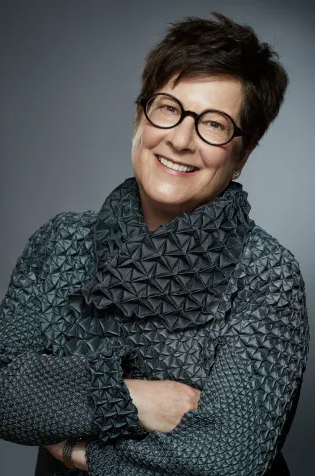
This is the story of Joanna Barsh. A story about a woman who spent three decades building one of the most rigorously human frameworks for leadership development in the world, who interviewed more than five hundred senior executives about what was alive in them and what they were afraid to let out, who facilitated the healing of other people’s light, who saw clearly that most of us are standing on our own bushel.
And who kept covering her own drawing for thirty years.
The woman who walked in wanting to be a father
Long before there was Centered Leadership, long before McKinsey or the workshops or the books or the 600 speeches, there was a small girl in the 1950s watching the front door.
Her father left through it in the morning and came back in the evening with money and authority and a life in the world. Her mother stayed inside, miserable. The girl decided, at age six, that she would grow up to be a father.
She said it simply, in our conversation, and I sat with it for a long time afterwards. She meant she would be in charge of herself. She would earn. She would not be contained. Financial independence was a word she used later, but the impulse was older: a child deciding that the life available to women was not the life she intended to live.
The other thing she wanted, from the very beginning, was to be a painter. Her mother was a painter. A beautiful woman, Joanna described her, full of life and full of talent. The mother arrived in Joanna’s life the way certain people do: in flashes of brilliance, light and music and dancing and art, and then gone again. Back to herself. Unavailable. And the small girl waited in the shadows.
She learned, during the waiting, to go quiet. To be still. To hold her breath and endure the absence until the light returned. She did not know, at six or at sixteen or even at fifty, that the waiting had shaped something in her as permanent as bone. She only knew she liked to draw. She liked to paint big, round, heavy women leaping through the air. And she had a creative force in her that was looking for a way out.
The way out, when it came, was serendipitous in the way that destiny sometimes disguises itself as accident.
She was told she was unqualified and would never get into Harvard Business School. So she applied and got in. She was told she was not a good candidate for McKinsey. So she applied and was the only one accepted. Her marketing professor described the firm to her class and Joanna thought: I should try that. A pattern was forming: tell me I cannot, and I will charge through a brick wall. “I’ve never felt not good enough,” she told me, and I believed her. What she felt, underneath the drive, was something more complicated. She felt she was missing something. She could not name it yet. She only knew she wanted to be a leader and was certain, in a way that coexisted entirely with her defiance, that she was not one.
She joined McKinsey. She would stay for more than thirty years.
The beginning of something she did not have a name for
In 2004, Joanna was a senior partner at one of the world’s most influential consulting firms. She had done well by most measures. She was travelling, speaking, working on the most difficult problems she could find. She was, by her own description, an extraordinary doer.
And she had a tremendous need she could not account for.
She had looked around at the women at the top of their fields, all over the world, and found herself wanting to sit with them. Wanting to understand what they carried. Not their strategies or their credentials, but the thing underneath. What had enabled them. What had cost them. What they were quietly carrying that nobody had thought to ask about.
She started interviewing women. She had no strategy. She did not know she was beginning something that would change the field. She just had the need. McKinsey tolerated it for a while, then the head of the firm said she could do twenty interviews. She interpreted that as twenty more. Then a young colleague said they had to write a book with this material, it was too good not to share, and there was a moratorium on books so they wrote a pamphlet, fifty-eight pages, and it was so good she took it to a client who happened to be a literary agent and he said: write me a book proposal.
And then she went back to the man who had said no books, and told him she had a book deal.
He said: that is so like you, Joanna.
She told me that for one second, she heard her father’s voice. And I understood then that she had been chasing something much older than a publishing deal.
What emerged from those interviews was Centered Leadership: a framework built on five capabilities, each one excavated from real conversations with real women at the heights of real careers. Meaning, framing, connecting, engaging, energising. Each one a different door into the self. Each one a question about what was actually alive in you, as opposed to what you were performing.
The centring image she kept using was the woman who had everything externally and was still suffering privately. The senior executive who had never told anyone what she was carrying. The leader who had been so fully shaped by the system around her that she could no longer locate the person she had been before the shaping began.
Joanna knew this person intimately. She had interviewed more than five hundred of them. She fell in love with every single one of them. She loved their flaws with the specific tenderness of someone who has been paying close attention.
The thing she was slower to see was how precisely she was describing herself.
The somatic exercise in 2011
She volunteered.
That is the part that stays with me. Of all the people in the room, Joanna stepped into the fishbowl. She agreed to let a facilitator move through her, in public, in front of her colleagues. An electrical engineer turned somatic guide. A Mobius workshop. The year is 2011, and Centered Leadership is already in the world.
The facilitator listened to her describe what she wanted: to bring Centered Leadership to everyone. He created a movement. She was supposed to mirror it. He was crushed to the floor. He battled something she could not see. Then he swam, or flew, and the movement opened outward.
She began. She was crushed to the floor.
And she could not get up.
Every time she tried, something pushed her back down. A force she described, years later in therapy, as dark and enveloping and genuinely frightening. The dementors from Harry Potter were her image for it: something that grabs the soul. She kept trying to rise and the thing kept pushing her down until the facilitator said: Joanna, get up. And she heard him. She battled it. She flew. She said so herself: not swimming, flying.
Everyone in the front row was weeping.
She had no idea, at the time, that she had just walked into something traumatic. She thought she was doing an exercise. She wrote it down, filed it, returned to the work. The dark force had receded. She was good at what she was doing. When you are good at what you are doing, the darkness can wait.
It waited thirty years.
What she found when she stopped
She retired from McKinsey at sixty. She wrote three books. She did the research on Black talent, then on Latina leaders, 160 interviews with some of the most fierce and determined and overlooked people she had ever met. She taught. She spoke. She travelled. She was busy in the specific way that people who have a dark force waiting for them are busy: productively, meaningfully, without rest.
And then the work slowed down enough that the thing came back.
At 72, she walked into therapy for the first time.
Her therapist told her she had done all these things and didn’t need anybody. Joanna said she still wanted her book published. She still needed that. The therapist said: let’s talk about why.
The question she had been asking herself, she told me, was: why aren’t I fixed? She had gone through the workshops. She had done the centred leadership programme over and over, as a facilitator and as a participant both. She had wept in rooms with women who were breaking open for the first time. She had loved every human being she had ever sat across from. She had given the gift, a thousand times over, of helping someone see what was already inside them.
And she was still, at the deepest level, waiting for someone to come back and say: you did a good job.
Her mother was a painter who left and came back and left again. Her father left when she was six and did not come back in the same way. The waiting she had learned in childhood had become the architecture of her emotional life: go still. Be patient. Do extraordinary work. Wait for the recognition that says you are allowed to exist fully now.
She said it plainly: “I am still a person who needs external validation.”
I find this one of the bravest things I have heard a 72-year-old woman say. Not because it is an unusual feeling; it is perhaps the most universal feeling in the world. But because Joanna Barsh said it after a career in which she helped thousands of people understand and accept exactly this about themselves, and after decades of applying a framework that specifically addresses the internal drivers of leadership, and after knowing, intellectually, that this fear of not being enough is a childhood wound that no amount of achievement can close.
She knew. And she was still inside it. And she chose to say so.
“People who don’t change fossilize,” she told me. She said it as a warning to herself.
The thing she was always teaching
Here is what Centered Leadership actually is.
It is a body of work that requires the body, not just the mind. Joanna was clear on this: the left brain is not really needed for this work. What is needed is the willingness to dig into your own life experience, the high points and the low points, the relationships and the ruptures, the moments where you came alive and the moments where you went quiet, and to look at those things clearly enough to understand what is actually driving you.
The framework has five doors. Meaning: what are your genuine strengths, not the ones you were told to have, the ones that actually light something in you. Framing: what are you afraid of, and how does that fear distort the way you see a difficult situation. Connecting: why do you not fully trust, and what would it take to build trust with the people around you. Engaging: what is your voice, and what is stopping you from using it. Energising: where does your energy come from, and what is costing it.
Each door leads somewhere different. The woman who emerges from a serious engagement with these five questions is someone different from the woman who walked in. Or rather, she is more herself. That is what Joanna found, over 500 interviews and years of facilitation: the people who most needed this work were not lacking something. They had chosen, out of fear, not to open certain doors. “I have chosen not to open doors because I am afraid,” she said. “I have not unlocked certain pieces of myself because I am afraid. And I’m going to go ahead with the help of the people around me and unlock those doors and love the flaws that will come out.”
The flaws. This is where Joanna’s thinking goes somewhere that most leadership frameworks do not follow. She does not ask people to fix themselves. She asks them to open. The act of trying to be perfect, she told me, means you keep locking more and more stuff away. A pebble that is trying to be a rock cannot move. A woman who is trying to be what the organisation needs her to be cannot grow. Only the person who accepts and inhabits her own shape, with all its apparent irregularities, can actually contribute what no one else has.
At McKinsey, early in her career, she was told in a review that she was too young, too bouncy, too short. She wore black. She wore higher heels. She stopped doing the bouncy, silly things she loved to do. A recruiter told her she was a pebble and that she needed to become a rock if she wanted to get far. She tried. Rocks don’t move. She couldn’t stay still.
“I have to be the pebble,” she said eventually. And she decided to be the best pebble she knew how to be.
What she is doing now
The EVE Programme runs in France, and in Mexico, and in Africa, and in Asia. Around 700 people a year pass through it in France alone, hosted by Danone and L’Oreal, drawing from companies across the European continent. Joanna teaches there. She teaches at Tecnológico de Monterrey in Mexico, a private university with campuses across the country, working with executive women and with the teachers who carry the work forward. The EVE Programme includes men now: Joanna long ago established, through research, that men have exactly the same capacity for this inner work as women. Gender is incidental. The question is simply whether you are willing to look.
She is looking for a co-author for a book about Latina women in leadership, built from 160 interviews with leaders across Latin America, Spanish-speaking US, and Spain: what she found, over and over, was women who were fierce and loyal and energetic and warm and systematically blocked at every turn. She has the research. She needs someone with the standing inside the community to carry it. She is not giving up on the book.
She is drawing a children’s book. By hand, with the same love for art that she had when she was drawing leaping women as a teenager. On one page, a set of rabbits are reading a romantic poem aloud, and the rattlesnakes nearby are weeping because the story is unjust and beautiful, and the trees are also weeping, and everyone has stopped being whatever they were to feel something together. She does not care whether it sells. She is making it because she needs to express what she is thinking and feeling. Because connecting, finally, is what she most wants to do. “Connect and express,” she said. “That’s all I want to do now.”
She is also in therapy.
At 72, for the first time in her life, she is in therapy.
The light they cannot see
There is a woman in every cohort Joanna has ever worked with who will not go to the retreat. Who will find a reason. Who will be in the building but not in the room. Who needs the work desperately and is afraid that doing the work in public means people will see her, and being seen is the thing she has spent her whole career managing.
Joanna knows this woman. She is this woman.
I think about this often: how many of us are facilitating, for others, the very journey we have not yet begun for ourselves. How many of the people who most eloquently describe the inner life are doing so from a safe theoretical distance. How many of us can describe the exact texture of another person’s fear and still find a reason to not go to the retreat.
Joanna did not go to the retreat. The other seven women colleagues bonded and laughed and came back changed. She stayed in her apartment, certain they had not noticed her absence. She is still working on what it means to accept that people want her in the room.
“I can’t wait,” she said at one point in our conversation, and for a moment I was not sure she was talking about her mother any more. “I’m fucking old. Why are we waiting? What the hell are we waiting for, Joanna?”
She was talking to herself. She has spent most of her life talking to herself in the background of her own extraordinary output. Now she is letting the conversation be heard.
This is what I most wanted to offer you from my time with Joanna: the idea that you do not have to be finished with your own journey to do great work. You do not have to have resolved the thing in yourself before you can help others find it. You can be the woman who built Centered Leadership while still, quietly, covering your own drawing. You can interview 500 people about what is alive in them and still be learning to tolerate your own aliveness.
What you cannot do, Joanna would say, is stop. The moment you stop growing is the moment you begin to fossilize. And Joanna Barsh has never stopped. Not at 30. Not at 60. Not at 72, on a therapist’s couch, learning at last that the recognition she was waiting for was always going to have to come from inside the room she was already in.
What her life is asking us to see
There is a kind of person who carries the work of healing in one hand and the work of their own becoming in the other, and who spends decades convinced that the second hand is somehow shameful. As though you forfeit your right to guide others through the interior if yours is still in progress. As though authority requires completion.
Joanna Barsh has never been complete. She has been in motion, in creative, determined, laughing, weeping motion, her whole life. And the motion has mattered. The five hundred interviews mattered. The framework mattered. The workshops where women say, for the first time aloud, I am not guilty because I love to work: those mattered.
None of it required her to have solved herself first.
She described the journey she is now on, the therapy, the sitting with darkness, the learning that a break in a relationship does not mean the relationship is over, with the same generosity she has brought to every person who has ever walked through one of her workshops. There was no performance in it. She was simply honest about being a person in progress, which is the most useful thing any of us can offer anyone.
At 72, she drew a picture she did not cover.
She would like to write more children’s books. She would like to finish the research on Latina talent. She would like to keep coming back to the work for as long as the work keeps teaching her something. She has a granddaughter who is nine months old and does not yet speak any language Joanna recognises, and Joanna talks to her nonstop anyway, because connection does not require shared vocabulary, only presence.
She got on the train decades ago and has been riding it ever since. She is not, I think, ready to get off. But she is learning, finally, to travel with her window open. To let people see her through it. To resist the habit of covering what she draws.
For anyone who has spent time helping others see what they carry while quietly hiding their own: this is the kind of permission Joanna’s life is offering.
You are allowed to shine.
The drawing does not need to be covered.
This is the kind of leadership our moment requires.
It is the kind of leadership Sincerely was built to honour.
A note on the conversation
This conversation runs for nearly an hour and a half, and there is not a single moment in it that wastes your time. Joanna is funny and raw and precise and unexpectedly willing to go to the exact place you would not expect a former McKinsey senior partner to go. She curses. She talks about her mother. She sits inside questions without rushing them toward answers. The conversation between her and Katherine is two people recognising themselves in each other: the same hunger for expression, the same early confusion of love and absence, the same long journey from achievement toward something quieter and realer.
Watch it when you have the evening for it. There is no hurry. The library is always here.
Three things Joanna said I am still sitting with
“I battled this thing and I knew it didn’t go away because it was still watching me. And then I walked and did my paces. I can’t… I’m not swimming, I’m flying.”
“I have chosen not to open doors because I am afraid. I have not unlocked certain pieces of myself because I am afraid. And I’m going to go ahead with the help of the people around me and unlock those doors and love the flaws that will come out.”
“People who don’t change fossilize. And so I had to discover this at 72. Joanna, you’re still vulnerable to the lack of external validation. Okay, let’s work on that.”
About Joanna Barsh
Joanna Barsh is the creator of Centered Leadership, a framework developed over a decade of research at McKinsey and Company, where she was a senior partner for more than thirty years. She is the author of three books including How Remarkable Women Lead and Centered Leadership: Leading with Purpose, Clarity, and Impact [TEAM NOTE: please verify these titles against Joanna’s actual bibliography before publishing]. She teaches at the EVE Leadership Programme, which runs across France, Mexico, Africa, and Asia, and at Tecnológico de Monterrey in Mexico. She is currently conducting research into Latina women in leadership, from interviews across Latin America, Spanish-speaking US, and Spain, seeking a Latina co-author for the resulting book. She lives in New York City, is a new grandmother, and is learning, at 72, what it means to finally stop covering the drawing.
Find Joanna: LinkedIn · Centered Leadership
Please stay.
Don’t just visit. This home is yours too.
There is a room here for you. It has always been here, waiting.
Once a week, you’ll receive a letter. Reflections from me. Sincerely recommendations. Small stories worth sitting with. Quiet offerings for the path, written for people who want to live a more gentle, bright, and honest life.
You’ll be the first to know when new conversations arrive on The Sincerely Show. When gatherings are announced. When the doors of Maison Millefleurs open for retreats.
The door is never locked. We’ve been preparing your room for a while now.
This conversation is for reflection and perspective only and should not be relied on as therapy or professional advice. Please seek qualified support where needed before making any decisions based on the information you learn through this conversation. This content is also subject to our full Terms and Conditions, which you can review on our website at sincerelyinc.com.