
She was somewhere between twelve and eighteen months old. It was the first of many such escapes, the climbing out and the exploring would carry on all through her childhood.
Her mother had gone out to the farm to tend to the animals. Her father was away at work. The house was quiet, and she was alone in her crib, and that was not going to hold her for long.
She climbed out. That was always how she was, even then, even before she had words for it: curious enough to go looking, determined enough not to stay put. She tore through the house. She looked in every drawer, opened every cupboard, picked up every object that didn’t make sense to her and tried to understand it. In her father’s drawer she found an old wind-up alarm clock and thought: this is boring. In her mother’s drawers, she found something else entirely. Silk slips. Beautiful camisoles. A jewellery box with clip earrings that fit over the ears of a toddler who had never once, in her short life, been told she shouldn’t want them.
She put them on. She went to the bathroom and found the lipstick. She put that on too.
And she felt free. She felt, in her word, alive.
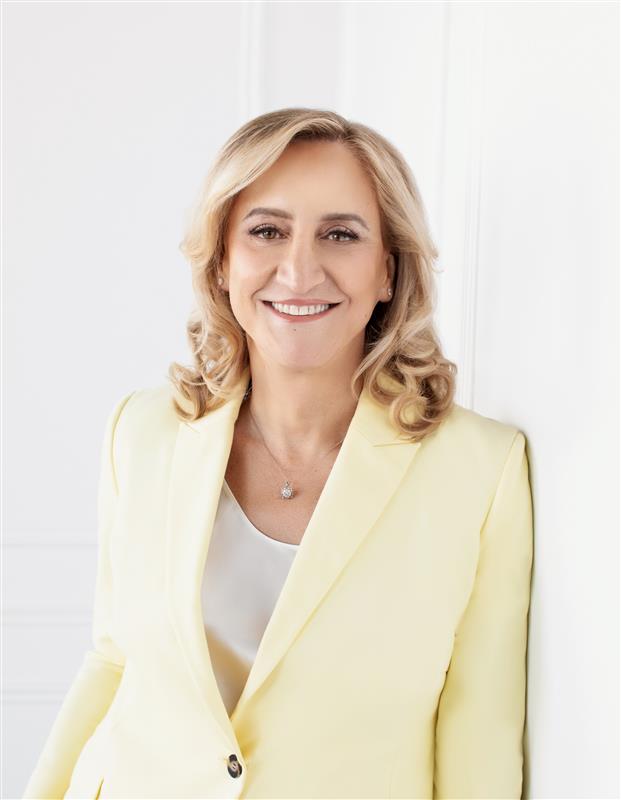
That child is Katherine Dudtschak. She is sixty years old now, and she is sitting in a room full of people who came to witness the birth of something: a book, a show, a platform, a movement. She has built all of it. She carries the farm and the lavender and the bees and the long dining table set for gathering. She carries the thirty-seven years inside one of the world’s largest financial institutions, the four children, the career that looked, from the outside, like exactly what a determined person could build.
And she will tell you, quietly and without any performance of drama, that the little girl with the clip earrings and the borrowed lipstick never left. She just had to wait a very long time to be let back in.
The formation
Katherine was born on March 9th, 1966, to parents who arrived in Canada carrying the weight of a world that had nearly destroyed them.
Her mother grew up in what is now Poland, born in 1935 in a region then called Prussia. She became a child refugee around age eight, spending time in a refugee camp where she was responsible for protecting her little sister. Her father was born in a small lumber village called Kummer in what was then Sudetenland, now the Czech Republic. At fifteen, when the war ended and Russia moved in, he and the other young boys were captured and spent the next three years across multiple Russian prison camps, living on bread and water, waking beside bodies, surviving things that have no name. Both his parents died during the war. When it ended, he crossed from East Germany to West Germany in darkness, skin and bones, with a bolt of cloth in his backpack that he traded for food and transport to go find his brother, who was only ten months his senior.
They came to Canada and built a life on a mink farm. They brought everything with them: the love and the terror, the warmth and the yelling and the deep, cellular anxiety about whether there would be money, whether there would be Christmas presents, whether the world would hold.
Katherine grew up in that atmosphere and learned to navigate it with the fluency that neurodivergent children develop when their survival depends on reading the room. She was hypersensitive and hyperaware, the kid who wanted to milk every teacher for knowledge and forgot there were twenty other children, the kid who ended up banished to the corner of a Grade Two classroom because being sent to the hall wasn’t working. She was dyslexic before anyone had a word for it. She was told, repeatedly, that she wasn’t applying herself. She decided, sometime in her early teens, that she was going to prove every last one of those people wrong.
She also knew, from the time she was very small, that there were things inside her that didn’t fit the world she was growing up in. The feminine tendencies, as she puts it. The way she was drawn to beauty: to her mother’s silk things, to elegance, to a great outfit glimpsed on the street that made something in her ache. This never went away. It was never an experiment. It was just there, and she learned, the way children learn everything, that some things are better buried. She went on to build a beautiful family, a demanding career, a life that looked, from the outside, complete.
“It worked,” she says. “Yet it wasn’t complete. It wasn’t complete.”
The life she built, and what it cost
Thirty-seven years inside one of Canada’s largest financial institutions. CEO. Award-winner. The kind of leader her colleagues called, privately, one of the strongest communicators they had ever encountered. Heart-centred, empathic, the executive who could spin twenty plates at once and did not consider this a metaphor.
She was also, for all of those years, performing.
Not performing badly. Not performing without love or skill or genuine care. But performing in the sense that the full Katherine, the one who had been in her mother’s jewellery box as a child, remained invisible. She had built guard rails. Anxieties. Belief systems. She had become, in her words, a guy’s guy: laughing at the right things, fitting into the world that was asking her to fit. She had developed a set of skills so refined that she could suppress whatever threatened to surface and simply get back to being busy.
“You can run,” she says, “but you can’t hide.”
Around age forty-five, the running got harder. She led a corporate restructuring that required her to let go of forty percent of a workforce in countries where those people might never find work again. The board applauded her. The CEO told her he had no idea she had it in her. She cried in private. She had gone into that career imagining that reaching the top would bring wisdom, enlightenment, some sense of having arrived at the thing she had been chasing. Instead it gave her a clear-eyed view of what the system actually was.
It wasn’t working. It was hurting people. And there was a growing ache in her, quiet at first, then louder and louder, that had nothing to do with strategy decks or quarterly targets.
She chose, for the first time, the job that she knew she could do intuitively. The one that would let her lead from her heart. It was around this same time that the four children were growing up, leaving home, and the suppressed feminine side of her began to be, as she puts it, “really, really loud.”
The lunch that undid fifty years
In 2017, she had lunch with a colleague.
She had recently read about Caitlyn Jenner and had genuinely not understood it. This detail matters: the walls she had built were that high. She asked her colleague to explain. He explained that gender is who you go to sleep as. Your inner self. That sexual orientation is who you go to sleep with. They are not the same thing.
“You could have pushed me over with a feather.”
Within hours her anxiety went through the roof. Within days, she was searching the internet differently than she had ever searched it before, looking for stories of people like her: people with a strong feminine side who had built a more masculine life to survive the world that was asking it of them, and who had found their way to the other side. Within a week, she told her spouse.
“I think I’m wired female on the inside.”
They cried together for weekend after weekend, night after night.
What followed was a year she describes as a next-to-impossible journey. Fear of rejection. Fear of abandonment. Friends from childhood who were deeply religious. A corporate world she was not sure was ready. And, underneath all of it, the absolute certainty of what she now knew about herself: a scab she had been scratching for fifty years and had finally, at fifty, named.
She wanted life to be over.
It was a dear friend, Lee Anne, who read her signals and sent her intergenerational trauma research on the children of parents who die by suicide. Katherine was stopped cold. Her plan, she saw, was flawed. She wrote a letter of intention: to embrace her whole self, to go on a journey toward it, whatever that cost.
She came out to her children. She came out to the CEO. She saw herself for the first time, in a mirror, in New York, in March of 2019.
And then, on June 17th, 2019, she came out to 80,000 people by video.
She told them the truth. She showed them her heart. She asked them, without saying so directly, for a second chance to prove that she could be as good a leader as she had been before, so she could keep her job and finish putting her children through school.
Within ten months, hundreds of emails. People writing about bravery and courage, words she says she hated. Not because she was modest. Because she knew how much it had cost.
“There’s nothing elegant about it at all. It’s literally death-defying.”
The collapse that began everything
The story could end there. Coming out as a public figure, at scale, with grace: that is one kind of remarkable ending.
But Katherine was not done collapsing. And she seems to know, now, that the collapses were never setbacks. They were the path.
In 2022, she was given a new opportunity within the company she had spent thirty-seven years serving. She sat with it and felt the weight of it settle in the wrong way. She broke down. She said no. She retired.
For two months, she cried daily in the park near her house. She grieved her work family, with their specific faces and their specific stories, stories people had trusted her with for twenty years: the woman from the Caribbean whose family had been stoned because she was gay, the man from India who had carried guilt his whole life for ostracising a friend who was later forced into an arranged marriage and died by suicide. She grieved her children growing up. She grieved her divorce, which she had not yet allowed herself to grieve. And she sat with an aloneness she traced all the way back to a crib on a farm: that oscillating pattern of deep love and sudden absence that her mother’s comings and goings had established in her before she had language.
Her coach, Theano, taught her to feel into her body and release pain that had been trapped there. She learned to meditate. She learned to sit with hurt and let it move through without trying to control it.
“In that darkness, you find yourself.”
She turned sixty last year. Her gender journey is nine years old. In that nine-year period, she says, she experienced two or three very heavy collapses, and then another, about nine months ago, inside a CEO role with record performance, when the weight of the quarterly board meetings and the same PowerPoint deck and the steady grind of completing things began to feel, again, like the wrong shape for a life.
She did not fight it this time.
“There’s a heaviness here. And I’m not going to fight this. I’m going to surrender to it.”
She surrendered toward Sincerely.
What she has built
Sincerely, Inc. is a platform, a podcast, a library of stories, a farm, and something harder to name than any of those things.
Katherine describes it as a blanket. A place where people can come and not be judged, where they can sit inside a warmth and hear other people’s stories told with the kind of honesty that makes you feel less alone. She traces the impulse all the way back to her reading, in the two years between learning who she was and coming out to the world: fifty to seventy books in that period, searching for people like her, searching for proof that it was possible to get to the other side and keep the family and the job and the life.
Story was what she needed. Story is what she is now offering.
The show itself is built around her singular gift. She has been described, by the person who introduced her on the night of Episode Zero, as someone who does not ask questions to extract information. She asks questions to set someone free. The distinction is not a small one. It is the whole difference between an interview and a witnessing.
The research arm of Sincerely, called Sincerely Human, is being built to validate the models Katherine has developed through her own journey and the framework she calls the Sincerely way. The Three Pillars: Sacred Structure, Sacred Flow, and Sacred Union. The Integration Journey: Shaped, Crossing, Becoming. The idea that from the beginning of time, humanity has transmitted knowledge, lesson, meaning, and hope through story, and that in a world drowning in information and disinformation, this ancient technology may be exactly what is needed.
The book, Sincerely, Katherine, published by Page Two, is the first story the platform has told. It contains a letter of intention she wrote to herself in 2017, when Lee Anne’s intergenerational trauma research stopped her cold, and it ends with the modus vivendi that has become her mantra: Slam your heart into the people and the places and the things that ignite something deep within your soul, and I promise, I promise: the right things will stay.
Maison Millefleurs is the physical anchor. The farmhouse and its fields, somewhere in Canada, are where Katherine has planted the lavender and the bees and the long table for gathering, and where, in time, retreats and salons will be held. She drove onto that land not knowing what she was looking for. She knew when she arrived.
And then there is the show itself: the library of extraordinary lives that is just beginning. Katherine has been, as she says, curious about the human condition since before she could name what curiosity was. She has spent her professional life in rooms where people came to her with the stories they carried in silence. She now has a place to put all of that attention and all of that care.
“I could interview people every day for the rest of my life on their stories.”
She will.
The thing about collapse
There is a pattern Katherine returns to throughout the night of Episode Zero, and it is worth sitting with.
She calls it collapse, crawling back, awakening, emergence. It goes in cycles. Most people, she says, experience it at least once; many of the people who have come into her orbit have experienced it multiple times. A period of darkness in which aspects of identity built to fit into the world begin to fall away. An aloneness. A meeting with yourself at the bottom. And then, always, a return: more whole than before, more accepting of the natural gifts and the natural essence, more able to build a life around the things that are actually true.
She does not romanticise this. She would not wish it on anyone. She is also clear that it cannot be rushed, that there is no light switch, that her own journey has been anywhere from nine to fifteen years long. What she offers is not a shortcut. It is company on the road.
“There’s hope,” she says, and she says it twice, and the second time it lands like something she has earned the right to mean.
The world we are living in is, she knows, a difficult one. She has named its four crises with the precision of someone who spent thirty-seven years inside the institutions that helped create them: social fracture, economic divide, planetary degradation, and the proliferation of disinformation and information accelerated by AI. She does not look away from any of this. She carries it, actively, as a weight and as a responsibility. She is also, somehow, at peace. The aloneness and the grief of 2022 did not produce bitterness. They produced a woman who says, without any performance of it, that she lives now with a level of love and joy and freedom and creativity that she could not have imagined.
That peace is not the absence of awareness. It is the consequence of having gone all the way through.
What her life is asking us to see
There is a version of this story that emphasises the courage. The coming out at scale. The choosing of oneself over the performance. The walking away.
Katherine is wary of that version. She hates the words brave and courageous, not because they are inaccurate but because they suggest that the particular thing she went through is exceptional, and she does not experience it that way. She experiences it as the human condition, lived with more visibility than most.
What strikes me about sitting with this conversation is something quieter than courage.
It is the through-line.
The child who climbed out of the crib again and again through her early childhood and put on her mother’s earrings and felt free: that was not a phase. It was not confusion. It was not something that needed to be overcome or grown out of. It was the self, accurately reported. Everything that followed, the farm and the dyslexia and the guard rails and the thirty-seven years and the collapses: all of it was, from some angle, the path back to that child. Not a path away from her. A path around and under and through the whole accumulated weight of a world that asks us to perform, back to the thing that was there before the performance started.
Katherine’s framework names this as coherence: living from your essential self, through your physical and inherited self, out into the world as an offering. She has a rigorous way of thinking about it. But underneath the framework is something very simple. The self that is most true in you is also the self that is most useful to the world. You were not built to suppress it. You were built to find your way back to it.
There is also something she said about story that I have not stopped thinking about. From the beginning of time, she said, humanity transmitted knowledge, lesson, meaning, inspiration, and hope through story. Long before Western civilisation, long before the institutions and the quarterly targets and the information overload: story. The indigenous cultures in Australia, with continuous threads stretching back 20,000 to 40,000 years, found a way to live in harmony with self, each other, and the land through story, through quiet, through observation. The sitting in circle, the passing of flame, the remembering through the telling.
Katherine is not offering a solution. She is offering a space. A blanket, held open, for stories told with enough honesty to help someone feel less alone. That is, she would say, enough. If it touches one person. If it helps one person find their way back to the child in the crib who knew exactly who they were.
“There is a wholeness within each person waiting to arise,” she says, “when the time is right for you.”
She has built Sincerely so that the time, for a few more people, might arrive a little sooner.
This is the kind of leadership our moment requires.
It is the kind of leadership Sincerely was built to honour.
A note on the conversation
The full conversation sits at the top of this page. It runs for just over an hour and was recorded live in front of a room of people gathered to witness the birth of something. Katherine was, for the first time, in the guest’s chair. She was interviewed by the woman who had built The Sincerely Show alongside her. It is unhurried, warm, and completely honest. There is no hurry. The library is always here.
Three things Katherine said I am still sitting with
“You can run, but you can’t hide. If there is something deep within you that is from your soul, you can run but you can’t hide. And if you don’t give it oxygen, it steals oxygen from you.”
“Slam your heart into the people and the places and the things that ignite something deep within your soul. And I promise, I promise: the right things will stay. You will never lose what is for you.”
“There is a wholeness within each person waiting to arise when the time is right for you. You’re on your journey. I hope these stories help.”
About Katherine Dudtschak
Katherine Dudtschak is the founder and host of Sincerely Inc. and The Sincerely Show, and the author of Sincerely, Katherine: Life, Gender, Inclusivity, and Leadership for the Future (Page Two, 2026). She spent thirty-seven years as a senior executive and CEO inside one of Canada’s largest financial institutions. She came out as a transgender woman to 80,000 employees in 2019. She is a recipient of the Catalyst Honours Award. She now lives on Maison Millefleurs, the lavender farm that is the physical home of Sincerely, and devotes her life to creating a platform where human stories can be told with the honesty that helps people find their way back to themselves.
Find Katherine
Instagram, LinkedIn, and YouTube: @KatherineDudtschak
sincerelyinc.com
Please stay
If this conversation moved something in you, you are welcome to stay.
The Sincerely newsletter arrives every Sunday. It is a letter, not a broadcast. Katherine writes it herself: honest, unhurried, and written as though to one person sitting quietly with their coffee, hoping to feel a little less alone in the world.
You’ll be the first to know when new conversations arrive on The Sincerely Show. When gatherings are announced. When the doors of Maison Millefleurs open for retreats.
The door is never locked. We’ve been preparing your room for a while now.
This conversation is for reflection and perspective only and should not be relied on as therapy or professional advice. Please seek qualified support where needed before making any decisions based on the information you learn through this conversation. This content is also subject to our full Terms and Conditions, which you can review on our website.