Partway through the conversation he stops talking and reaches for a song. He has not prepared it. He says as much, and then he asks Katherine and everyone listening to close their eyes, to put a hand on the heart, to feel the heartbeat underneath the palm. Then he sings. Three lines, over and over, each one a truth about the body he carries.
Without this body, I do not exist as a human being. Without this body, I cannot experience life as a human being. Without this body, my soul cannot evolve in this lifetime.
He asks Katherine afterward how she feels. She tells him: shivers all the way through, from the moment it started, and tears of love and peace and honour. He receives that plainly, the way he receives everything.
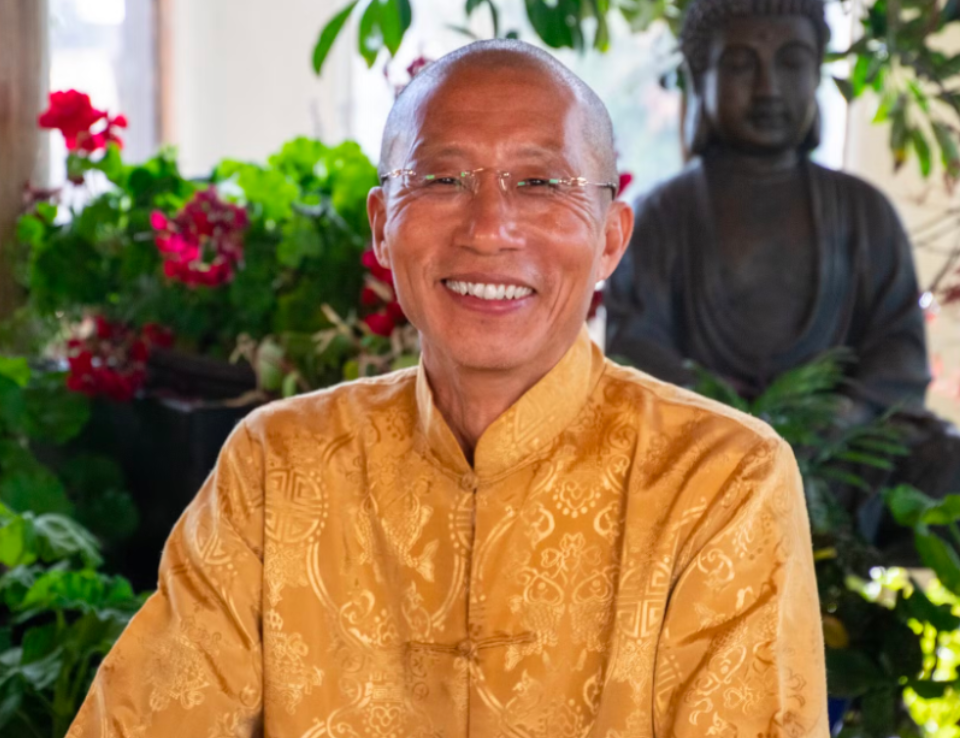
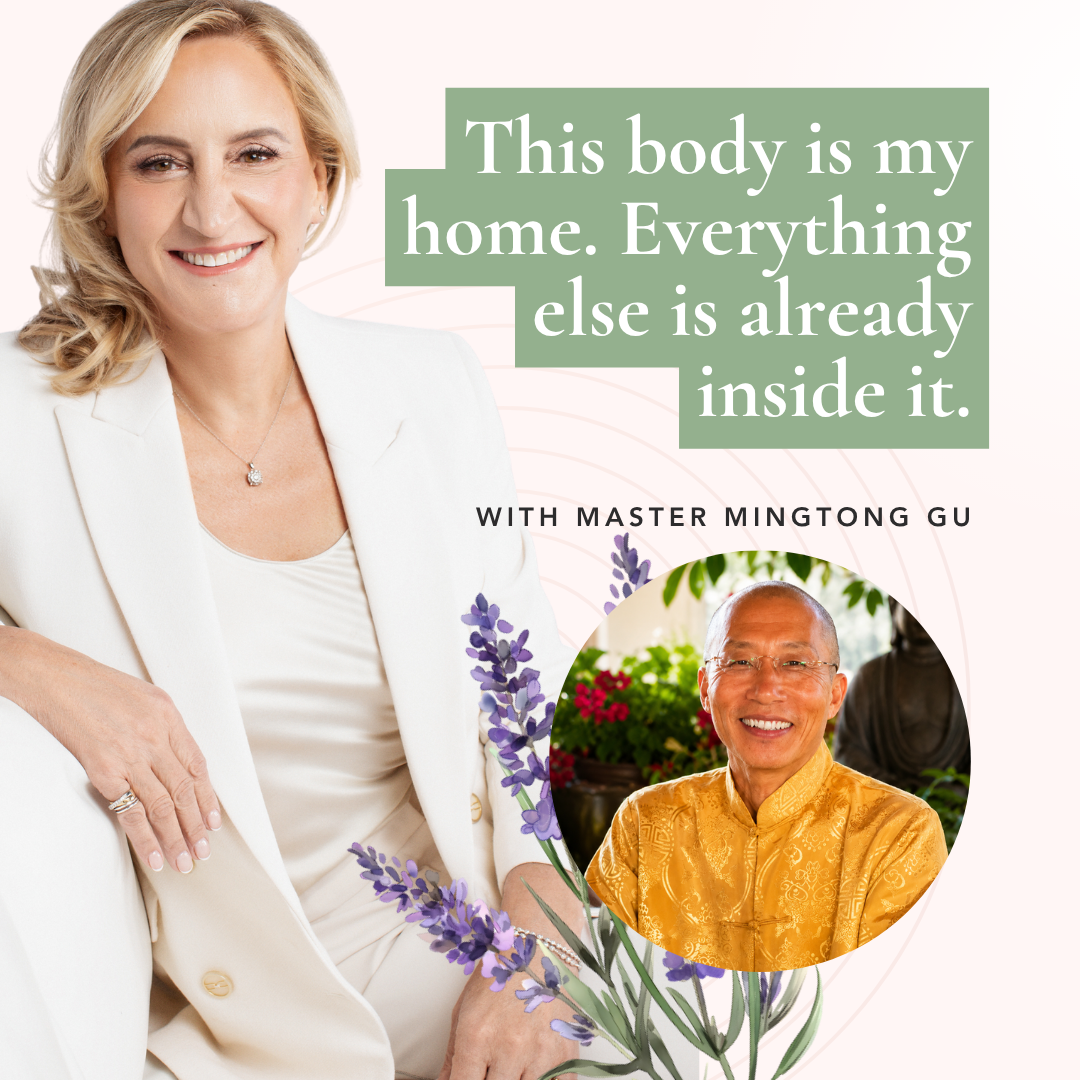
This is Master Mingtong Gu. He is a Qigong master teacher, the founder of Wisdom Healing Qigong and of the Southwest Sanctuary near Santa Fe, where he leads people, one month and sometimes longer at a time, back to themselves. He has taught full time for twenty-five years. He has just released a new book. And when Katherine asks him who he is, he begins with a little child playful inside him, an artist who loves what he creates, and a person devoted to a vision he means to give away as widely as he can.
The long search for a place to belong
He grew up poor in a rural farming village in China. His birth family had seven children and not enough food, so he was given to another family, and then, when his adoptive parents divorced, he moved again, and again, across three different homes before he came back to the family he was born into. A childhood like that does not hand a person a stable sense of belonging. He carried illness too, from very early, including asthma he later traced to a fall at six years old into a septic pit, a fall that cost him consciousness. His breath stayed broken for decades.
He tells this gently, in his own words. “I grew up poor and lost, disconnected, and our disease, you know, challenged.” He came to the United States looking for happiness, looking for a sense of belonging he had never been able to find. He studied mathematics. Then he found his heart through art, through photography and video, taking off his clothes to meditate in snow and waterfalls and empty rock, making double-exposed images of his own body dissolving into the wild. He was reaching, but the reaching still pointed away from himself.
The hand on his shoulder, and the run up the hill
The turn came in his later thirties, inside what he calls the medicine-less Qigong hospital in China, where thousands of people practised together, day and night, a month at a time. He lived and trained there for close to two years. His asthma left him. And near the end of that healing, an old childhood memory surfaced, the fall, the pit, and with it something began to close.
His teacher’s wife touched him on the shoulder.
“she touched me on my shoulder gently. She said, Now you have found your home. Now you can return your home as often, anytime.”
Something loosened in his chest and moved outward into his whole body, and only afterward did his mind put words to what had already happened. The home he had been looking for across families and cultures and careers and relationships was here, all along, inside the body he had been trying to escape from. “This body is my home. This is my home. That’s what I’ve been missing.” He ran up the hill behind the centre and screamed it to the whole world. And from that moment, he says, he stopped seeking outside himself.
Katherine hears the shape of this and names it back to him: first the becoming, the recognition of the full self, then the being, the arrival, witnessed years later when his teacher looked at him at graduation and time simply stopped. Mingtong agrees, and then he refuses to let it stay tidy. The journey is a spiral, he says. You pass the same nine gates again, at another level, and then again. It never finishes. Katherine offers her own image, up then down then up, a descent into our true humanity as much as an ascent, and the two of them recognise each other across it.
What he has built near Santa Fe
Nine years ago he opened the Southwest Sanctuary. He took on real risk to do it, with no way of knowing whether people in the West would commit to a retreat a month long, whether the numbers would ever work. He built it anyway. The land does part of the teaching: high desert, spring blossom, water and fountains and the Kiva. And three grandmother trees, each one older than five hundred years.
The word he uses for the healing that happens there is rebirth. “healing is about recovering yourself to the wholeness. It’s about realizing yourself to the truth of who you are. And that’s everything else come as a side effect.” He is interested in giving a person back to themselves, and letting the rest follow.
His diagnosis of our moment is exact, and it comes from a lifetime of watching the mind climb up over the neck and stay there. We have built a civilisation on thinking, he says, and now the digital world has hijacked even that. When Katherine names her three layers of self, the lived experience self, the physical and inherited self, and the essential self you could call the soul, he recognises them all, and then he adds the thing he has been discovering: these three are inseparable, and it is the body that holds them together. Descartes said, I think, therefore I am. The Buddha, in his reading, said, I am aware, therefore I am. Mingtong offers the piece he believes we have been missing. “I feel therefore I am.”
What his life is asking us to see
During the pandemic he passed through his own dark night. He questioned the meaning of all of it. He asked the grandmother tree whether the earth needs human beings, and the answer came back clear and humbling: no. And then the second truth: human beings need the earth. Katherine met him there with her own glacier calving into the Arctic ocean, and her guide’s words, that the earth does not need saving, that what needs saving is humanity and ourselves.
Out of that wilderness came a second song, sung beside the water in San Diego, about everybody looking and looking for themselves, and the welcome home that ends it. Everything we are looking for, he says, is already inside our own body. Living so far up in our heads, we come to feel like nobody. Coming back to the body is how we discover we are somebody at all.
Katherine names his essence back to him in the room, the way she does: innocent, devoted, embodied, joyful, present, in service. When she reflects the word innocence, he receives it as the truest thing said all day. Wisdom lives there, she tells him. He is beginning, after thirty years of practice, a new chapter of asking the most innocent question of all. What is this body?
His wish for us is a single change he believes changes everything. That each of us discovers the deepest connection of our own mind and body, because until we do, nothing else moves. It costs no resources. It waits on no one. This moment, he says, we can do it.
This is the kind of leadership our moment requires.
It is the kind of leadership Sincerely was built to honour.
A few hours with Mingtong
This conversation runs a little over an hour, and it moves the way the best conversations do, without rehearsal, following feeling from one truth to the next. There is a song in the middle you are invited to sing along to, a hand on the heart, a grandmother tree, a glacier. Come and sit with it when you have the space to feel it.
There is no hurry. The library is always here.
Three things Mingtong said I am still sitting with
“In that moment, I realized the home is here. This body is my home. This is my home. That’s what I’ve been missing.”
“I’m aware, therefore I am. But what I’m adding to, to this conversation about humanity is I feel therefore I am.”
“Everything we’re looking for is already inside of us, inside of our body.”
About Master Mingtong Gu
Master Mingtong Gu is a Qigong master teacher and the founder of Wisdom Healing Qigong, a global movement now in its third decade. He is also the founder of the Southwest Sanctuary near Santa Fe, New Mexico, where he leads month-long and longer retreats teaching people to reconnect mind and body. He has taught full time for twenty-five years. He trained for close to two years at a medicine-less Qigong hospital in China and received parallel transmissions from teachers in the Tibetan Dzogchen tradition, and his own early life in a poor farming village, shaped by illness and loss, is part of what he now teaches from. His new book, Coming Home to Embodied Awakening, is available in Spring 2026.
Find Mingtong: www.mingtonggu.com · Coming Home to Embodied Awakening (Spring 2026, available through Amazon, Barnes & Noble, and his website)
Free Chapter Here: Reclaim Your Body in an Age of Disconnection
Please stay.
Don’t just visit. This home is yours too.
There is a room here for you. It has always been here, waiting.
Once a week, you’ll receive a letter. Reflections from me. Sincerely recommendations. Small stories worth sitting with. Quiet offerings for the path, written for people who want to live a more gentle, bright, and honest life.
You’ll be the first to know when new conversations arrive on The Sincerely Show. When gatherings are announced. When the doors of Maison Millefleurs open for retreats.
The door is never locked. We’ve been preparing your room for a while now.
This conversation is for reflection and perspective only and should not be relied on as therapy or professional advice. Please seek qualified support where needed before making any decisions based on the information you learn through this conversation. This content is also subject to our full Terms and Conditions, which you can review on our website at sincerelyinc.com