
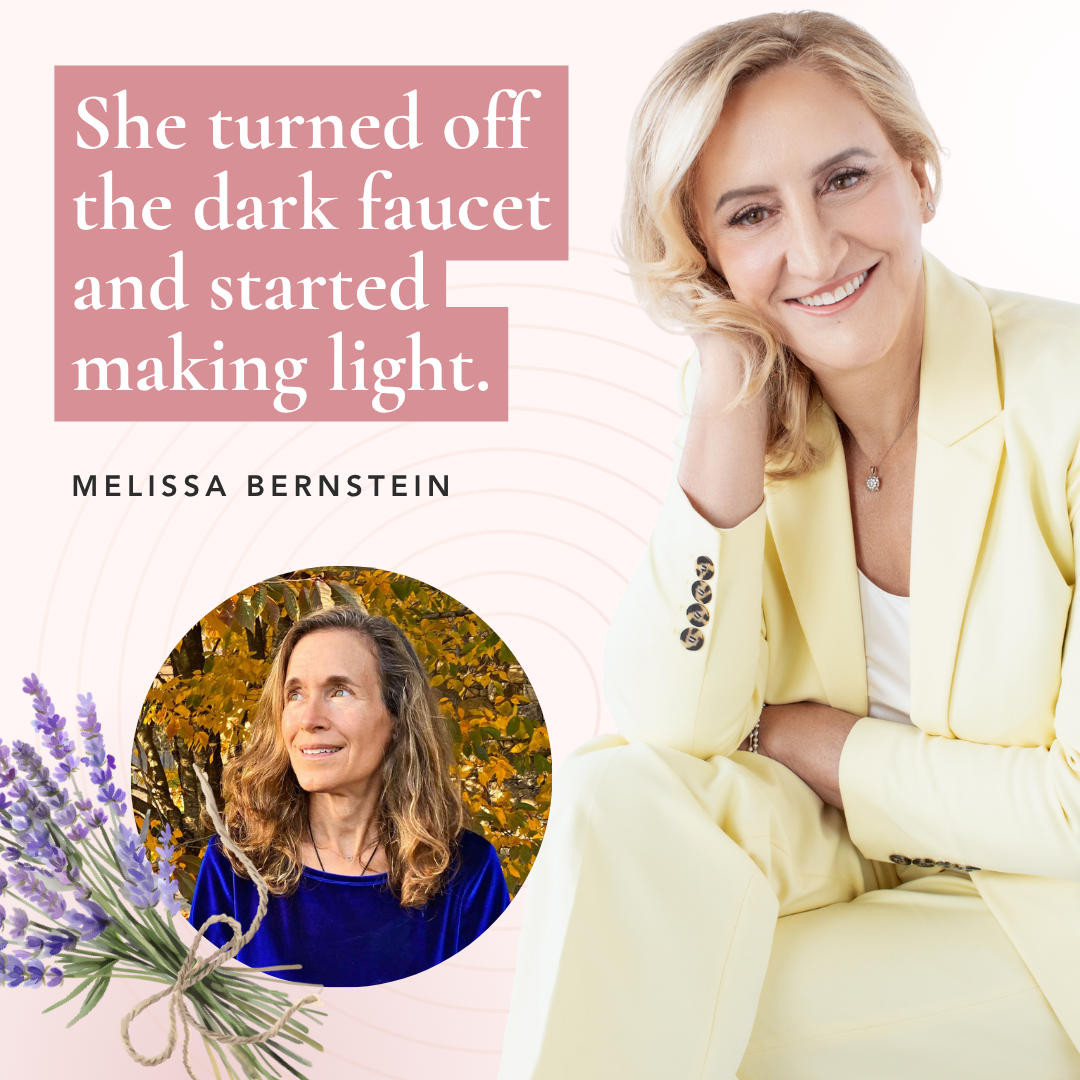
Ask Melissa Bernstein who she is and she does not reach for a title. She reaches for an image. “I am truly a creative being in every cell of my body,” she says, “and I live to channel and transform my innate chaos and darkness into radiant light through tangible forms.”
She means it plainly. There is a faucet inside her, the way she tells it, and for most of her life it ran one direction only. Then one day, in her early twenties, she found she could turn it. Turn off the dark one. Turn on the light one full tilt. Let the same unsettledness that had always poured out as heaviness come out instead as something a child could hold.
The thing she made first was toys. Close to ten thousand of them. Bright, playful, warm objects, made by a woman who did not once, in her own words, think of herself as bright or playful or warm.
The faucet is still running. These days what comes through it is a company called Lifelines, and a habit of picking up the phone for the most despondent person who reaches out, and a verse she wrote when she was eight that she has been living out ever since without quite knowing it.
The child who wrote verses no one wanted to see
She was born, she says, with a crisis of meaning. Her mother remembers her crying through the whole of her first year. They called it colic. Melissa suspects it was a question. At two and three years old she was already wondering why everyone else seemed to be having so much fun when it all felt so hard, and asking aloud what we have to show for ourselves at the end.
The family she grew up in did not want the question. Love there felt conditional, arranged around performing and pleasing rather than around being known. She looked to television for the family she longed for, the Waltons, the Partridges, the big raucous households full of yelling and laughter, and she promised herself she would one day build that.
Meanwhile she wrote. Thousands of rhyming verses, most of them dark, poured out of a child who had nowhere else to put what she carried. When she tried to share them, she met horror on grown-up faces and a clear message: we do not make things like that, and your job is to go and play. She had no answer they would accept. She was five.
She built a self the world would accept. She calls it the three P’s: perfectionism, pleasing, performance. A’s on every test. The good girl who did what was asked. The bright smile answering “great, awesome” over a well of angst pushed down and out of sight.
The one who saw through the performance
The three P’s held for a long time, and then they did not. In college both of her pillars gave way in the same season, the social one and the academic one, and she reached the lowest point of her life. She has spoken about this openly, on this show and elsewhere, as part of what shaped her. What matters for the story is what came after.
She met a man named Doug the summer of her junior year. She was very ill by then, an eating disorder having taken hold of her, and Doug, who is a fixer rather than a talker, looked at her and decided without much discussion that he was going to feed her. He would sit across a table and refuse to leave until her plate was empty. Because she wanted to please him, she ate. The very habit that had bent her whole life out of shape became, in his company, the thing that pulled her back toward it.
Katherine, hearing this, offered Melissa something she had not quite let herself see. Doug may be pragmatic, may not speak of feelings, and still, Katherine said, “you just don’t show up in somebody’s life” and feed them without some draw of love and connection underneath. Melissa went quiet. “That makes me appreciate him in a new way.”
What she has built
At twenty-two and twenty-four, against everything a stable 1980s career path demanded, Melissa and Doug pooled their savings and started a toy company. She had never taken a design class. She did not even like the word creative. Then she stopped channelling darkness into darkness, and the ideas arrived finished, whole, one after another. That company became the leading preschool toy brand in the United States, close to ten thousand toys over three decades.
In her mid-forties a second crisis surfaced, and with it a name. Reading Viktor Frankl again, she understood that what she had carried her whole life had a word, existential angst, a non-pathological condition common in deeply creative people. She said so out loud on Jonathan Fields’ Good Life Project podcast, telling her whole story for the first time. When the episode aired months later, the letters came. Twenty in a day, then fifty, then hundreds. People telling her she had given words to the thing they had never been able to name.
Out of that came Lifelines: first free workshops, then her own study to become a meaning coach, and now a consumer products company making sensory tools designed to interrupt the stress response and bring people back into the body and into joy. Alongside it she coaches despondent people for free, one at a time, and mentors young founders through the Melissa and Doug accelerator at Duke University, now in its thirteenth year, with a soft spot for women who lack the confidence that so often comes easily to others.
The pie of meaning
Her medicine, she says, is meaning, made continually, every single day. And meaning, she has learned, cannot rest on a single source. She calls it the pie of meaning. If your whole pie is one flavour, being a mother, say, then when your children grow and no longer need you, the pie empties and you fall into a vacuum. She keeps many slices. Meaning. Creativity through entrepreneurship. Spirituality. Each with its feet on the ground in the present and its eyes lifted toward something greater.
There is a line from the Talmud she keeps close: to save one life is to save the world entire. For years her ego wanted the big stages, the millions of hands her products might reach. About ten years ago something turned. “I have to do it one person at a time,” she says. “And that is more than enough.” One call with one person at their lowest, one thing said that lets them think differently, and the ripple carries where she will never see it.
She wrote that truth once already, at eight years old, in a verse she only recently understood. Keep on cultivating seeds, give them water, pull the weeds, then repeat it all again, for we can’t be certain when they will germinate and grow, touching lives we’ll never know. If you have ever felt too sensitive, too much, quietly wrong, her life reads that same quality differently. The thing you were told to hide may be exactly the thing you were sent to give.
What her life is asking us to see
Melissa lives from three pillars she named herself, and every one of them, when you follow it down, arrives at the same floor: contribution. The meaning she makes, she makes for the despondent stranger. The products she creates need to be in someone’s hands; that is where they become real to her. The mentoring she loves most is the courage she hands a young founder to try. All of it is service, chosen through love.
This is what she means when she says she has turned off the dark faucet. She feels the chaos every morning. She has simply learned where to point it. That is the choice she found in her early twenties and has been living into ever since: we solve our problems from darkness or from light, and we are always, always allowed to choose.
There is a Greek word Katherine offered her, Enteleki, for the unending desire to express our most fundamental self fully in this lifetime. Melissa has a plainer word for it. A song. “They have a song inside them that wants to be heard by others,” she says of the people she serves. “And I just try to give them one by one the courage to find that song, because some don’t even know if they have one.”
She does not cling any more to how it turns out. Some seeds germinate, some do not, and the joy of making is the same either way. She scatters her grains of sand onto the hill from love, not knowing which one begins the landslide, trusting that it is not hers to know.
This is the kind of leadership our moment requires.
It is the kind of leadership Sincerely was built to honour.
A few hours with Melissa
This conversation runs close to an hour and a half. Melissa traces her arc from the child writing verses in a dark room to the woman building tools that hand calm to strangers, and at one point she and Katherine sit quietly together in the recognition that they have been asking the same question their whole lives. Come when you have space for it.
There is no hurry. The library is always here.
Three things Melissa said I am still sitting with
“I basically saw that I have a choice. I can choose to either create more darkness out of darkness… But now I actually metaphorically and figuratively turned off the dark faucet.”
“I believe in having a bunch of different slices of different varieties of pie in your pie. And I think for me, I live that every day.”
“When you save one life, you save the world entire… I have to do it one person at a time. And that that is more than enough.”
About Melissa Bernstein
Melissa Bernstein is a creative entrepreneur, author, and the founder of Lifelines, a company making sensory tools designed to interrupt the stress response and bring people back into joy and into their bodies. With her husband Doug she co-founded one of the leading preschool toy brands in the United States, designing close to ten thousand toys across three decades. She is the author of several books, including Lifelines and The Heart of Entrepreneurship, mentors young founders through the Melissa and Doug accelerator at Duke University, and coaches despondent people one at a time, without charge, from her conviction that to save one life is to save the world entire.
Find Melissa: melissajourney.com/about-melissa · lifelines.com
Please stay.
Don’t just visit. This home is yours too.
There is a room here for you. It has always been here, waiting.
Once a week, you’ll receive a letter. Reflections from me. Sincerely recommendations. Small stories worth sitting with. Quiet offerings for the path, written for people who want to live a more gentle, bright, and honest life.
You’ll be the first to know when new conversations arrive on The Sincerely Show. When gatherings are announced. When the doors of Maison Millefleurs open for retreats.
The door is never locked. We’ve been preparing your room for a while now.
This conversation is for reflection and perspective only and should not be relied on as therapy or professional advice. Please seek qualified support where needed before making any decisions based on the information you learn through this conversation. This content is also subject to our full Terms and Conditions, which you can review on our website at sincerelyinc.com.