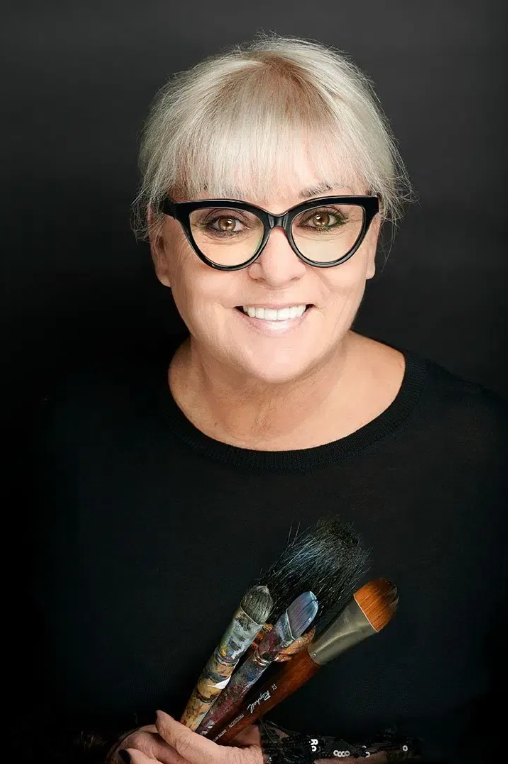
Stand in front of one of Patricia Gagic’s canvases and you may notice, at first, only the greys, the whites, the blacks. Katherine did. She confessed it on the show: she had a bias toward colour, and she felt something she could not name looking at these still, dark surfaces from a woman who was so plainly full of light.
She asked. What happens, she wondered aloud, if you take all the colours of the universe and mesh them together?
Gray, Patricia said.
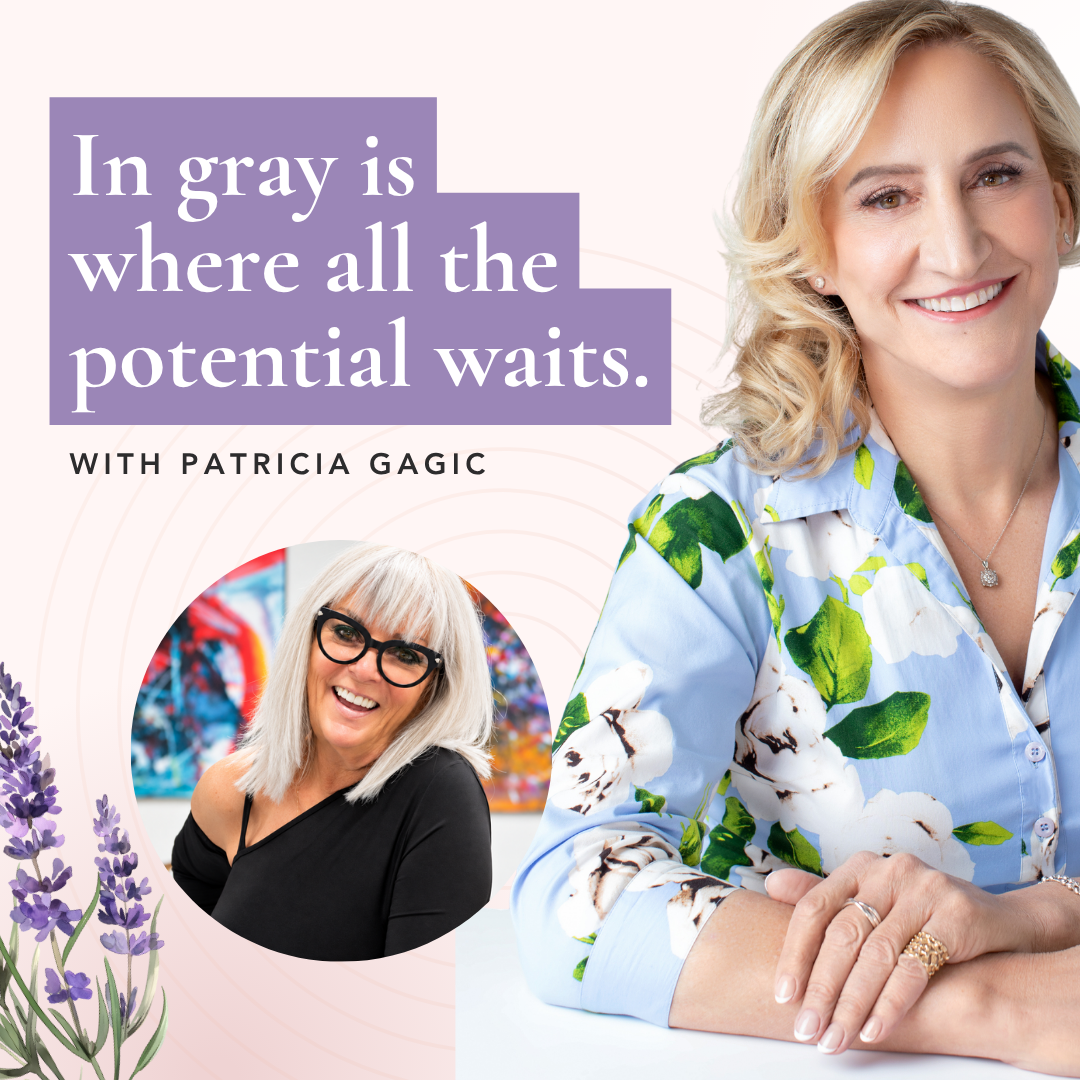
Then Katherine looked at the paintings again, and something turned over in her. Gray is not where colour goes to die. Gray is where all of it lives at once. Under every one of Patricia’s finished canvases there is an underpainting soaked in red and green and yellow, the whole spectrum, and as the truth of the work reveals itself the colour shifts and gathers and comes to rest.
That is the teaching she carries and the teaching she gives: darkness is the place where all the potential waits.
The child who read her way through every faith
She was, by her own account, a quirky and voraciously aware child. She has told her mother she remembers lying in her crib, months old, wondering when she would be allowed to walk. When the other children laced up white skates, she wanted blue ones. When her father brought home the Encyclopedia Britannica in grade three, bought on the doorstep at twenty-five cents a month for life, she sat with every volume from A to Z.
Raised Roman Catholic, she turned that same appetite loose on the whole of belief: Hinduism, the Baha’i faith, Buddhism, on and on. Some of it came from wonder. Some of it came from a wound. In 1962, in Omaha, she was sent home from school one day because a Black woman was living in the house her family rented. The injustice made no sense to a small girl, and it drove her deeper into wanting to understand the world.
Underneath all of it was her father, her role model, and the ethic he lived. She names it plainly.
“dedicated flawlessly to servitude where I think that was inbred in me by my father, you know, just like in Rotary, you know, service above self that that never left me.”
She lost him one month after her twenty-fifth birthday. His mother, her grandmother, followed a week later to the day, of a broken heart. They buried her father on her mother’s birthday. Before that she had already lost her first love, gone in a boating accident. She was young, and she was learning early how to make the choice she would go on making all her life.
The name on a horse painting in France
In 1999, in a home in France, she looked up and saw a horse painting with a name at the bottom: Dragic. She was not, she says, particularly a lover of that kind of art. But she could not let it go. She learned that a master painter named Dragan Dragic lived three hours away, and she knew, without being able to explain it, that she had to meet him.
“it’s that moment where you’re sitting there and in your brain you don’t know why you’re saying yes. And I don’t like what it just happened. And I went, I need to meet this man.”
He did not want to meet her. She made her husband phone back in Serbian. Granted an hour, they arrived two hours late, having taken the wrong way up the mountain, and when she walked into his atelier and saw his name on posters beside Picasso and Christo, she thought she had no business being there at all. He asked what she wanted. Fame? Money? Her husband answered for her: she just wants to know how to paint. She did not speak French. She said she would learn, took thirty-two hours of tutored lessons, and carried her grammar book everywhere until she was dreaming in the language.
That began twenty-six years of study. He would not tell her the names of the colours, only numbers. She spent a decade learning to mix, to melange, until she could reproduce any colour she could see. A master, he told her, is someone who can walk into any gallery and analyse a piece, then paint it. That is where he took her.
What she has built
Patricia Gagic is an internationally recognised contemporary artist, an author, a drummer, and a humanitarian. In 2018 her photograph, one entry among some forty thousand submitted to the Salon National des Beaux-Arts, won the gold medal at the Carrousel du Louvre. Her Black Madonnas, drawn in pointillism, entered the Vatican Museum Library. She has been named among the top ten contemporary artists in books held across tens of thousands of museums and galleries.
Since 2006 she has given herself to Cambodia. It began with a phone call and a request for five thousand dollars to build a library near Angkor Wat. She cashed out an RSP and did not think twice. She went back, and then she did not leave: a school in Bueng Mealea, an Innovation House, year after year woven into their world.
And she teaches. Through her Karmic Art Experience she takes people, as she puts it, tabula rasa, through painting, meditation, story and music.
“you’re talented, you definitely have something inside of you, you just haven’t been able to scratch the surface of it yet.”
Choosing love as a practice
She has known more loss than most lives hold. A near-death fall from a spooked horse onto the Trans-Canada Highway, from which she remembers coming back to life. Her mother beaten and robbed. And in April 2024, her forty-one-year-old daughter Kira, a musician and mother of three, whose children she now helps to raise while carrying her own grief.
She does not pretend the grief away. She wept telling it, and Katherine held the moment gently: grief is important, it is important to feel. What Patricia has found is not the absence of sorrow but a way to live inside it.
“Gray is the underpainting beneath every canvas, where all the color and all the potential are already waiting. It is not emptiness. It is everything that hasn’t been revealed yet, and I think that is also a practice. You make a choice, again and again, how you are going to meet what is in front of you.”
Fear, she says again and again, doesn’t move her. What does is the same faith she brings to the canvas, the same knowing that under the surface, in the gray, the whole spectrum is still there.
What her life is asking us to see
Patricia meets the world the way she paints: she starts with everything, then lets the truth reveal itself.
Watch how she moves through a life and you see her frameworks and Katherine’s meeting quietly. This is a woman remembering who she has always been, essence shining as the armour falls away. This is service as the completion of a whole self, the joy that comes from making a difference in someone else’s life, five thousand dollars for a library given without a second thought.
She is voraciously curious. She is present. She chooses love and she chooses faith, over and over, not once but as a daily practice. The losses are chapters in her life. They are not the whole of her, and she would be the first to tell you so.
What she leaves us with is the gray. The place we are tempted to read as empty is where all the colour is held, waiting. There is a path through darkness to creativity, to service, to joy, and she has walked it long enough to be trusted on the road.
This is the kind of leadership our moment requires.
It is the kind of leadership Sincerely was built to honour.
A few hours with Patricia
This is a long, meandering, luminous conversation between two friends, close to an hour and a half of art, faith, loss, and the practice of presence. Settle in with a cup of something warm and let it unfold at its own pace.
There is no hurry. The library is always here.
Three things Patricia said I am still sitting with
“In gray is where all potentiality exists.”
“fear is not my currency. So I will not let that dictate.”
“The most greatest gift in this world we can give ourselves is the feeling of love one feels when they make a difference in the life of somebody else.”
About Patricia Gagic
Patricia Gagic is an internationally recognised contemporary artist, author, drummer and humanitarian. A gold medallist at the Salon National des Beaux-Arts at the Carrousel du Louvre, she studied for twenty-six years with master painter Dragan Dragic, and her Black Madonnas are held in the Vatican Museum Library. She is the author of Karmic Alibi, The Karmic Framework, How to Be Human Today, and Karma and Cash, and she teaches through her Karmic Art Experience. Since 2006 she has built schools, libraries and an Innovation House in Cambodia. She lives art as healing and service, and holds together a life of creative, spiritual and humanitarian work.
Find Patricia: https://patriciakarengagic.com/
Please stay.
Don’t just visit. This home is yours too.
There is a room here for you. It has always been here, waiting.
Once a week, you’ll receive a letter. Reflections from me. Sincerely recommendations. Small stories worth sitting with. Quiet offerings for the path, written for people who want to live a more gentle, bright, and honest life.
You’ll be the first to know when new conversations arrive on The Sincerely Show. When gatherings are announced. When the doors of Maison Millefleurs open for retreats.
The door is never locked. We’ve been preparing your room for a while now.
This conversation is for reflection and perspective only and should not be relied on as therapy or professional advice. Please seek qualified support where needed before making any decisions based on the information you learn through this conversation. This content is also subject to our full Terms and Conditions, which you can review on our website at sincerelyinc.com.