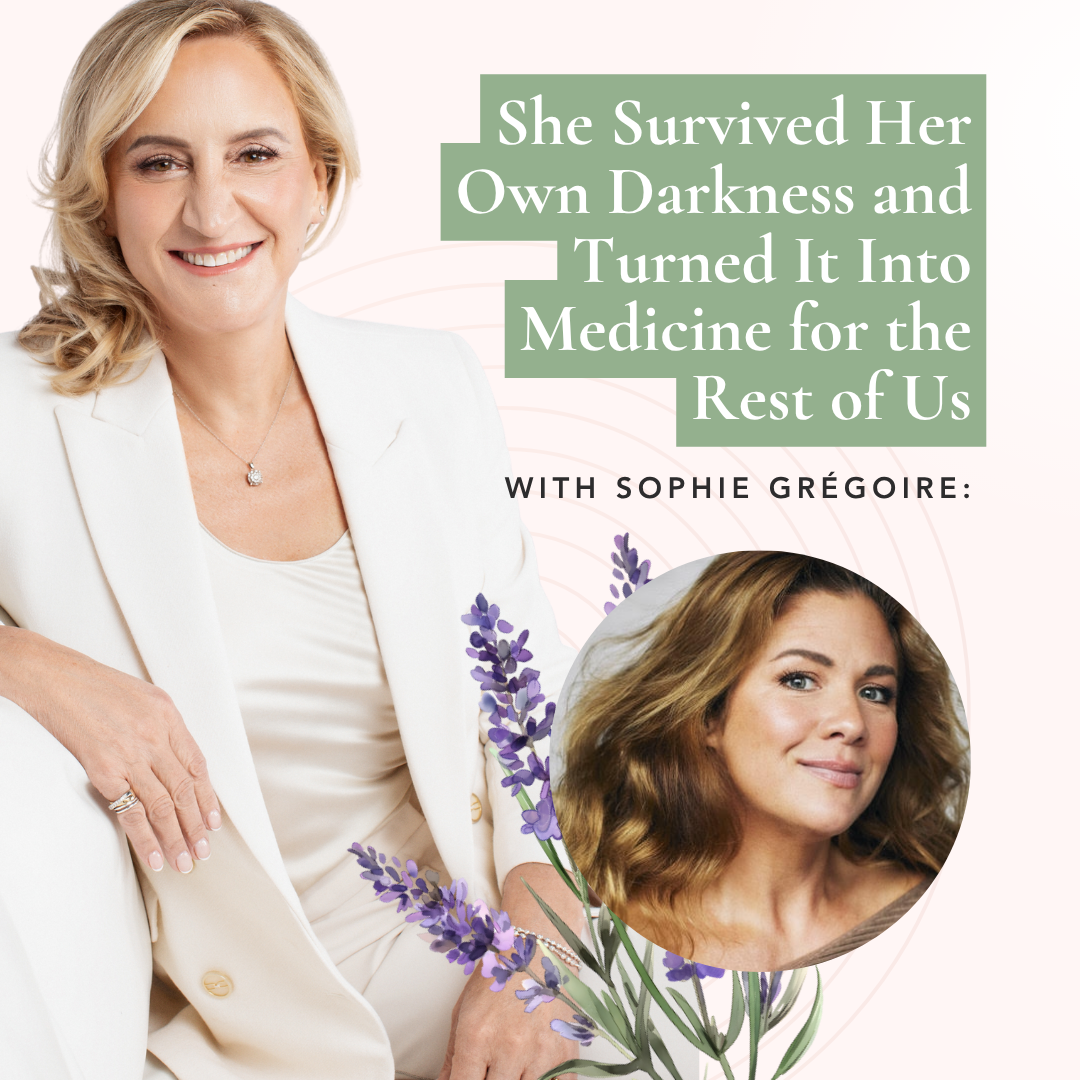
The morning of our conversation, Sophie’s uncle sent her a photograph. She is three years old in it. She is standing outside the cabin in the Laurentians where she spent the first years of her life, in the kind of light that only exists in the woods in early morning. She looked at it and wept.
Not from grief exactly. From recognition. The little girl in the picture looked back at her, and Sophie saw it all at once: the innocence, the presence, a tad of sadness she hadn’t known was visible in a child that young. She told me about it at the start of our recording, still close to it, still a little undone. And then she said something I have been turning over since.
“I’m holding her now.”
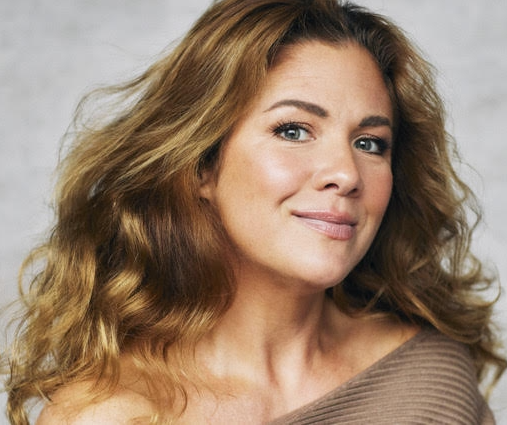
That is Sophie Grégoire, in four words. A woman who has spent decades learning to feel rather than flee, and who has quietly, steadily turned that practice into one of the most honest bodies of work on mental health and human connection that Canada has produced. She is fifty years old. She is funny, fierce, occasionally profane, and so genuinely open to the person in front of her that you feel seen simply by being near her. She wrote a bestselling book. She was Canada’s de facto First Lady for eight years. She has stood on stages in front of tens of thousands of people. And none of that is the interesting thing about her.
The interesting thing is that she can look at a photograph of herself at three and feel tenderness rather than distance. That she earned that tenderness. That she knows exactly what it cost.
The cabin and the cape
Sophie grew up in a small cabin in the Laurentians, in a village called Sainte-Adèle in Quebec, the kind of place where a child has a frozen lake to cross and a mountain to skidoo over and a father who will tell her to jump off a cliff and mean it as an act of love. Her father was action-oriented, confident, physically brave. He gave her the message that her body was capable, that the world could be met rather than avoided. Her mother was tender, observant, attuned to details, soft in the way that teaches a child their interior life matters. Sophie received both. She absorbed the fierce and the gentle in equal measure, and it gave her, as she put it, a solid home base inside herself, a place she could move from.
It also gave her something harder to name.
There was addiction on both sides of her family. Alcoholism, depression, people living with wounds they had no language for because that generation, as Sophie says, wasn’t looking at their trauma. It wasn’t accessible the way it is now. Little Sophie, an only child surrounded by adults, learned early to read the room. To sense what was unspoken. To wear what she called “the cape of wanting to save.” She absorbed the emotional weight of the people around her with the hyper-attunement of a child who has never been taught it isn’t hers to carry.
No child should wear that cape, she told me. And she said it with gentleness, not blame. It is simply what happened. It is how she became someone who could smell dishonesty from across a room, who defaulted to seeing beauty first, who carried a deep sensitivity beneath the rambunctiousness, the fort-building, the hanging out with the boys who always did the crazier things.
The sensitivity was the point. It always had been.
The night she flew over herself
By her late teens, Sophie was using food the way some people use alcohol or work or the noise of being constantly available. As a drug of numbness, she says. As a way of finding temporary relief from a pain she hadn’t yet learned to sit with. Bulimia, for years, in secret. On the surface: a good student, athletic, popular, living in an affluent Montreal suburb with, as she puts it, all of it. On the inside: shame, and the particular exhaustion of a person performing a version of themselves that doesn’t quite fit.
One night she trembled in her single bed in a small room. She had purged too hard, too long. She could hear her mother through the bathroom wall, just the ordinary sounds of someone moving through their evening. Sophie lay there and felt something she had not felt before: she flew over herself. She looked down at the girl in the bed and said, no more. You don’t have to do this to yourself.
“I was aware that I was aware. Holy.”
She called for her mother. Her mother came. Sophie told her she was sick, that she had an eating disorder, that she needed help. And her mother said: I knew something was off. I’m going to be here for you.
What followed was chaos in the body, she told me. Sadness and anger at once. Feeling alone and then accompanied. Feeling understood and then misunderstood. The emotions didn’t resolve themselves into something clean and manageable. They came all at the same time, which is how emotions actually come when you stop suppressing them. Sophie sat in the middle of it. And something in that sitting changed her. She had discovered that someone inside herself was watching over her. From that night on, she decided she was going to understand what was happening to her.
The eating disorder didn’t vanish overnight. Recovery is not an event. But a direction had been chosen. She was going to know herself rather than flee herself. That choice, made in a small room in the dark, is the hinge on which her entire life turns.
What you suppress, and what it costs
A few years later, in her mid-twenties, a girlfriend was setting up a foundation for people with eating disorders in Montreal. There was almost nothing then, she told me. People weren’t talking about it. The girlfriend asked Sophie if she would tell her story at a press conference. Sophie was a newcomer in the television and radio scene. She was terrified she would lose every contract she had. She thought of how people would see her: the girl who vomits, the girl with no control, the girl who couldn’t handle herself. So much stigma. So much she had internalised.
She did it anyway.
“I don’t want to live with this lie to myself,” she said. And the response, when her story came out in magazines and on television, was what she describes as a big exhale from the public. Finally. If she could say it, maybe others could too. Maybe they didn’t have to carry it alone.
That press conference was the beginning of twenty years of advocacy for mental health, for emotional literacy, for the right of ordinary people to access the knowledge that had been kept in therapy rooms and academic journals and the expensive offices of private practitioners.
But even as she was giving others permission, she was still learning to give it to herself. There were parts of Sophie she had suppressed, she told me, for those same twenty years. Her creativity, the way she reads poetry and feels something light up inside her. Her sensuality, her eroticism. Her ambition, expressed through what she now calls feminine leadership. She thought she had to be masculine to lead. She thought the world required a certain shape from her, and she gave it that shape, and it cost her the parts she had to squeeze out to fit.
She named them to me directly, without hesitation, which is itself a form of the work. Not “I struggled with self-expression” or “I found it difficult to be authentic in certain domains.” She named the things: creativity, sensuality, ambition through feminine leadership. The specificity is the honesty. And the honesty is the beginning of recovery.
Closer together, and what Gabor Maté named
Sophie’s book Closer Together: Knowing Ourselves, Loving Each Other became a number one bestseller. It is part memoir, part guide, woven through with interviews she conducted with some of the most respected voices in human behaviour: Gabor Maté, Terrence Real, Liz Plank, Harville Hendrix and Helen LaKelly Hunt, among others. Hillary Rodham Clinton called it “candid, enlightening, and an intrepid exploration into achieving a life filled with purpose, meaning, and a sense of wonder.”
Sophie wrote it because she had been lucky. She had access, through her platform and her connections, to conversations and knowledge that most people never get near. She sat with experts who had spent their careers understanding why we do what we do, why we hurt the way we hurt, why the patterns of our childhoods play themselves out in our marriages and our workplaces and our bodies decades later. And she kept thinking: this cannot be only for people like me. This has to be available to everyone.
The workshops she runs now cost forty dollars. Not forty thousand. Forty. That number is deliberate. Sophie knows what it is like to need something and not be able to afford it. She knows what it is like to have a pain with no container. She is building containers at a price that doesn’t require privilege.
At the Vancouver launch of Closer Together, Sophie stood on stage with Gabor Maté. There was a first question planned. He looked at her and didn’t ask it. He said: “This is not a book.” Sophie waited, uncertain. He said: “This is your love letter to the world, isn’t it?”
She was in tears within the first five seconds.
She told me this story with the quiet wonder of someone who has been seen so precisely that words fail. The person who had helped her understand trauma looked at the work she had made and named it more accurately than she had named it herself. That is what Sincerely calls witnessing. Not analysis. Not praise. Simply: I see what this actually is.
The book is a love letter. And that Gabor Maté named it that means something that transcends the review or the endorsement. He was telling her what she had already known but hadn’t quite let herself say out loud.
The gene for aggression is not aggression
There is a thread in this conversation that runs from Sophie’s tiny bedroom all the way to the state of democracies, and it is the thread I most want to pull at here.
Sophie learned something from genetic research that she keeps returning to: the gene associated with what we commonly read as aggression is, in fact, not aggression. It is hypersensitivity. The person in the boardroom who lashes out. The leader who doubles down when challenged. The colleague who goes silent and then explodes. All of them are, at the root, a nervous system that was never given the tools to regulate the emotions it is carrying. They are not villains. They are overwhelmed.
Sophie links this directly to the fractured world we are living in. She references Todd Rose’s research on collective illusion: eighty per cent of what we consume on social media is created by ten per cent of users, and that ten per cent is not representative of who we actually are as a collective. What is happening now, particularly in the United States and across western democracies, is that the loudest, most repeated voices are mistaken for the majority. The validation of fear has become a political tool. You find the person who is already dysregulated, already struggling, already feeling left behind, and you tell them it is someone else’s fault. You tell them who to direct the pain at. And it works, because it names the pain without healing it.
“We are dysregulated children in adult bodies,” Sophie said. She said it without contempt. Without despair. She is describing a diagnosis, not a condemnation.
And the diagnosis matters because it points toward the cure. Emotional literacy is not a soft skill. It is the skill that makes every other skill possible. A person who can sit with their own pain, name it, stay with it long enough to understand what it is asking, is a person who does not need a scapegoat. A person who has been given the tools to regulate is a person who can build something with their anger rather than burning things down.
This is what Sophie Grégoire has devoted twenty years to saying in rooms large and small, in books and workshops and conversations and advocacy campaigns: you are not broken. Your pain is not your fault. And you can learn to sit with it. All of you can.
What it means to hold your own child
Late in our conversation, Sophie described something small that has stayed with me.
When her nervous system is overwhelmed, when fear or grief or shame comes flooding in, she holds herself. Both arms wrapped around her own body, butterfly taps on her upper arms, a soft voice speaking to whatever part of her is frightened: you are not alone. You are not being abandoned. This too shall pass. You are loved.
She calls it a somatic technique, which it is. But she also calls it what it actually is, which is an act of tenderness toward the child who still lives inside her. The child who felt alone in the small room. The child who wore the cape. The child who got her first photo sent from the Laurentians that morning and immediately wept.
Sophie is fifty now. She has navigated a very public marriage and a very public separation. She has raised three children while advocating for the inner lives of millions. She has been photographed and scrutinised and praised and criticised and reduced to a surname that was never her only name. She is reclaiming the one she was born with.
And she is still unfolding. She said this without apology. She said it with something close to joy.
Rainer Maria Rilke wrote: I want to unfold. Let there be no space in me that holds itself closed, for where I am closed, I am false. Sophie knows these lines. She closed our conversation with them. She said: I don’t want to be false, baby. I want to unfold and open, and I wish the same for everybody else.
The “baby” is characteristic. She says it the way she says everything: like she means it, like it costs her nothing to be warm, like warmth is not a performance but simply what comes out when she stops trying to control the shape of herself.
What her life is asking us to see
Sophie Grégoire has spent her entire adult life arguing, in every form available to her, for one idea: that to know yourself is not a luxury. That self-knowledge is the foundation of every other form of love, every other form of leadership, every other form of repair. That the pain you are carrying has something to teach you, if you are willing to stay with it long enough to hear.
This is not a comfortable argument to make in public. Sophie made it twenty years ago when eating disorders were still largely unspoken, at the cost of television contracts she could not afford to lose. She made it through the years of public life when her role was officially ornamental and her interior world was nobody’s business. She made it through a marriage and a separation that were conducted in full view of a nation. She is still making it.
What I witnessed in our conversation was someone who has arrived, in the most honest sense of the word. She is not performing equanimity. She is not reciting lessons she has learned. She is someone who has done the actual work of sitting with her own pain, and who has come out the other side with a tenderness for every person she meets, including the cashier at the grocery store, including the person across the political divide, including the little girl in the photograph her uncle sent her that morning.
“My soul dances with your soul,” she said to me at one point, without any apparent irony.
I believed her. Because she had already spent an hour being completely, undefendedly present. Nothing about her was performing. She was just there.
That quality, that capacity for full presence, is itself a form of the work she teaches. You cannot be fully present when you are running from your own experience. You cannot really see another person when you are busy managing how they see you. Sophie has stopped managing. She is just here. Fiercely, gently, totally here.
The heart cannot break, she told me as we finished. It can only break open.
She has lived that. It shows. Every word she spoke carried the weight of someone who learned it not from a book but from the long, quiet, hard work of staying with herself until the staying felt like home.
This is the kind of leadership our moment requires.
It is the kind of leadership Sincerely was built to honour.
A note on this conversation
This episode runs for approximately one hour. It is warm and unhurried, the kind of conversation where both people are fully present and completely undefended. Sophie and Katherine have known each other for several years, and that ease comes through in every exchange. Two women who have walked through something real, talking honestly about what they found on the other side.
There is no hurry. The library is always here.
Three things Sophie said I am still sitting with
“I was aware that I was aware. Holy.”
“Being able to sit with your pain and your truth is the greatest freaking gift you will ever gift yourself. Ever.”
“Your heart can’t break. It can only break open.”
About Sophie Grégoire
Sophie Grégoire is a mental health advocate, author, global speaker, and certified yoga instructor based in Canada. Her book Closer Together: Knowing Ourselves, Loving Each Other is a number one bestseller, combining memoir with expert knowledge on human behaviour, emotional literacy, and the roots of connection and disconnection. It is currently being adapted into a documentary series. Sophie has devoted more than twenty years to making self-knowledge accessible to everyone, not only those with the resources to seek it privately. She is the First National Volunteer for the Canadian Mental Health Association and Youth Leadership Global Ambassador for Plan International Canada. She has received multiple United Nations recognition awards for her humanitarian work.
Find Sophie
Website and workshops: sophiegregoiretrudeau.com
Instagram: @sophiegregoiretrudeau
Facebook: Sophie Grégoire Trudeau
LinkedIn: Sophie Grégoire
Please stay.
Don’t just visit. This home is yours too.
There is a room here for you. It has always been here, waiting.
Once a week, you’ll receive a letter. Reflections from Katherine. Sincerely recommendations. Small stories worth sitting with. Quiet offerings for the path, written for people who want to live a more gentle, bright, and honest life.
You’ll be the first to know when new conversations arrive on The Sincerely Show. When gatherings are announced. When the doors of Maison Millefleurs open for retreats.
The door is never locked. We’ve been preparing your room for a while now.